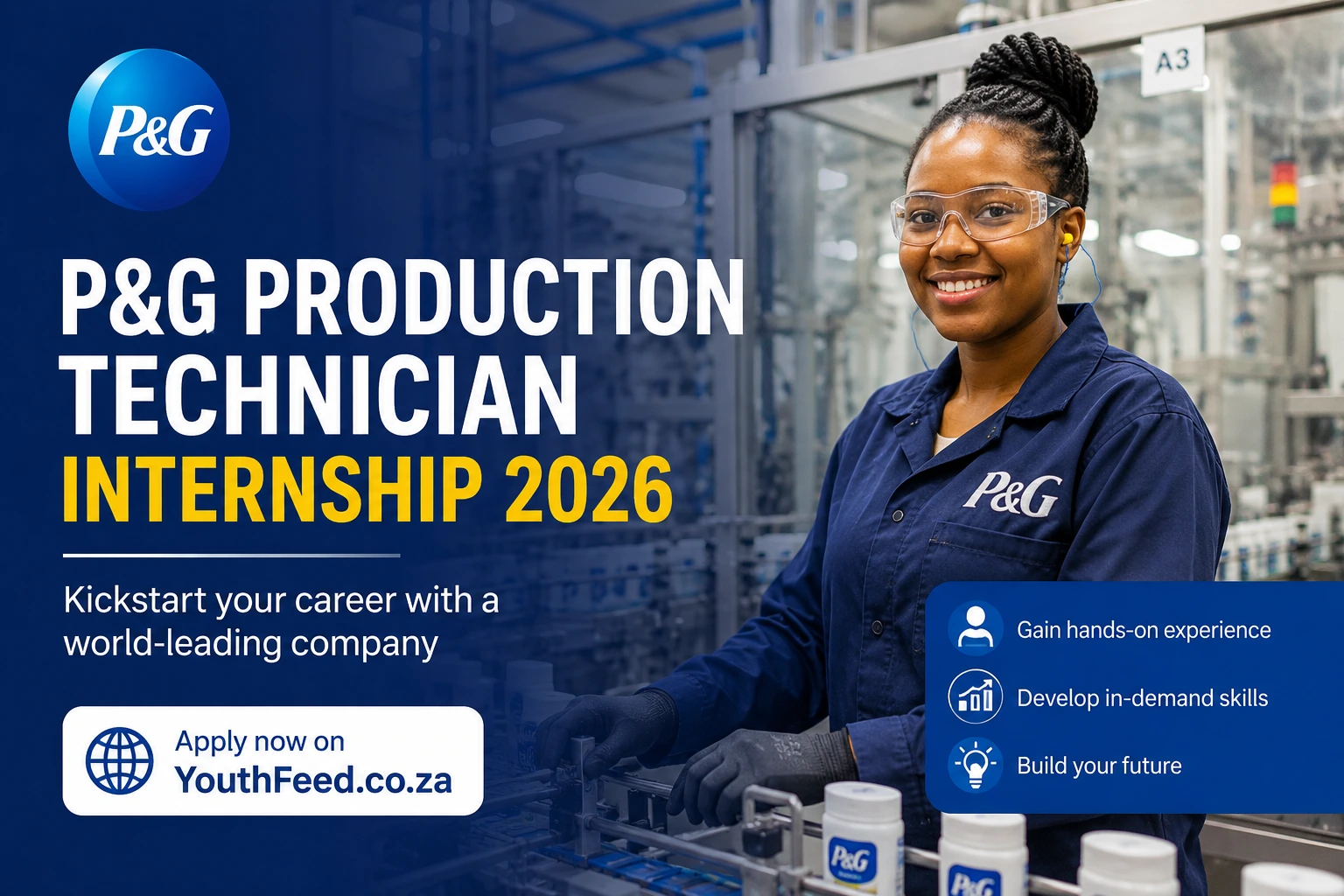
The race for stable entry-level opportunities in South Africa has become more competitive than ever, which is exactly why the P&G Production Technician Internship is suddenly attracting attention across job-seeker circles, student WhatsApp groups, and career-focused social media pages.
For many young South Africans, internships in manufacturing are no longer seen as “backup options.” They are increasingly viewed as practical pathways into long-term employment, especially when global companies are involved. And when a company like Procter & Gamble opens a production-focused internship at its Spartan manufacturing plant in Johannesburg, people notice quickly.
The 2026 intake comes at a time when technical skills are becoming more valuable in South Africa’s industrial economy. With employers placing greater emphasis on hands-on capability rather than theoretical knowledge alone, programs that combine training, shift-based operational exposure, and potential permanent employment are receiving stronger public interest than they did just a few years ago.
What makes this internship especially notable is that it does not demand a university degree. Instead, it targets candidates with a matric certificate and N5 or N6 engineering qualifications a route that many technical college graduates have long hoped would receive more attention from major employers.
And that alone explains why conversations around the P&G Production Technician Internship are spreading so rapidly online.
Why This Internship Is Drawing Attention in 2026
South Africa’s youth unemployment crisis continues to shape how young people evaluate career opportunities. Many graduates have become increasingly skeptical of internships that offer little practical development or no realistic employment pathway afterward.
That is where the P&G opportunity stands out.
According to the internship description, the program is structured around developing participants into qualified production technicians inside a “world-class facility” located in Spartan, Johannesburg. More importantly, successful completion may lead to consideration for full-time employment.
That possibility changes the perception of the internship entirely.
For technical students, especially those from TVET colleges and engineering programs, manufacturing internships are often seen as critical stepping stones into industries that otherwise demand prior experience. The problem has always been access. Companies frequently advertise “entry-level” jobs that still require years of exposure.
Programs like this appear to address that gap directly.
The internship responsibilities also suggest participants will be integrated into real operational environments rather than simply shadowing senior staff. Duties include:
- Operating machinery
- Loading raw materials
- Monitoring production processes
- Recording machine breakdowns
- Conducting maintenance checks
- Ensuring production quality
- Meeting daily production targets
- Following health and safety protocols
These are not symbolic tasks. They reflect actual production-floor responsibilities that align with industrial technician roles globally.
For applicants trying to build employable technical experience, that distinction matters enormously.
Also apply for Road Accident Fund Intern: Offer Management 2026
The Bigger Shift Happening in Manufacturing Careers
A few years ago, many young South Africans prioritized office-based careers, corporate administration, or retail management. Today, attitudes are changing.
There is growing awareness that technical trades and manufacturing operations can provide more sustainable long-term career growth than overcrowded white-collar sectors.
Companies operating advanced manufacturing plants increasingly rely on automation, process optimization, machine monitoring, and maintenance systems that require skilled technicians. This has created renewed demand for candidates with electrical and mechanical engineering backgrounds.
The P&G Production Technician Internship reflects that broader industrial trend.
Rather than recruiting general graduates with unrelated qualifications, the company is specifically looking for candidates with N5 or N6 engineering qualifications, particularly those with mechanical or electrical exposure.
That focus suggests employers are becoming more intentional about building technically competent talent pipelines from the beginning.
It also highlights the growing importance of vocational education in South Africa’s future workforce strategy.
For years, TVET pathways were often undervalued compared to university degrees. But in sectors like manufacturing, logistics, and industrial production, practical technical qualifications are increasingly becoming direct gateways into employment.
Spartan’s Industrial Importance Adds Another Layer
The internship’s location in Spartan, Johannesburg, is another reason the opportunity carries weight.
Spartan remains one of Gauteng’s key industrial zones, hosting manufacturing, engineering, and production facilities across multiple sectors. For many young technicians, working in such an environment offers exposure to industrial standards, production systems, and operational discipline that smaller employers may not provide.
Being trained within a multinational company environment can also significantly strengthen a candidate’s future employability.
Even temporary exposure to structured production systems, maintenance schedules, safety compliance procedures, and operational targets can improve long-term career prospects.
That reality explains why internships tied to established manufacturing brands tend to receive strong application volumes.
Many applicants are not only chasing immediate employment. They are trying to gain recognizable industrial experience that improves their competitiveness later.
The Shift Work Requirement Is Sparking Discussion
One of the more talked-about aspects of the internship is the requirement to work a 24/7 shift schedule, including night shifts from 18:00 to 06:00.
Public reaction to this requirement has been mixed.
Some applicants see it as demanding and physically challenging, particularly for young workers entering manufacturing for the first time. Long shifts, night work, and rotating schedules can place strain on sleep patterns, commuting, and personal routines.
Others, however, view it as realistic preparation for industrial careers.
Manufacturing facilities often operate continuously to maintain production efficiency, and technicians are expected to adapt to operational schedules. In that sense, the internship may offer an accurate introduction to real manufacturing conditions rather than presenting an idealized version of factory work.
The physical and medical fitness requirement also reflects the operational nature of the role.
Unlike desk-based internships, production technician positions involve active movement, machinery interaction, and safety-sensitive environments. Employers therefore prioritize candidates capable of handling the physical demands of the workplace safely and consistently.
also apply for Anglo American Cybersecurity Learnership 2026
Why Large Companies Are Investing in Technical Internships Again
Another reason the P&G Production Technician Internship matters is that it reflects a broader corporate workforce strategy emerging across South Africa.
Many companies are struggling with skills shortages in technical operations. Experienced technicians are aging out of the workforce, while younger replacements often lack industrial exposure.
Internships have become one of the fastest ways for companies to build future-ready operational talent internally.
Instead of competing endlessly for already-experienced technicians, firms increasingly prefer to train candidates early according to their own production standards and systems.
That approach benefits both employers and participants.
Companies develop workers aligned with their operational culture, while interns gain access to structured technical development opportunities that might otherwise remain inaccessible.
This is especially important in manufacturing environments where precision, safety, consistency, and process reliability directly affect output quality.
Public Reaction: Optimism Mixed With Competition Anxiety
Online reaction to opportunities like this usually follows two patterns simultaneously: excitement and frustration.
Excitement comes from the fact that multinational companies continue opening technical opportunities for young South Africans despite economic uncertainty.
Frustration emerges because competition is expected to be extremely high.
Many applicants already understand that internships connected to recognized brands attract thousands of submissions. In some cases, candidates with strong qualifications still struggle to secure interviews due to overwhelming demand.
That reality has created growing anxiety among technical graduates, especially those who have spent months or years searching unsuccessfully for workplace exposure opportunities.
Still, opportunities tied to production, engineering, and manufacturing tend to generate stronger optimism than generic internship programs because they are linked to sectors with clearer operational career paths.
Unlike some administrative internships that may not translate into permanent roles, production technician pathways often connect directly to operational employment structures.
That distinction explains why technical internships continue receiving strong attention despite tough competition.
Also apply for Optix Africa Graduate Intern 2026
Why This Matters Right Now
The timing of the P&G Production Technician Internship is particularly significant because South Africa is entering a period where practical industrial skills are becoming more economically valuable.
Several trends are colliding at once:
- Rising youth unemployment
- Increased pressure on graduates to gain experience quickly
- Growth in automation and manufacturing technologies
- Renewed interest in vocational training
- Corporate focus on operational efficiency
Together, these trends are reshaping how young people think about career entry points.
Internships that offer genuine workplace exposure, operational training, and possible long-term employment now carry far greater weight than they once did.
For many candidates, the opportunity is not simply about getting an internship certificate. It is about accessing a realistic career pathway.
The manufacturing sector also remains one of the few areas where technical competence can still create upward mobility without requiring a traditional university degree.
That makes opportunities like this especially important for TVET graduates and engineering diploma holders trying to enter the formal economy.
There is also symbolic value involved.
When globally recognized companies continue investing in local technical talent development, it sends a message that industrial capability still matters within South Africa’s economic future.
What Could Happen Next
Several possible outcomes could emerge from the growing attention surrounding the internship.
The first is a surge in applications from engineering students and recent graduates across Gauteng and beyond. Given current employment pressures, competition is likely to be intense.
Second, successful candidates could use the internship as a launching point into broader industrial careers, even if they do not secure permanent placement immediately afterward. Experience within structured manufacturing environments often strengthens future applications significantly.
Third, programs like this may encourage more companies to revisit technical internship pipelines. If manufacturing firms continue struggling to source operational talent, structured technician development programs may become increasingly common.
There is also the possibility that vocational education gains stronger public recognition as more employers recruit directly from N5 and N6 qualification streams.
That shift could gradually reshape career perceptions among younger South Africans who previously believed university degrees were the only route into stable employment.
At the same time, pressure will continue mounting on companies to ensure internships provide genuine development rather than temporary labor substitution.
Young applicants are becoming more selective and more vocal about workplace quality, training standards, and career progression opportunities.
Programs that fail to deliver meaningful experience may struggle to maintain credibility in future recruitment cycles.
The Human Side of Opportunities Like This
Behind every internship application is usually a much larger personal story.
Some applicants are trying to support families. Others are hoping to secure their first stable income. Many simply want a chance to prove themselves after struggling to gain industry exposure.
That human reality often gets lost in corporate recruitment announcements.
But it is precisely why internships tied to operational industries generate such strong emotional reactions online. For many young people, these opportunities represent more than career development. They represent movement, dignity, independence, and possibility.
The manufacturing floor may not sound glamorous in the social media era, but for thousands of technical graduates, it remains one of the clearest paths toward meaningful employment experience.
And that is why the P&G Production Technician Internship is resonating far beyond a simple job listing.
APPLY HERE: P&G Production Technician Internship 2026
FAQ: P&G Production Technician Internship 2026
1. Where is the P&G Production Technician Internship located?
The internship is based at P&G’s manufacturing plant in Spartan, Johannesburg.
2. What qualifications are required?
Applicants need a matric certificate and an N5 or N6 engineering qualification. Mechanical or electrical backgrounds are considered advantageous.
3. Is this a permanent job?
No, it is a full-time internship program. However, successful completion may lead to consideration for permanent employment.
4. Will interns work shifts?
Yes. Candidates must be willing to work a 24/7 shift schedule, including night shifts.
5. What type of work will interns do?
Interns will assist with machine operations, maintenance, production monitoring, safety procedures, and quality control tasks.