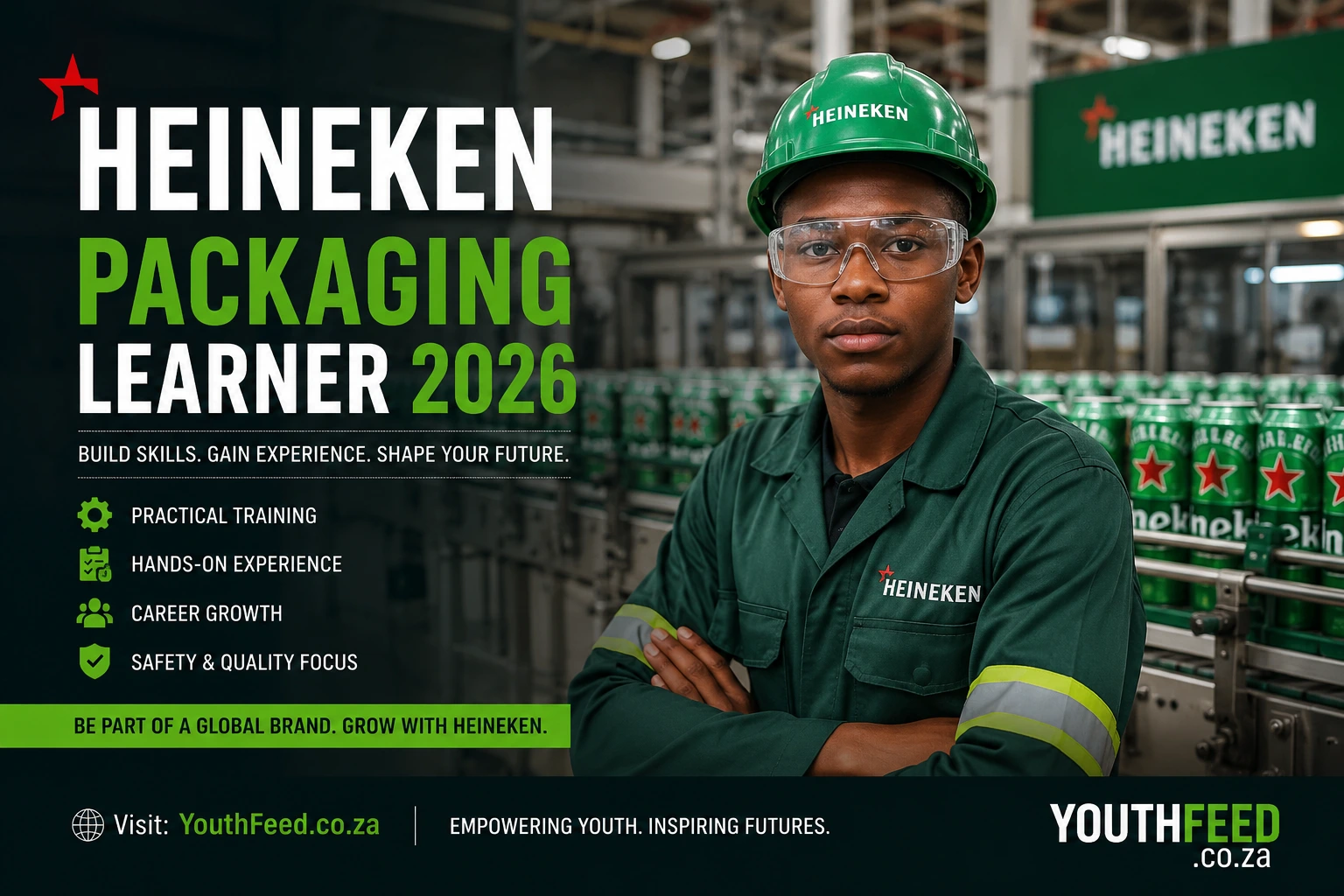
The growing conversation around the Heineken Packaging Learner programme is not happening by accident. Across South Africa, thousands of young people are actively searching for practical career opportunities that offer more than just classroom theory. In a job market where experience often matters as much as qualifications, learnerships linked to major manufacturers are increasingly becoming some of the most valuable entry points into stable employment.
That is why the latest learnership opportunity at the Sedibeng Manufacturing Plant is attracting significant attention online. For many matriculants with strong technical ability, the chance to gain hands-on exposure inside one of the world’s biggest beverage companies represents more than another training programme. It represents access to a structured industrial environment where real operational skills are developed.
The Heineken Packaging Learner opportunity also arrives at a time when South Africa’s manufacturing sector is under pressure to modernize operations, improve productivity, and build a new generation of technically skilled workers. As industries become more automated and process-driven, packaging operations are no longer viewed as simple factory tasks. They are increasingly recognized as specialized technical roles requiring precision, safety awareness, problem-solving ability, and mechanical understanding.
For young people trying to break into manufacturing, this learnership could become an important stepping stone.
Why the Heineken Packaging Learner Programme Is Drawing Attention
There has been a noticeable shift in how South African youth view learnerships over the past few years. Previously, many applicants focused mainly on university pathways or office-based internships. But with rising unemployment and growing competition for graduate roles, practical skills programmes linked to established companies are now seen differently.
The Heineken Packaging Learner programme stands out because it combines technical training with real operational exposure inside a live manufacturing environment.
According to the programme outline, successful learners at the Sedibeng Plant will gain competence in several key packaging operations, including:
- Filling and date coding
- Sealing processes
- Packing and unpacking
- Labelling systems
- First-line maintenance
- Problem-solving techniques
- Quality control processes
- Health and safety regulations
- Asset management
This broad operational exposure matters because packaging plants operate on speed, efficiency, and consistency. Learners are not simply observing from the sidelines. They are being introduced to systems that keep large-scale production lines running every day.
In modern manufacturing, packaging operations are deeply connected to automation and quality assurance. Even entry-level employees are expected to understand production flow, machine performance, fault detection, and workplace safety procedures.
That makes this learnership especially attractive for technically minded applicants.
The Bigger Story Behind Manufacturing Learnerships in South Africa
The popularity of programmes like the Heineken Packaging Learner initiative also reflects broader economic realities.
South Africa continues to face one of the highest youth unemployment rates in the world. While many sectors have struggled to create enough opportunities, manufacturing remains one of the few industries still capable of producing structured technical career pipelines.
Large beverage manufacturers, food processing companies, logistics firms, and industrial plants continue to invest in skills development because operational continuity depends on skilled workers.
This creates a unique situation where learnerships become more than temporary training programmes. They become talent pipelines.
Companies benefit by identifying young people who can adapt to industrial environments early. Learners benefit by gaining practical workplace exposure that significantly improves employability later on.
The Sedibeng Manufacturing Plant learnership appears designed around that philosophy.
The inclusion of first-line maintenance and problem-solving modules is particularly important. Modern production facilities increasingly value workers who can identify operational issues before they escalate into expensive downtime.
In many ways, today’s packaging environments resemble technical control systems rather than traditional factory floors.
Read more about Complete Guide to Learnerships in South Africa (2026–2027)
What Makes the Sedibeng Plant Opportunity Different
Not all learnerships generate the same level of interest. Some focus mainly on administrative exposure or theoretical training. What makes the Heineken Packaging Learner programme stand out is its operational intensity.
Applicants are expected to work shifts and extended hours when required. That detail alone signals the programme’s alignment with real manufacturing conditions.
Production plants operate continuously to meet demand, and shift-based work is part of the reality of industrial careers. By exposing learners to this environment early, the programme appears designed to prepare candidates for long-term employability rather than short-term participation.
The minimum requirement of Matric with Pure Mathematics and English also suggests the company is targeting candidates with strong analytical foundations.
Pure Mathematics often acts as an indicator of technical reasoning ability, especially in manufacturing environments involving measurements, calculations, machine settings, and process control.
Preference for applicants with strong academic performance further reinforces the programme’s technical orientation.
This is not simply about filling positions. It appears to be about identifying trainable talent capable of adapting to industrial systems.
Public Reaction and Growing Interest Online
Learnership opportunities linked to large brands often generate strong public interest, but the response surrounding the Heineken Packaging Learner programme reflects something deeper.
Many young South Africans increasingly see manufacturing-based opportunities as more stable than some entry-level office careers.
Online discussions around technical learnerships frequently highlight several recurring themes:
- The value of practical experience
- Exposure to industrial technology
- Better long-term employability
- Opportunities for internal growth
- Potential pathways into permanent roles
While companies do not always guarantee employment after completion, experience gained inside recognized manufacturing environments can significantly strengthen future job applications.
For many applicants, the brand reputation attached to a global company also matters. Experience in a structured operational environment often signals discipline, technical exposure, and workplace readiness to future employers.
There is also growing recognition that skilled trades and technical operations remain essential even as automation expands.
Machines still require operators, technicians, maintenance teams, and quality controllers. Automation changes jobs, but it does not eliminate the need for skilled people.
Why Technical Orientation Matters More Than Ever
One of the most interesting aspects of the Heineken Packaging Learner programme is its emphasis on technical orientation and mechanical focus.
That requirement reflects a major transformation happening across manufacturing industries worldwide.
Production facilities are becoming increasingly data-driven and automated. Packaging systems now integrate sensors, monitoring systems, coding technologies, and efficiency tracking tools.
As a result, employers are no longer only looking for physical labour capacity. They want adaptable workers capable of understanding systems and responding to technical challenges.
The programme’s focus on:
- Problem-solving
- Maintenance awareness
- Safety compliance
- Quality control
shows how industrial training is evolving.
Even entry-level workers are expected to think critically about operational efficiency and machine performance.
For learners willing to develop those skills, manufacturing can offer more career mobility than many people realize.
Some packaging operators eventually move into:
- Maintenance roles
- Process control positions
- Production supervision
- Technical operations management
- Quality assurance careers
That long-term progression is one reason technical learnerships continue attracting attention despite broader economic uncertainty.
Read more about The Best CV Format for Learnerships 2026
Why This Matters Right Now
The timing of the Heineken Packaging Learner opportunity is especially relevant in 2026.
South Africa is currently experiencing growing demand for practical workplace skills rather than purely academic credentials. Employers across several industries increasingly prioritize candidates who can demonstrate operational competence and adaptability.
At the same time, young people are becoming more realistic about career pathways.
Many job seekers now recognize that entering industries through learnerships can sometimes create faster access to long-term employment than waiting for traditional graduate programmes.
The manufacturing sector is also under pressure to replace aging technical workforces. Experienced operators and technicians are retiring in many industries, creating the need for younger talent capable of learning modern production systems.
This creates an important window for technically minded youth.
The Sedibeng Plant learnership arrives during a period where companies are actively searching for workers who can grow alongside industrial modernization efforts.
For applicants with strong discipline, technical curiosity, and willingness to work in demanding environments, this kind of opportunity could become career-defining.
The Pressure and Reality of Manufacturing Careers
At the same time, it is important to maintain realistic expectations.
Industrial environments are demanding.
The requirement for shift work and extended hours highlights the intensity associated with production operations. Packaging plants operate according to strict timelines, output targets, and safety protocols.
Learners entering these environments will likely face:
- Fast-paced workflows
- Performance pressure
- Strict safety procedures
- Repetitive operational tasks
- Technical troubleshooting situations
Success in manufacturing often depends as much on mindset as technical ability.
Employers typically value reliability, consistency, punctuality, teamwork, and willingness to learn.
The formal assessment process mentioned in the programme requirements also suggests the company aims to identify candidates with both technical aptitude and operational discipline.
That screening process may become increasingly competitive as more young people pursue industrial training opportunities.
What Could Happen Next
The growing interest surrounding the Heineken Packaging Learner programme may signal broader trends for South Africa’s industrial sector.
If demand for technical learnerships continues increasing, more manufacturing companies could expand workplace training pipelines in response.
Several possible developments could emerge:
Increased Competition for Technical Learnerships
As awareness grows around the value of industrial skills, applicants may need stronger academic performance and better technical readiness to stand out.
Greater Focus on Automation Skills
Future packaging programmes may include more exposure to automated systems, machine diagnostics, and digital production monitoring technologies.
Stronger Pathways Into Permanent Employment
Companies facing long-term skills shortages may increasingly use learnerships as recruitment pipelines for future operational staff.
Expanded Youth Interest in Manufacturing Careers
Technical manufacturing careers may continue gaining credibility among young South Africans seeking stable, skill-based employment.
The broader implication is clear: practical industrial training is becoming increasingly important in South Africa’s employment landscape.
The Skills That Could Define the Next Generation
One overlooked aspect of programmes like the Heineken Packaging Learner initiative is how they shape workplace behaviour beyond technical knowledge.
Industrial environments teach:
- Time management
- Process discipline
- Operational accountability
- Team coordination
- Safety awareness
These are transferable skills valued across multiple industries.
Even learners who eventually pursue other technical fields often carry forward the operational mindset developed inside manufacturing plants.
That is why learnerships tied to real production environments often hold long-term value beyond the immediate qualification itself.
Final Thoughts
The attention surrounding the Heineken Packaging Learner programme reflects more than simple excitement over another learnership advertisement.
It highlights a growing shift in how South African youth view technical careers, industrial training, and workplace readiness.
At a time when employability increasingly depends on practical competence, opportunities connected to structured manufacturing environments are becoming more valuable.
The Sedibeng Plant programme appears designed not only to teach packaging operations, but also to develop disciplined, technically capable workers who can function inside modern production systems.
For applicants with strong mathematical foundations, technical curiosity, and willingness to work in demanding operational environments, this learnership could represent an important first step into South Africa’s manufacturing sector.
And in 2026, that kind of opportunity matters more than ever.
APPLY HERE: Heineken Packaging Learner Programme 2026
FAQ About the Heineken Packaging Learner Programme
1. What qualification is required for the Heineken Packaging Learner programme?
Applicants need a minimum of Matric/Grade 12 with Pure Mathematics and English.
2. Where is the learnership based?
The programme is based at the Sedibeng Manufacturing Plant.
3. What skills will learners gain?
Learners will gain exposure to packaging operations, maintenance, quality control, safety procedures, and problem-solving techniques.
4. Will learners work shifts?
Yes. Candidates may be required to work shifts and extended hours depending on operational requirements.
5. Is prior work experience required?
The programme mainly focuses on academic performance, technical orientation, and the ability to work in a manufacturing environment.