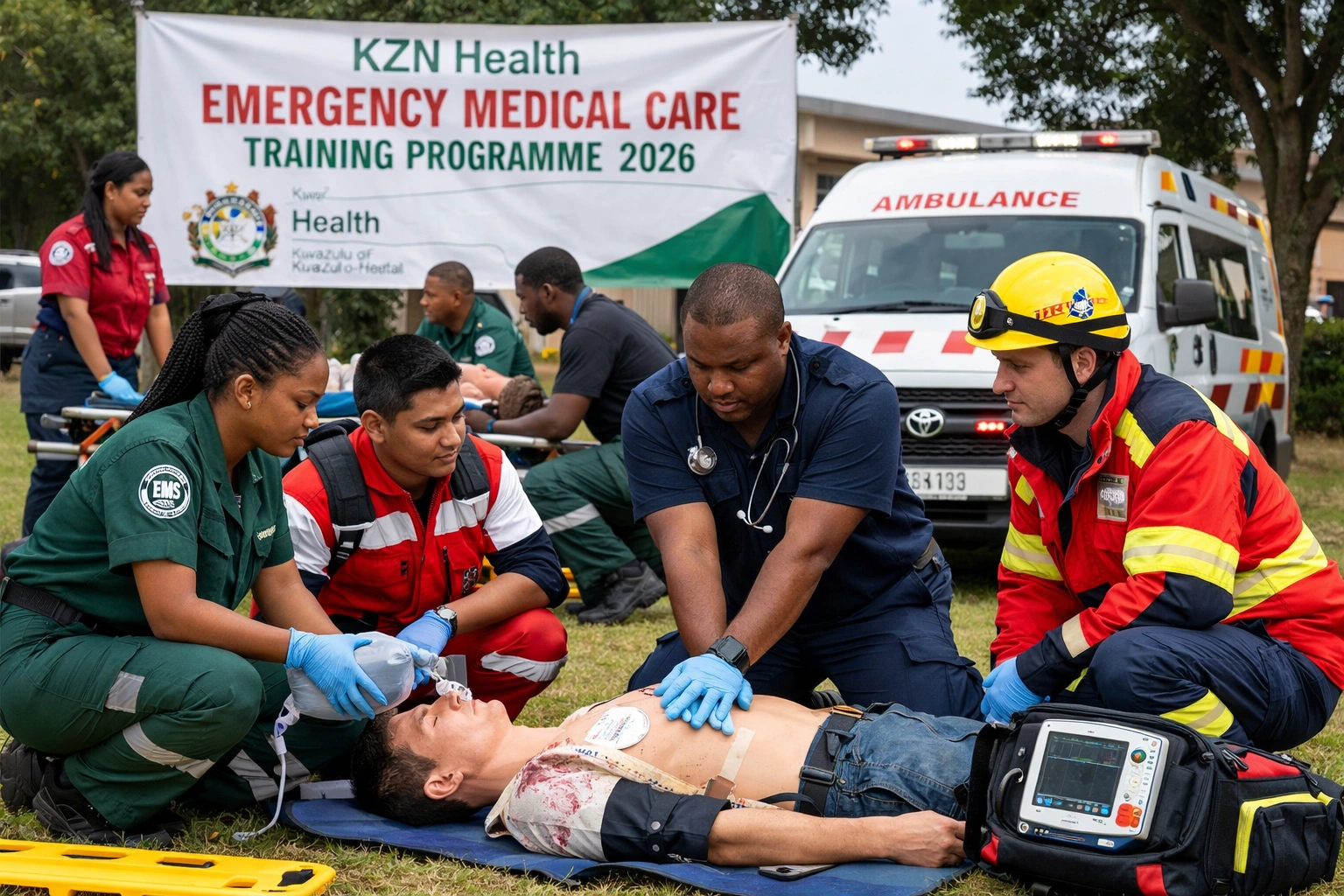
KZN Health Emergency Medical Care Training Programme 2026: The KwaZulu-Natal Department of Health is inviting applications for its Higher Certificate in Emergency Medical Care Training Programme for the July 2026 intake. The programme is delivered through the KZN College of Emergency Care and focuses on strengthening the skills of emergency medical personnel working within Emergency Medical Services (EMS).
Application closing date: 03 April 2026
Training location: KwaZulu-Natal
Qualification: Higher Certificate in Emergency Medical Care (NQF Level 5)
What this programme is (plain English)
This programme is a one-year professional healthcare qualification designed to train and upskill emergency medical staff who respond to accidents, medical emergencies, and disasters.
In practical terms, it prepares EMS personnel to:
- Assess patients in high-pressure situations
- Provide immediate life-saving treatment
- Stabilise injured or critically ill patients before hospital care
The qualification (SAQA ID 120401) carries 125 credits and combines classroom learning with real-world emergency response training.
For EMS workers already in the field, this qualification is a step toward more advanced clinical responsibilities.
What you’ll actually do (real-world examples)
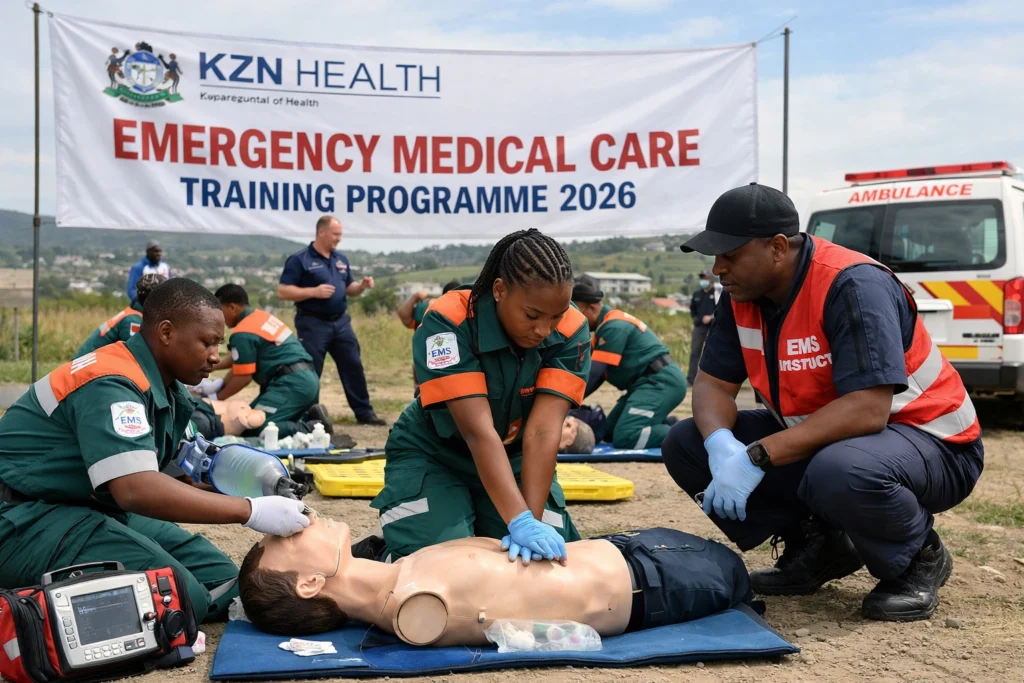
Participants don’t just study theory — they also complete hands-on emergency training and supervised field experience.
Typical learning activities include:
Patient assessment
- Checking airway, breathing, and circulation at accident scenes
- Determining whether a patient needs urgent hospital care
Trauma care
- Stabilising patients after road accidents
- Managing bleeding, fractures, and shock
Basic life support
- Performing CPR during cardiac emergencies
- Using oxygen therapy and other emergency equipment
Ambulance operations
- Learning safe patient transport procedures
- Communicating with hospitals and dispatch centres
Emergency scene management
- Coordinating care at accident scenes
- Working with police, fire services, and hospitals
Professional conduct
- Understanding patient rights, confidentiality, and medical ethics
Students also complete supervised field practice, where they participate in real emergency response situations under qualified professionals.
Who qualifies (minimum requirements checklist)
Applicants must meet both academic and professional criteria.
Academic requirements (one of the following)
Senior Certificate (pre-2009)
Must include passes in:
- English
- Mathematics
- Biology and/or Physical Science
National Senior Certificate
- English
- Mathematics or Mathematical Literacy
- Life Sciences or Physical Sciences
National Certificate (Vocational)
Minimum 60% in:
- English
- Mathematics
- Life Sciences or Physical Sciences
Additional requirements
Applicants must also:
- Have a minimum APS score of 18
- Pass a medical fitness assessment
- Pass a physical fitness assessment
- Be currently employed as EMS personnel
The programme is only open to in-service emergency medical staff.
Why applicants get disqualified
Several issues commonly lead to applications being rejected:
1. Not working in EMS
This programme is strictly for current emergency medical personnel.
2. APS score below 18
Even if other criteria are met, the application may not proceed.
3. Missing science subjects
Life Sciences or Physical Sciences are usually required.
4. Failing fitness assessments
Emergency response work involves lifting, long shifts, and high stress.
5. Incomplete documents
Missing certificates or proof of employment can disqualify applicants.
6. Late applications
Applications submitted after 03 April 2026 may not be considered.
Who should apply (expert analysis)
This programme is best suited for:
Operational EMS staff looking to upgrade qualifications
For example:
- Ambulance assistants wanting formal academic training
- EMS personnel aiming for career progression in emergency care
- Staff seeking to move toward advanced clinical roles
It is not ideal for people trying to enter EMS for the first time, since the programme requires current employment in emergency medical services.
For in-service personnel, however, the qualification can significantly strengthen long-term career prospects within public health emergency services.
Competition level
Competition level: Medium
Why:
- The programme is limited to in-service EMS personnel, which reduces the overall applicant pool.
- However, EMS professionals across the province may apply, creating competition among experienced candidates.
Selection often depends on:
- Academic results
- Physical fitness
- Professional readiness for advanced training
Tips to improve selection chances
1. Ensure your APS score is calculated correctly
Use your six best matric subjects (excluding Life Orientation).
2. Prepare for the physical fitness test
EMS training often requires:
- Lifting patients
- Carrying equipment
- Endurance in stressful situations
3. Submit a complete application
Include all required documentation from the start.
4. Highlight EMS experience
Work experience in emergency care strengthens your application.
5. Apply well before the deadline
Avoid last-minute technical issues.
Common mistakes applicants make
- Applying despite not being employed in EMS
- Uploading uncertified copies of documents
- Miscalculating APS scores
- Ignoring the physical fitness requirement
- Waiting until the last day to submit the application
These errors frequently result in automatic disqualification.
Application strategy (step-by-step)
A careful approach improves your chances of submitting a valid application.
Step 1 — Confirm eligibility
Check that you meet academic requirements and are currently employed in EMS.
Step 2 — Calculate your APS score
Ensure it reaches the minimum of 18 points.
Step 3 — Gather documents early
Prepare certified copies of certificates and supporting documents.
Step 4 — Complete the online application
Submit through the official programme application platform.
Step 5 — Verify submission
Ensure you receive confirmation that your application was successfully submitted.
APPLY HERE: KZN Health Emergency Medical Care Training Programme 2026
ALSO APPLY FOR: Citi Learnership Programme 2026
Documents checklist
Applicants should prepare the following documents.
(Some items are assumed based on standard training programme applications.)
- Certified copy of ID
- Certified copy of Senior Certificate / NSC / NCV
- Academic transcript (if applicable)
- Proof of employment in EMS
- Updated CV
- Medical fitness certificate (may be requested later)
- Any additional documents requested by the training provider
Safety & Scam Check (Important)
When applying for training programmes, keep these precautions in mind:
- Never pay fees for government-funded learnerships or training programmes.
- Always verify the official domain of the KwaZulu-Natal Department of Health.
- Confirm the programme details through the KZN College of Emergency Care if unsure.
- Be cautious of WhatsApp-only application instructions.
- Apply through official online portals or government channels where possible.
FAQ
1. How long is the programme?
The training runs for one year full-time.
2. What qualification will I receive?
A Higher Certificate in Emergency Medical Care (NQF Level 5)
3. Is this programme open to the public?
No. It is intended only for in-service EMS personnel.
4. Where is the training conducted?
At the KZN College of Emergency Care in KwaZulu-Natal.
5. Is practical training included?
Yes. Students complete supervised field practice in emergency environments
6. What is the minimum APS score required?
Applicants must have an APS of at least 18.
7. Do applicants need to pass a medical exam?
Yes. Both medical and physical fitness assessments are required.
8. When is the application deadline?
Applications close on 03 April 2026.
9. Does the programme involve ambulance training?
Yes. Ambulance operations and emergency response procedures are included.
Final assessment
The KZN Health Emergency Medical Care Training Programme offers a structured pathway for EMS professionals who want to deepen their emergency care skills and move toward more advanced responsibilities.
Because it is limited to in-service emergency personnel, the programme targets people already working in demanding healthcare environments. For those candidates, it provides both formal academic recognition and practical emergency training.
However, applicants must ensure they meet the academic, fitness, and employment requirements before applying, as these criteria are strictly enforced.
For eligible EMS professionals in KwaZulu-Natal, the programme can be a meaningful step toward professional development within emergency medical services.
APPLY HERE: KZN Health Emergency Medical Care Training Programme 2026
closing date: 03 April 2026