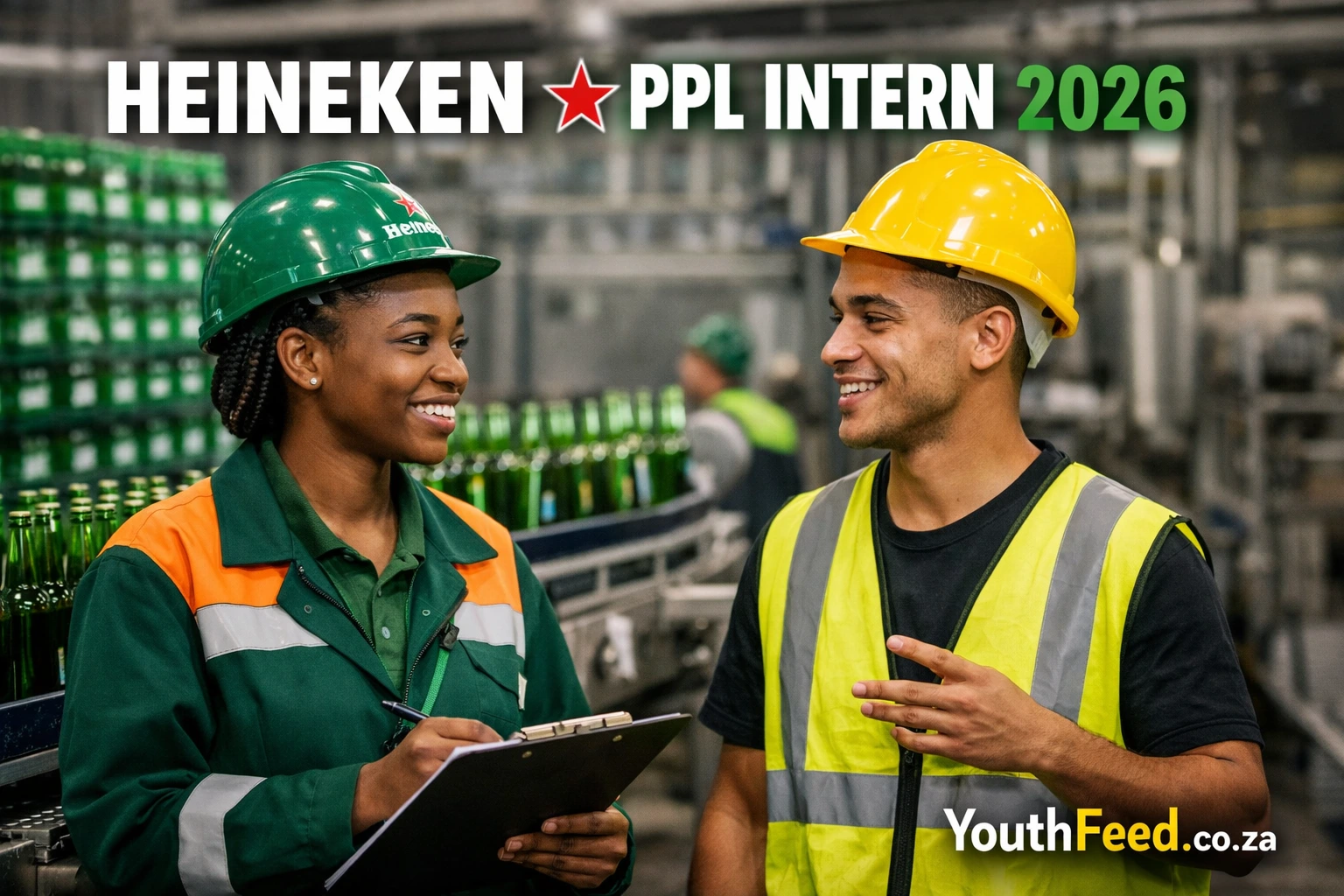
There’s a reason the HEINEKEN PPL Intern 2026 opportunity is suddenly getting more attention than a typical internship listing.
At first glance, it looks like a familiar graduate pathway: a 12-month internship, practical workplace exposure, and a chance for final-year students to bridge the gap between lecture halls and real operations. But look a little closer, and this role reveals something bigger about where youth employment, industrial skills, and supply chain careers are heading in South Africa right now.
The HEINEKEN PPL Intern 2026 position, based at Sedibeng Production Manufacturing, lands at a moment when students are under growing pressure to graduate with more than theory. Employers want applied experience. Graduates want credible brands on their CVs. And sectors like logistics, warehousing, procurement, and production planning are becoming far more central to business performance than many students realize.
That’s what makes this opportunity relevant beyond just one vacancy.
This isn’t only about getting an internship. It’s about getting inside the machinery of how a major manufacturing operation actually works.
And for many applicants, that’s the real draw.
A Logistics Internship That Feels More Strategic Than It Sounds
The title may read Planning & Logistics Internship, but the role itself touches a lot more than routine admin.
According to the opportunity details, the successful intern will report to the Planning & Logistics Manager and will be based in a live manufacturing environment. That matters because logistics in a production setting is not just about moving boxes or updating spreadsheets. It is about timing, coordination, stock flow, supplier management, and keeping operations moving without expensive disruptions.
In other words, this is the part of the business where delays become costs very quickly.
That’s why the listed responsibilities are more important than they may initially appear. The role includes:
- Preparing and completing warehouse orders for production
- Receiving and processing stock
- Executing inventory controls
- Participating in stock counts
- Verifying inbound shipments
- Managing inter-plant material transfers
- Placing purchase orders for MRP goods
- Confirming supplier orders
- Supporting SAP and MRP scheduling processes
For students studying Logistics or Supply Chain Management, that is a meaningful practical learning environment. It places an intern close to the heartbeat of operational decision-making.
And that is exactly the kind of exposure many employers say graduates are missing.
How Opportunities Like This Became So Valuable
A few years ago, many students treated internships as optional add-ons useful, yes, but not always urgent.
That mindset has changed sharply.
Today, internships are increasingly viewed as a near-essential part of employability, especially in sectors where systems, reporting, process discipline, and operational readiness matter from day one. South African employers, particularly in industrial and manufacturing environments, are placing more emphasis on whether candidates can step into structured work settings and understand how departments interact.
That’s one reason programmes like the HEINEKEN PPL Intern 2026 are attracting attention.
They sit at the intersection of three realities:
- Graduate competition is intense
Many students now complete degrees or diplomas without guaranteed employment. - Work-integrated learning is no longer a “nice-to-have”
For some qualifications, practical workplace exposure is necessary to complete or strengthen professional readiness. - Supply chain careers are becoming more visible
What was once seen as a “behind-the-scenes” field is now recognized as essential to production, distribution, retail, and customer satisfaction.
When people talk about “future-proof” skills, they often mention tech or data. But logistics and planning are quietly part of that conversation too.
Because when systems fail, stock runs out, or procurement delays hit production lines, businesses feel it immediately.
That makes this internship especially relevant for students who want careers with practical, long-term demand.
ALSO APPLY FOR: Bidvest Graduate Programme 2026
Why Sedibeng Matters More Than It Might Seem
The location of this internship is not a minor detail.
Being placed at Sedibeng Production Manufacturing means the intern would be entering a real industrial ecosystem not a purely office-based training environment detached from operational pressure. That distinction matters because the learning curve in production-linked logistics is often much steeper, but also far more valuable.
In a manufacturing context, every process connects to another:
- A delayed delivery affects production planning
- Poor inventory accuracy affects warehouse performance
- Incorrect order scheduling affects supplier relationships
- Material transfer issues affect output and efficiency
That kind of environment can be demanding, but it also gives interns a more realistic understanding of how modern supply chains actually function.
For students hoping to eventually move into roles such as:
- Supply Chain Analyst
- Warehouse Planner
- Procurement Coordinator
- Inventory Controller
- Production Scheduler
- Logistics Officer
…this kind of placement can be a serious career advantage.
Not because it guarantees a job afterward, but because it gives candidates something far more useful in the short term: evidence of workplace readiness.
And in a crowded entry-level market, that can be decisive.
What HEINEKEN Appears to Be Looking For
One of the more revealing aspects of this opportunity is that the qualification requirements are fairly straightforward, but the capability expectations are not.
To qualify, applicants need:
- A Degree or Diploma in Logistics or Supply Chain Management
- Computer literacy in Word, Excel, and PowerPoint
- Strong communication and presentation skills
- Effective time management
- The ability to multitask and work under pressure
- Teamwork ability
- South African citizenship
On paper, this sounds standard. In practice, it tells you quite a lot.
This is not a role for someone expecting passive observation. It is designed for someone who can enter a structured environment and contribute while learning. The mention of quality standards, procedures, inventory control, and SAP/MRP principles strongly suggests that accuracy and discipline will matter as much as enthusiasm.
That’s an important distinction.
A lot of students think internships are mostly about “getting exposure.” But in operations-focused roles, exposure only goes so far. Employers are also assessing whether interns can handle accountability, deadlines, process compliance, and business communication.
That means applicants who stand out are likely to be the ones who can show not only academic relevance, but also reliability.
And reliability is a currency of its own in logistics.
Public Reaction: Why Students Are Paying Attention
Whenever a major employer opens a structured internship opportunity, the response is usually immediate. But this one is likely to resonate for a few specific reasons.
First, the brand carries weight. A recognized employer on a CV often changes how future applications are perceived, especially for graduates trying to build early credibility.
Second, the internship is clearly aligned to a practical business function. Students are not being invited into a vague “general training” programme. They are being placed into a department with operational relevance and measurable responsibilities.
Third, the timeline is attractive. A 12-month contract running from 01 May 2026 to 30 April 2027 gives enough time for an intern to move beyond surface-level orientation and into actual contribution.
That matters because one of the frustrations many graduates have with short placements is that they end just as the real learning begins.
On social and student circles, opportunities like this often generate a familiar mix of reactions:
- Excitement from final-year students needing practical experience
- Anxiety around competition and application quality
- Questions about whether the internship could lead to future employment
- Increased interest from students now realizing how broad supply chain careers can be
That last point is especially interesting.
Internships don’t just fill roles. They also shape how industries are perceived.
And in that sense, the HEINEKEN PPL Intern opening may do more than recruit a student it may also encourage more young people to see logistics as a serious and viable professional pathway.
APPLY HERE: Bosch Administrator Learnership 2026
Why This Matters Right Now
This matters right now because South Africa’s graduate economy is becoming more skills-sensitive, not less.
Degrees still matter. Diplomas still matter. But employers increasingly want evidence that candidates can function in actual business environments, use workplace systems, communicate clearly, and adapt under pressure.
That is particularly true in sectors connected to:
- Manufacturing
- Procurement
- Warehousing
- Inventory management
- Production support
- Supply chain planning
The HEINEKEN PPL Intern 2026 opportunity reflects this shift very clearly.
It shows that businesses are not only hiring for academic alignment, but for practical operational potential. It also highlights how internships are becoming one of the most important stepping stones between education and employability.
For students, this means one thing: opportunities like this should not be treated casually.
A rushed CV, generic motivational letter, or incomplete application can cost more than just one internship. It can cost a key career-building moment.
And because the closing date is 10 April 2026, the urgency here is real.
Not dramatic. Just real.
What Applicants Should Pay Attention To Before Applying
A lot of candidates lose strong opportunities not because they are unqualified, but because they underestimate the application process.
For this internship, prospective interns are expected to submit:
- A Covering Letter / Motivational Letter
- A Curriculum Vitae (CV)
- Academic Record
- Qualification
- Certified Grade 12 Certificate
- Certified Copy of Identity Document
That document list may look routine, but it is often where selection quality starts being judged.
Here’s what likely matters most:
1. Your motivational letter must sound specific
Avoid writing as if you are applying to “any internship.” Show that you understand the role involves warehouse operations, stock control, planning, procurement support, and supply chain coordination.
2. Your CV should highlight relevant exposure
Even if you don’t have formal work experience, mention projects, simulations, practical modules, software exposure, presentations, group assignments, or academic work related to logistics and planning.
3. Accuracy matters
This is a logistics environment. If your own application contains missing files, poor formatting, or inconsistent information, it quietly sends the wrong message.
4. Don’t ignore Excel and systems readiness
If you have any familiarity with spreadsheets, reporting, stock records, SAP exposure, or MRP concepts, make that visible.
This is one of those opportunities where polish and relevance could matter more than dramatic self-promotion.
Because the role itself is about systems, order, and process.
The Bigger Career Lesson Hidden Inside This Internship
There’s a wider lesson here that students should not miss.
Many graduates still focus only on high-visibility career titles marketing, HR, finance, IT, communications while overlooking operational careers that are often just as stable and in demand.
But planning and logistics roles sit at the center of how businesses actually function.
They influence:
- Product availability
- Production efficiency
- Supplier coordination
- Cost control
- Warehouse performance
- Customer satisfaction
That makes them powerful career foundations.
The HEINEKEN PPL Intern opening is a reminder that some of the smartest early-career moves are not always the loudest ones. Sometimes the most strategic opportunities are the ones that teach you how a business truly runs.
And once you understand that, your career options often widen.
Not narrow.
What Could Happen Next
In the short term, this internship is likely to draw strong interest from final-year students in logistics and supply chain-related fields, particularly those seeking practical experience tied to a recognized employer and a live production environment.
If response levels are high and they probably will be selection may become less about minimum qualifications and more about application quality, readiness, and professional presentation.
Longer term, there are a few possible outcomes for the successful intern:
1. Strong workplace exposure
Even if the internship does not directly convert into permanent employment, the experience itself could significantly strengthen future applications.
2. Internal visibility
Internships in operational departments often expose candidates to managers, systems, and workflows that can create future opportunities.
3. Career direction clarity
For many students, internships don’t just build employability they help answer a deeper question: Do I actually want to work in this field long term?
4. A more competitive graduate profile
A year of structured exposure in planning and logistics can make a candidate more credible across multiple sectors, not only beverage manufacturing.
That’s why this opportunity should be viewed less as a one-year placeholder and more as a possible launch platform.
Because that is often what good internships become.
APPLY HERE: HEINEKEN PPL Intern 2026
FAQ: HEINEKEN PPL Intern 2026
1) What does the HEINEKEN PPL Intern role involve?
The internship focuses on planning and logistics tasks such as stock processing, warehouse support, inventory control, supplier coordination, purchase orders, and production-related logistics.
2) Who can apply for the HEINEKEN PPL Intern 2026 opportunity?
Applicants need a Degree or Diploma in Logistics or Supply Chain Management and must be South African citizens.
3) How long is the internship?
The internship runs for 12 months, from 01 May 2026 to 30 April 2027.
4) Where is the internship based?
The role is based at Sedibeng Production Manufacturing.
5) When is the closing date?
The closing date for applications is 10 April 2026.
Final Take
The HEINEKEN PPL Intern 2026 opportunity stands out not because it promises instant success, but because it offers something more useful: relevant exposure in a function that businesses genuinely depend on.
For final-year students in Logistics or Supply Chain Management, this is the kind of internship that can sharpen technical understanding, improve workplace confidence, and strengthen long-term employability.
And in the current graduate climate, that matters a lot.
The smartest applicants will likely be the ones who recognize that this is not just about “getting experience.”
It is about getting the right kind of experience.
And that can change everything.