There was a time when applying for a learnership meant sending a basic one-page CV and hoping for the best. In 2026, that approach is rapidly losing effectiveness.
Across South Africa, more young people are applying for learnerships than ever before. From retail and banking to logistics, government programmes, and ICT opportunities, competition has intensified dramatically. At the same time, recruiters are filtering through enormous volumes of applications using faster digital systems and stricter screening methods.
That shift is changing one important thing many applicants underestimate: CV format.
Search trends around The Best CV Format for Learnerships have surged in recent months as applicants realize that even qualified candidates are being overlooked because their CVs are difficult to scan, too generic, or missing key information recruiters now expect. The February 2026 changes in search visibility and content quality standards also pushed more career-related advice into the spotlight, especially practical guidance that offers real value rather than recycled templates.
For many South African job seekers, particularly matriculants and first-time applicants, the question is no longer simply “What should I include in my CV?” It has become “What format actually gives me a better chance of getting shortlisted?”
That distinction matters more than most people think.
Why CV Formatting Has Suddenly Become a Big Conversation
The learnership market in South Africa has evolved quickly over the last few years.
Companies are receiving record application numbers for entry-level opportunities. Some programmes reportedly attract tens of thousands of applicants for only a few hundred positions. This is especially true in sectors like banking, telecommunications, retail, and government-sponsored youth employment initiatives.
As a result, recruiters have become more selective about presentation and readability.
Applicants who still use outdated CV styles often create problems without realizing it. Dense paragraphs, decorative fonts, excessive personal information, and poorly organized layouts make applications harder to process. In many cases, recruiters spend only seconds reviewing a CV before deciding whether to continue reading.
That reality has changed the advice career coaches and HR professionals now give to first-time applicants.
The modern learnership CV is becoming shorter, cleaner, and more skills-focused.
Instead of trying to sound overly professional, successful applicants are increasingly prioritizing clarity, structure, and relevance. Recruiters want to quickly identify education history, contact details, availability, digital skills, and communication abilities without searching through unnecessary information.
This trend aligns closely with broader hiring shifts happening globally.
Companies are focusing less on fancy wording and more on practical potential.
What The Best CV Format for Learnerships Actually Looks Like in 2026
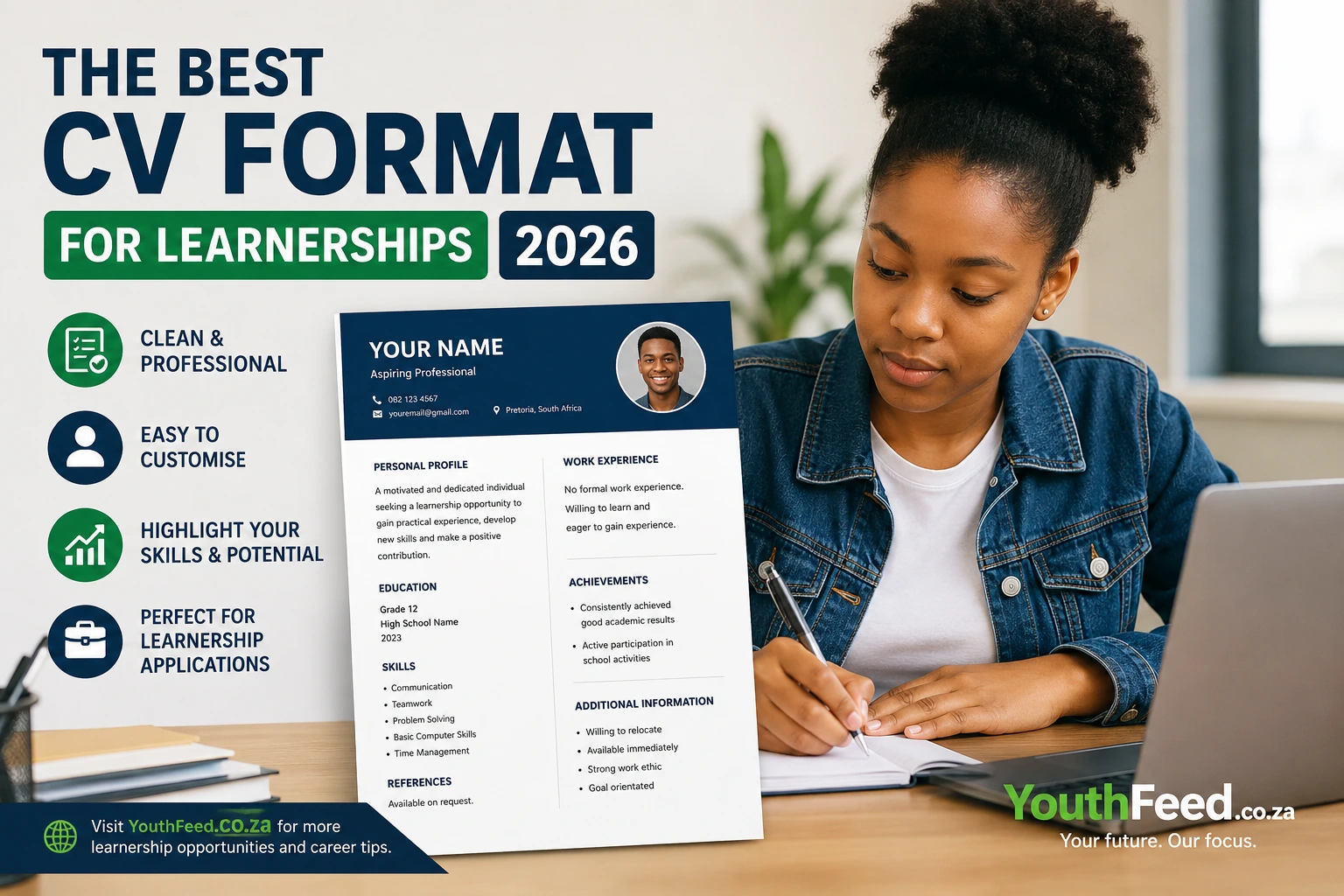
The strongest learnership CVs in 2026 tend to follow a simple but strategic structure.
1. A Clear Professional Header
The top section should immediately show:
- Full name
- Phone number
- Professional email address
- Location
- LinkedIn profile (optional)
Many applicants still include unnecessary details such as ID numbers, marital status, religion, or full home addresses. Most recruiters no longer require these in the first screening stage.
A cleaner header improves readability instantly.
2. A Short Personal Statement
This section has become increasingly important.
Recruiters want a quick snapshot of who the applicant is and what they are looking for. A good personal statement is usually 3–4 lines long and focused on motivation, career interest, and willingness to learn.
For example:
“Motivated matric graduate seeking a learnership opportunity in administration and customer service. Strong communication skills, computer literacy, and a willingness to learn in a professional environment.”
Simple works better than exaggerated corporate language.
3. Education Comes Before Experience
For learnership applications, education often matters more than work history because many applicants are entering the workforce for the first time.
This section should include:
- School or institution name
- Qualification
- Subjects or specialization
- Completion year
Applicants with certifications in computer skills, digital literacy, customer service, or online courses should include them clearly.
4. Skills Section
This is one of the most important additions in modern CV formatting.
Recruiters increasingly search for skills quickly rather than reading long descriptions.
Useful examples include:
- Microsoft Office
- Communication skills
- Time management
- Teamwork
- Customer service
- Problem-solving
- Computer literacy
- Data capturing
Short bullet points work best.
5. Work Experience or Volunteer Experience
Even informal experience can help.
Many successful learnership applicants now include:
- School leadership roles
- Community volunteering
- Small business assistance
- Tutoring
- Family business support
- Event assistance
The key is showing responsibility and reliability.
The Shift Away From “Fancy” CV Templates
One surprising trend in 2026 is the decline of overly designed CV templates.
For years, social media promoted colorful, graphic-heavy CV designs. But recruiters are increasingly warning applicants that these formats sometimes create problems with digital recruitment systems.
Simple formatting is now often more effective.
That means:
- Black text on white background
- Easy-to-read fonts
- Clear section headings
- Consistent spacing
- Minimal graphics
This does not mean CVs should look boring. It means readability now matters more than decoration.
Many applicants are discovering that a clean layout can outperform a visually impressive design if it helps recruiters find information faster.
READ MORE ABOUT: How Employers Benefit From Learnership Programmes in South Africa 2026
Public Reaction: Why Young Job Seekers Feel Frustrated
The growing focus on CV formatting has sparked mixed reactions online.
Some applicants feel frustrated because they believe the hiring process has become too competitive even for entry-level opportunities. Others argue that young people without professional guidance are disadvantaged because they may not know modern recruitment expectations.
On social media platforms and career forums, many users share stories about submitting hundreds of applications without responses. That experience has increased interest in practical career advice and CV improvement strategies.
At the same time, HR professionals argue that formatting matters because recruiters simply do not have time to decode confusing applications.
Both perspectives contain some truth.
The pressure on job seekers is real, especially in South Africa’s difficult employment environment. But clearer applications also genuinely help candidates present themselves more effectively.
Why This Matters Right Now
The timing of this conversation is important.
South Africa continues to face significant youth unemployment challenges, and learnerships remain one of the most accessible pathways into the workforce. For many young people, these programmes are not just training opportunities — they are potential turning points.
At the same time, employers are placing greater emphasis on digital readiness and professional communication.
That means applicants are increasingly judged on presentation before interviews even happen.
The February 2026 search and content quality shifts also changed how career information spreads online. Practical, experience-driven content is now performing better than generic advice stuffed with keywords or unrealistic promises.
Readers want guidance that feels current and useful.
That explains why topics like The Best CV Format for Learnerships are gaining traction now. People are searching for clarity in a highly competitive environment where small improvements can make a meaningful difference.
READ MORE ABOUT Learnership vs Internship vs Apprenticeship 2026
The Biggest Mistakes Applicants Still Make
Despite growing awareness, certain CV mistakes continue appearing repeatedly.
Including Too Much Information
Long CVs are still common among first-time applicants trying to impress recruiters.
Ironically, too much information often weakens the application.
A learnership CV should usually stay between one and two pages.
Using Unprofessional Email Addresses
This remains surprisingly common.
Email addresses with nicknames or slang can create a poor first impression immediately.
Copying Generic Internet Templates
Recruiters can often spot copied content quickly.
Phrases like “hardworking individual with excellent interpersonal skills” appear so frequently that they lose impact unless supported by real examples.
Poor Grammar and Spelling
Basic errors still hurt applications significantly.
Even strong candidates can appear careless if their CV contains avoidable mistakes.
Submitting the Same CV Everywhere
One of the biggest shifts in 2026 is the growing importance of tailoring applications.
Applicants who slightly adjust skills and personal statements to match the learnership sector often perform better.
How Technology Is Changing Learnership Applications
Another major factor shaping CV trends is automation.
Many employers now use digital application systems that scan CVs before a human recruiter sees them. These systems search for relevant keywords and structured formatting.
That means applicants should naturally include terms connected to the learnership they want.
For example:
- Administration
- Customer service
- IT support
- Data capturing
- Retail operations
- Communication skills
However, keyword stuffing can backfire.
The strongest CVs sound natural while still matching the role requirements.
This balance has become increasingly important as online applications continue replacing manual recruitment processes.
The Growing Importance of Soft Skills
One interesting trend in learnership recruitment is the rising emphasis on soft skills.
Technical knowledge still matters, but employers are paying closer attention to:
- Reliability
- Communication
- Adaptability
- Professional attitude
- Willingness to learn
This is partly because many learnerships are designed to train candidates from the ground up.
Employers often believe skills can be taught more easily than attitude.
That is why modern CV formats increasingly highlight personality strengths alongside qualifications.
What Could Happen Next
The evolution of learnership CVs is unlikely to slow down.
Several trends could shape applications even further over the next few years.
More Digital-First Applications
Online recruitment systems will probably continue expanding, especially among larger companies and government-linked programmes.
This means structured, ATS-friendly CVs may become even more important.
Skills-Based Hiring Could Increase
Employers may rely less on traditional experience requirements and focus more on practical abilities and short certifications.
Applicants with digital skills, online learning certificates, or project experience could gain stronger advantages.
Video Applications May Grow
Some companies are already experimenting with short introductory videos or digital assessments.
This could eventually change how first-time applicants present themselves beyond written CVs alone.
AI-Generated Applications Could Create New Challenges
As AI tools become more accessible, recruiters may become stricter about authenticity.
Generic applications generated without personal detail may become easier to identify.
That could make genuine, personalized CVs more valuable again.
The Real Lesson Behind the CV Conversation
At its core, the growing discussion around The Best CV Format for Learnerships reflects something bigger than formatting alone.
Young South Africans are trying to stand out in an increasingly crowded opportunity landscape.
A CV cannot guarantee success. It cannot solve unemployment challenges or remove competition. But it can improve visibility, professionalism, and first impressions.
And in many cases, that first impression determines whether an application moves forward or disappears unnoticed.
The most effective learnership CVs in 2026 are not necessarily the most creative or complicated.
They are the clearest.
They communicate potential quickly.
They show effort without exaggeration.
And they respect the reality that recruiters are searching for capable, motivated people — not perfect corporate language.
For many applicants, that realization may be the most valuable career advice of all.
Read more on other sources: Mastering job applications: Important CV tips
FAQ: The Best CV Format for Learnerships
1. How long should a learnership CV be?
A learnership CV should usually be one to two pages long, especially for first-time applicants.
2. Should I include references on my CV?
You can include “References available upon request” unless the application specifically asks for names and contact details.
3. Is a photo necessary on a learnership CV?
No. Most South African employers do not require photos unless specifically requested.
4. What font is best for a CV?
Simple fonts like Arial, Calibri, or Times New Roman are safest and easiest to read.
5. Can I apply for multiple learnerships using the same CV?
Yes, but tailoring your personal statement and skills section for each opportunity usually improves your chances.