
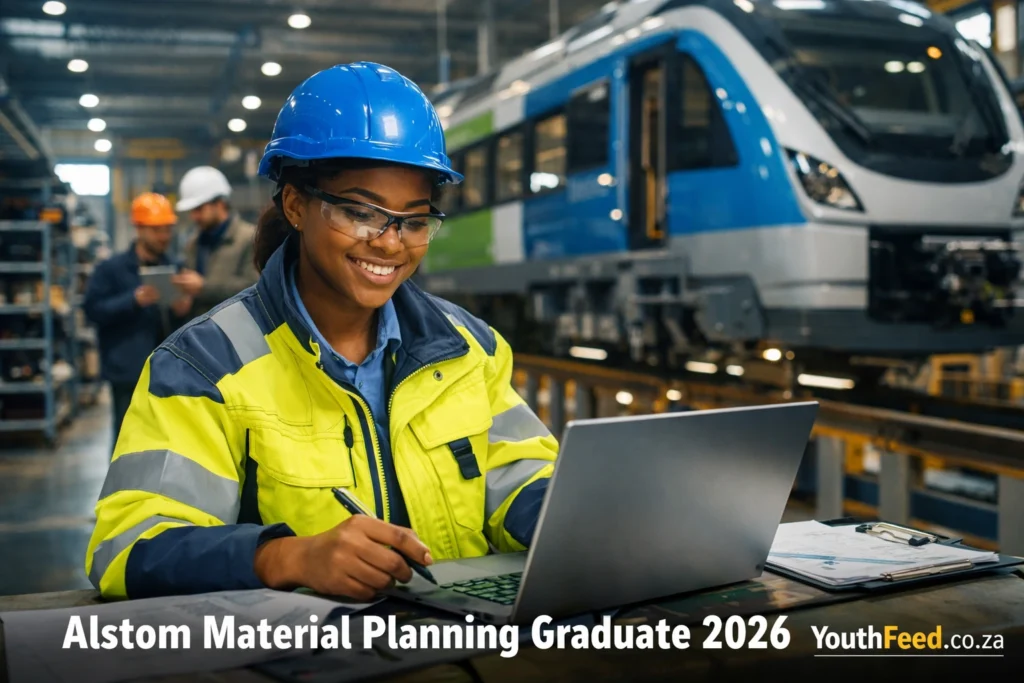
There’s a reason the Alstom Material Planning Graduate opportunity is starting to stand out among South Africa’s 2026 graduate openings.
At first glance, it may look like just another graduate programme. A 24-month placement. A Midrand location. A supply chain-related role inside a major rail manufacturing environment. Standard enough, right?
But in the current South African job market, where thousands of graduates are chasing meaningful entry-level opportunities and employers are increasingly prioritising operational efficiency, infrastructure readiness, and future-facing technical skills, this opening feels more significant than it first appears.
That’s because the Alstom Material Planning Graduate 2026 programme sits at the intersection of several important national conversations: youth employment, industrial growth, commuter rail revival, localisation, and the growing importance of logistics intelligence in modern manufacturing.
And that changes the story.
This is not just about getting a graduate role. It’s about where the role sits, what it exposes a candidate to, and what it says about where South Africa’s industrial economy may be heading next.
A Graduate Role With Bigger Meaning
The opportunity is offered under Gibela, the rail manufacturing and maintenance company closely linked to the broader Alstom ecosystem in South Africa.
That connection matters.
For many graduates, especially those in supply chain management, logistics, or industrial engineering, the dream isn’t only to “get a job.” It’s to get into a system that teaches them how large-scale operations actually work.
And few systems are as layered and demanding as transport manufacturing.
Material planning may not sound glamorous to outsiders, but anyone who understands operations knows this is where a huge amount of the real pressure lives. If materials don’t arrive on time, production slows. If inventory is mismanaged, costs rise. If planning assumptions are wrong, entire workflows begin to wobble.
So when a company opens a graduate programme specifically around material planning and inventory strategy, it usually signals something deeper: they need future talent in the machinery of execution, not just the polished front-facing side of business.
That is a serious opportunity.
ALSO APPLY FOR: CIPC Internships 2026
Why This Role Is Trending With Job Seekers
Part of the appeal is simple. The requirements are realistic for many recent graduates.
Applicants need a BTech in Supply Chain Management, Logistics, or Industrial Engineering, must be South African citizens between 18 and 35, and must have no previous work experience. For a lot of graduates who feel locked out of the labour market by “entry-level jobs” demanding years of experience, that alone makes this programme worth attention.
But there’s another reason it’s generating interest: it reflects a shift in what employers are valuing.
In 2026, the market is no longer just asking whether graduates are qualified on paper. It is increasingly asking whether they can help organisations become more efficient, more resilient, and more cost-conscious.
That’s exactly what this role points to.
The listed responsibilities involve:
- Executing material planning and inventory strategies
- Defining planning tactics using parts typology
- Setting MRP parameters
- Analysing inventory content
- Supporting finance around inventory depreciation
- Driving inventory reduction improvements
- Measuring material planning performance
That’s not filler language. That’s a real operational toolkit.
And for graduates who want a role that can later open doors into procurement, operations planning, production control, inventory management, or even supply chain analytics, this is the kind of early-career exposure that can quietly shape an entire career.
The Bigger Context: South Africa’s Rail Story
To understand why this opportunity feels more important than a typical graduate ad, you have to look at the broader rail context in South Africa.
For years, commuter rail has been part of a bigger national conversation about infrastructure decline, public mobility, urban inequality, and economic productivity. Reliable transport isn’t just a convenience issue. It affects whether people get to work on time, whether businesses operate efficiently, and whether cities function properly.
That’s why Gibela’s positioning matters.
The company presents its work as part of a much larger socio-economic transformation agenda: rebuilding passenger rail, strengthening industrial capability, and supporting the future of commuter mobility in South Africa.
That language isn’t just corporate branding. It reflects a genuine reality: rail manufacturing and maintenance are deeply tied to long-term national development.
So when graduates step into a role like this, they are not simply joining “a company.” They are entering a sector connected to industrial renewal, public transport reform, and strategic infrastructure.
That gives the opportunity a weight many graduate programmes don’t have.
ALSO APPLY FOR: NEF Graduate Internship Programme 2026
What the Job Really Tells Us
One of the most revealing parts of the listing is what the company wants the graduate to actually do.
This isn’t a programme built around passive observation.
The responsibilities suggest the graduate will be exposed to the mechanics of how materials move through a complex manufacturing and maintenance environment. That includes not only inventory and planning, but also the logic behind why certain planning decisions are made.
That’s important because many graduates struggle when they enter workplaces that expect them to “understand the business” without ever giving them meaningful visibility.
This programme appears to do the opposite.
It introduces participants to:
- Planning strategy
- Operations coordination
- Inventory control
- Systems thinking
- Performance measurement
- Cross-functional collaboration
Those are not small things.
They are the kinds of capabilities employers across sectors increasingly want — not just in rail, but in FMCG, automotive, warehousing, manufacturing, e-commerce logistics, and procurement-heavy industries.
In other words, this role may be rail-specific in setting, but its skill value is broader than that.
Public Reaction: Why Graduates Are Paying Attention
Whenever opportunities like this appear, public reaction tends to split into two camps.
The first group sees it as a strong career foothold. And honestly, that’s a fair reading.
A structured 24-month graduate programme in a major industrial environment can offer more long-term value than a random short-term admin role with no development path. Graduates are increasingly becoming more strategic about this. They are looking beyond just “being employed” and asking whether a role actually builds marketable experience.
The second group reacts with caution.
That caution usually comes from experience. South African graduates have seen many promising opportunities that end in silence, high competition, or unclear progression. So even when a role looks strong, there’s often a layer of realism in the public response: Yes, it looks good — but will it lead anywhere?
That’s not cynicism. That’s the labour market talking.
Still, one of the more encouraging aspects of this listing is that it doesn’t overpromise. It presents the programme as a place to gain skills and industry exposure, not as an automatic pipeline to guaranteed permanent employment.
Oddly enough, that honesty makes it more credible.
Why This Matters Right Now
The Alstom Material Planning Graduate programme matters right now because it reflects where opportunity is becoming more practical and more strategic in South Africa.
For years, many young job seekers were encouraged to chase broad “office jobs” without much clarity on what industries actually need. But the 2026 landscape is different. Employers are increasingly valuing graduates who can operate inside systems — supply chains, planning environments, industrial operations, and performance-driven teams.
That’s exactly what this programme is about.
It also matters because South Africa’s employment challenge is no longer just about job quantity. It’s also about job quality and career mobility. A graduate opportunity that gives someone direct exposure to MRP systems, inventory strategy, operations support, and cross-functional planning can create stronger long-term employability than a role with a more impressive title but weaker substance.
Then there’s the infrastructure angle.
As the country continues to wrestle with transport reliability, logistics bottlenecks, and industrial competitiveness, opportunities linked to operational excellence become more than just career stepping stones. They become part of a broader national productivity story.
That’s why this opening deserves more attention than a casual scroll might give it.
The Employment Equity and Inclusion Dimension
Another important part of the listing is its explicit note that appointments will be made in line with the company’s employment equity plan, and that people with disabilities are encouraged to apply.
That matters for two reasons.
First, it signals that the programme is operating within South Africa’s wider transformation framework, which remains a central part of how many major employers structure access and representation.
Second, it reinforces a broader point often overlooked in job conversations: inclusion should not be treated as a side note. For many applicants, whether a company explicitly encourages applications from underrepresented groups can shape whether they feel the opportunity is genuinely open to them.
Of course, inclusion statements alone are not enough. What matters is whether they are reflected in real hiring outcomes and workplace support.
Still, in a graduate market where many candidates already feel invisible, that wording is not insignificant.
What Applicants Should Read Between the Lines
There are a few details in this listing that smart applicants should pay close attention to.
The first is the requirement for a recently updated comprehensive CV, certified qualifications, academic transcript, and certified SA ID copy.
That tells you this is not the kind of application where vague effort will survive. Employers running structured graduate programmes often use documentation quality as an early filter. Missing transcripts, poorly arranged CVs, and rushed submissions can quietly eliminate candidates before anyone even looks at their potential.
The second is the emphasis on behavioural qualities like:
- Honesty
- Integrity
- Teamwork
- Respect
- Reliability
- Flexibility
- Positive outlook
Some applicants skim past these and assume they’re generic HR language. Big mistake.
In operations-heavy environments, behavioural consistency matters a lot. Planning roles require accuracy, responsiveness, communication, and trust. A candidate who looks technically qualified but careless, disorganised, or difficult to work with can easily lose ground to someone more rounded.
In short: this role is asking for more than a qualification. It’s asking for professional readiness.
What Could Happen Next
There are a few possible outcomes worth watching.
The first is that this programme becomes one of those “quietly competitive” opportunities — not as publicly hyped as some flashy corporate internships, but heavily targeted by informed applicants who understand the value of supply chain and operations experience.
That would not be surprising.
The second is that more companies in transport, manufacturing, and infrastructure-linked sectors may continue moving toward these highly specific graduate pathways. Instead of generic trainee roles, we may see more focused opportunities in planning, procurement, maintenance systems, production analytics, and industrial coordination.
That would actually be a healthy shift.
The third possibility is more personal: for the right candidate, this programme could become a launchpad into a much broader industrial career. Material planning is one of those fields that can start narrowly and expand quickly into bigger operational leadership pathways.
And that’s where this opportunity becomes especially interesting.
Because while many graduate roles promise “exposure,” this one appears to offer something more valuable: usable operational experience.
And in 2026, that is currency.
Quick Application Snapshot
Programme: 24-Month Graduate Programme
Company: Gibela / Alstom-linked environment
Department: Services
Reports to: Planning and Procurement Manager
Location: Midrand
Closing Date: 3 April 2026
Minimum Requirements:
- BTech in Supply Chain Management, Logistics, or Industrial Engineering
- No previous work experience
- South African citizen aged 18–35
- Strong English communication skills
- MS Office literate
Documents Required:
- Updated CV
- Certified qualifications
- Academic transcript
- Certified SA ID copy
APPLY HERE: Alstom Material Planning Graduate 2026
FAQ: Alstom Material Planning Graduate 2026
1) Who should apply for the Alstom Material Planning Graduate programme?
Graduates with a BTech in Supply Chain Management, Logistics, or Industrial Engineering who want practical experience in planning, inventory, and operations.
2) Do I need work experience to apply?
No. The listing specifically states no previous work experience is required.
3) Where is the programme based?
The role is based in Midrand, South Africa.
4) How long is the graduate programme?
It runs for 24 months.
5) What kind of work will the graduate do?
The role focuses on material planning, inventory strategy, MRP setup, stock analysis, and performance measurement within a rail manufacturing and maintenance environment.
Final Take
The Alstom Material Planning Graduate 2026 opportunity deserves attention not because it is loud, but because it is structurally smart.
It connects graduate development with a real industrial need. It sits inside a sector with national significance. It offers exposure to planning, inventory, compliance, and operations logic — all of which remain highly relevant in today’s economy.
For applicants with the right qualification background, this is not the kind of role to dismiss simply because it doesn’t come wrapped in trendy corporate language.
Sometimes the strongest graduate opportunities are the ones hidden inside serious industries doing serious work.
And this looks like one of them.