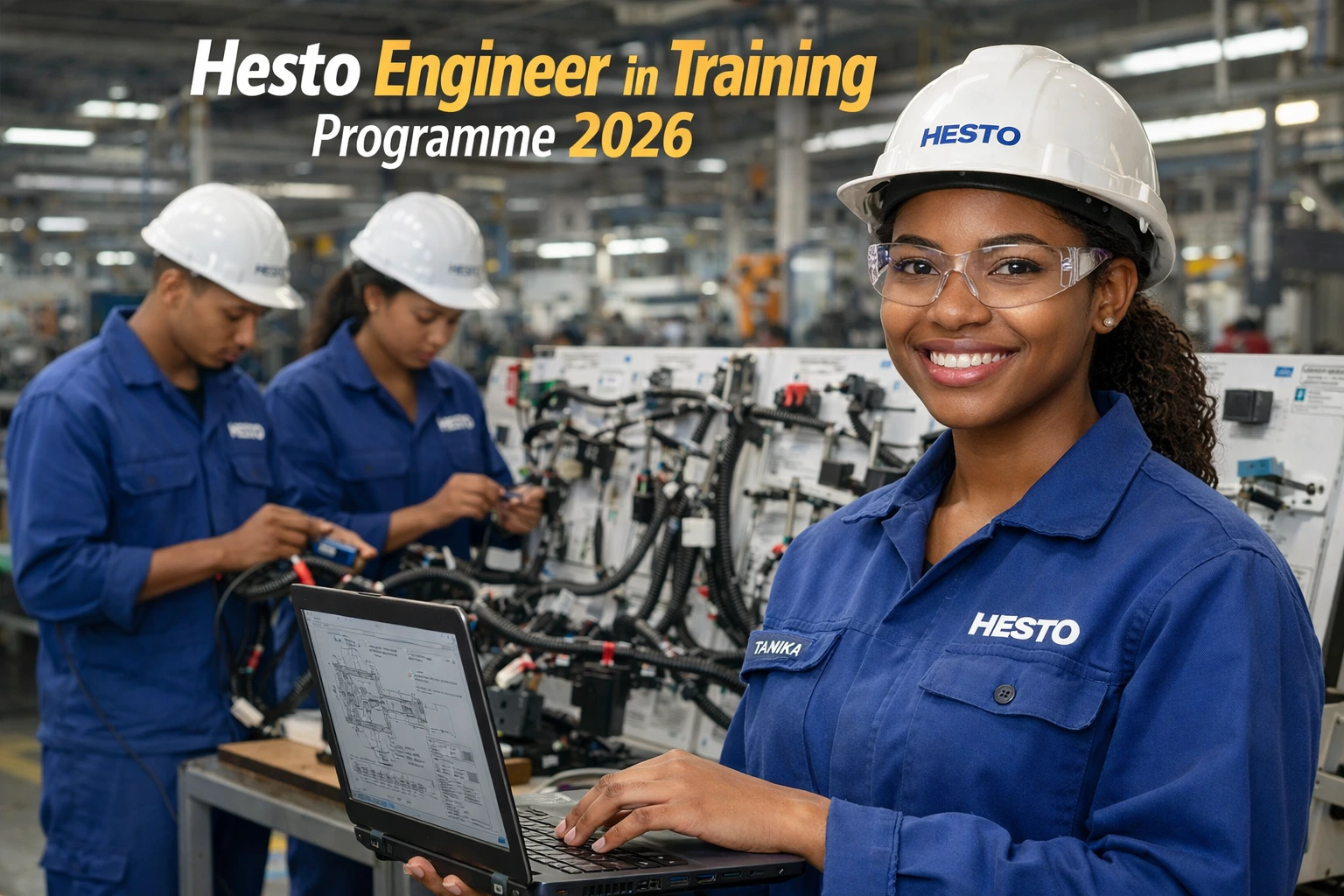
Hesto Engineer in Training Programme 2026: For Industrial Engineering graduates who want real exposure to manufacturing, the Engineer in Training Programme at Hesto Harnesses is one of the more practical entry points into the automotive sector.
This two-year programme places graduates inside a working factory environment in Stanger, where they can learn how engineering theory translates into real production systems.
Below is a clear breakdown of what applicants should realistically expect before applying.
What is this program?
This programme is a 24-month graduate training opportunity designed for Industrial Engineering graduates who have not yet entered the job market.
Instead of classroom learning, participants are placed inside operational departments at Hesto’s manufacturing facility. The goal is to help new engineers understand how automotive components are produced at scale.
Over two years, trainees learn how engineering teams:
- design efficient production processes
- analyse workflow bottlenecks
- improve factory productivity
- maintain quality standards for automotive clients
Think of it as a structured transition from university to industry, with supervision from experienced engineers.
What you’ll actually do (real-world examples)
While the job description sounds broad, the daily work usually includes tasks such as:
Factory process analysis
You may study how a wiring harness moves through production — identifying where delays happen and suggesting improvements.
Data tracking and reporting
Many Industrial Engineering roles involve analysing production numbers. For example, tracking how many units are produced per shift and investigating inefficiencies.
Continuous improvement projects
You could work on Lean or Six Sigma-type initiatives — like reducing wasted movement on the assembly line or improving workstation layout.
Supporting engineering teams
Trainees often assist engineers with documentation, project coordination, and performance monitoring.
Regular performance reviews
Because this is a training programme, progress assessments usually happen several times during the two years.
In short: you’ll be learning how factories actually run.
Who qualifies (minimum requirements checklist)
Applicants must meet all of the following:
- South African citizen
- Age 18 or older
- BEng or BSc in Industrial Engineering
- Minimum 60% academic average
- No previous internship or graduate programme experience
- No criminal record
- Fluent in English
- Official academic transcript or statement of results
- No outstanding university tuition fees
Location requirement:
- Must be willing to relocate or commute to Stanger
Why applicants get disqualified
Several requirements in this programme are strictly enforced.
Common disqualification reasons include:
Wrong engineering discipline
Mechanical, electrical, or chemical engineering degrees usually won’t qualify.
Average below 60%
Even 59% can lead to automatic rejection.
Previous internships
This programme targets first-time graduates only.
Outstanding university fees
Some companies require proof that your qualification has been fully released.
Missing academic documents
Applications without transcripts or official results are often filtered out.
Applying after the closing date
The deadline listed is 27 March 2026.
Who should apply (expert insight)
This programme suits graduates who want to build a career in manufacturing or operations engineering.
Strong candidates often have:
- interest in factory systems and process optimisation
- experience with engineering projects during university
- familiarity with Excel, data analysis, or production modelling
- willingness to work in industrial environments
If your long-term goal is areas like:
- operations management
- production engineering
- supply chain optimisation
- automotive manufacturing
…this type of programme can be a valuable first step.
However, if you prefer design engineering, robotics, or research roles, this may not align perfectly.
Competition level
Competition level: Medium–High
Reasons:
- Industrial Engineering graduates apply in large numbers
- Automotive sector programmes are popular
- The programme only targets one engineering discipline
However, competition may be slightly lower than large national graduate schemes because:
- the role is location-specific (Stanger)
- the discipline requirement is very narrow
Tips to improve selection chances
1. Highlight practical university projects
Manufacturing simulations, operations research projects, or production optimisation assignments should appear clearly on your CV.
2. Show interest in manufacturing
Mention coursework related to:
- production systems
- logistics engineering
- operations management
3. Quantify achievements
Example:
Instead of writing:
Completed industrial engineering project
Write:
Led production line simulation project that reduced cycle time by 18% in modelling scenario.
4. Keep your CV technical but simple
Graduate engineers often over-design CVs. Focus on clarity.
5. Prepare to relocate
Showing willingness to work in KwaZulu-Natal can help.
Common mistakes applicants make
These mistakes appear frequently with graduate programmes:
Applying with the wrong qualification
Mechanical Engineering applicants often try anyway.
Ignoring the “no internship” rule
Even short formal internships may disqualify candidates.
Uploading incomplete documents
Missing transcripts or certification stamps are common issues.
Overly generic CVs
Many graduates submit identical CVs for all programmes.
Poor document formatting
Unreadable PDFs or poorly scanned documents can hurt applications.
Application strategy (verification-first approach)
A careful approach helps avoid rejection.
Step 1 – Confirm eligibility
Before applying, verify:
- your average is above 60%
- you studied Industrial Engineering
- you have no internship experience
Step 2 – Prepare documents
Have all files ready in clear PDF format.
Step 3 – Check the reference number
The advertised reference number is:
hesto_000371
Step 4 – Apply through the official careers portal
Submit your application via the official website of
Hesto Harnesses.
APPLY HERE: Hesto Engineer in Training Programme 2026
Avoid third-party application sites.
Step 5 – Double-check your information
Verify:
- email address
- phone number
- uploaded documents
Step 6 – Submit before the deadline
Closing date listed:
27 March 2026
ALSO APPLY FOR: Moses Kotane Learnership 2026
ALSO APPLY FOR: TotalEnergies Internship Programme 2026
Documents checklist
Prepare the following:
Required documents (stated)
- Updated CV
- Certified copy of South African ID
- Academic transcript / Statement of Results
- Certified copy of degree certificate
Possible additional documents (assumption based on typical graduate programmes)
- Proof of residence
- Motivation letter
- Academic project portfolio
Label files clearly, for example:
Surname_Name_CV.pdf
Surname_ID.pdf
Surname_Transcript.pdf
Safety & Scam Check (mandatory)
When applying for graduate programmes, always follow these safety practices:
- Never pay fees for internships, learnerships, or graduate programmes
- Always verify the official company website domain
- Confirm the reference number (hesto_000371) where possible
- Be cautious of WhatsApp-only job applications
- Apply via official careers portals whenever available
Legitimate employers such as
Hesto Harnesses do not charge application fees.
Frequently Asked Questions (FAQ)
1. Is this a learnership or internship?
It is a graduate training programme under a fixed-term contract.
2. What engineering qualification is required?
Only Industrial Engineering degrees qualify.
3. Can Mechanical Engineering graduates apply?
No. The programme specifically requires Industrial Engineering.
4. Is prior internship experience allowed?
No. The programme targets graduates without prior internship or graduate programme experience.
5. What academic average is required?
At least 60% overall average.
6. Is the programme paid?
Remuneration is listed as market related. Exact details are usually shared with shortlisted candidates.
7. Do I need to relocate?
Yes, you must be able to work in Stanger, KwaZulu-Natal.
8. When is the closing date?
Applications close 27 March 2026.
9. Will everyone receive feedback?
Typically only shortlisted candidates are contacted.
10. Can final-year students apply?
Usually only graduates with official results available are considered.
Final assessment
The Hesto Engineer in Training Programme offers a practical entry point into automotive manufacturing for Industrial Engineering graduates.
Strengths of the programme:
- long 24-month training period
- exposure to real factory operations
- potential pathway into the automotive sector
Limitations to consider:
- location may require relocation
- strict eligibility rules reduce flexibility
- stipend details are not publicly listed
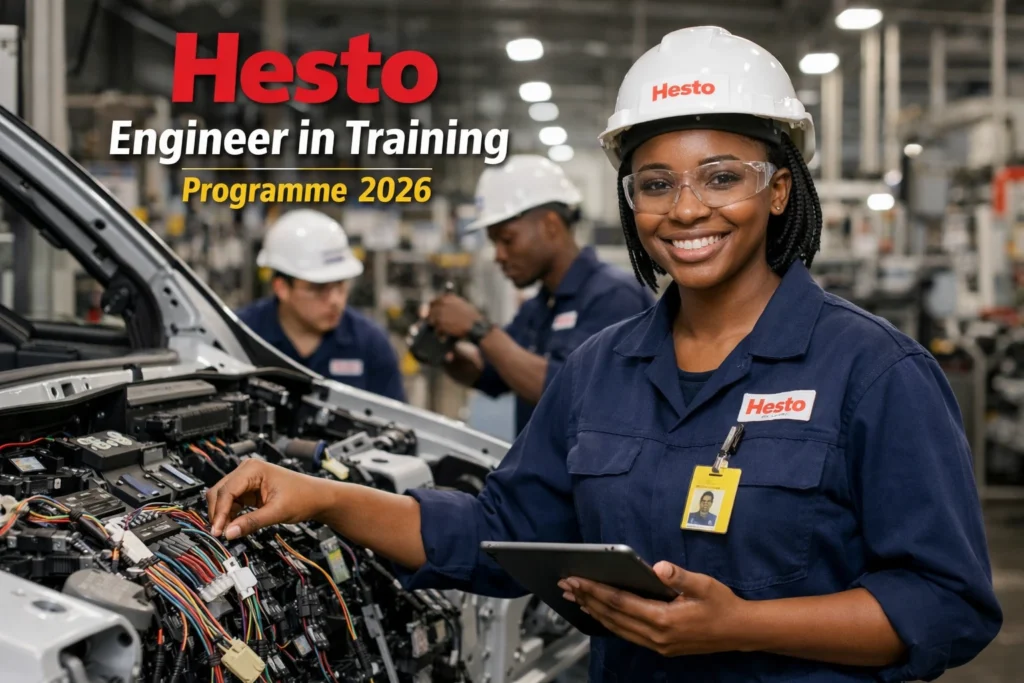
For graduates interested in operations engineering, production optimisation, or manufacturing systems, this programme can provide valuable early-career experience.
APPLY HERE: Hesto Engineer in Training Programme 2026
Applications close 27 March 2026.