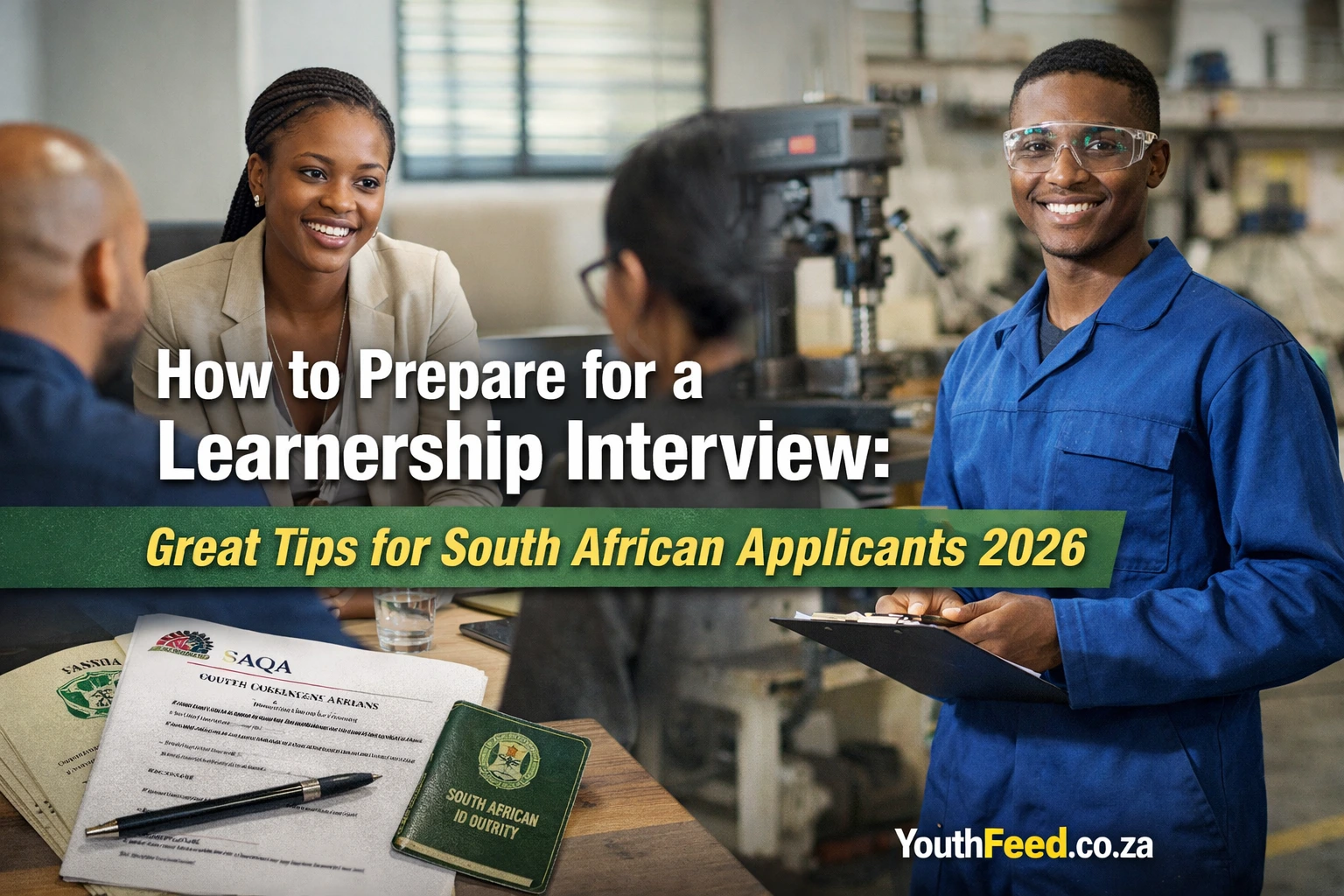
Learnership programmes remain one of the most accessible pathways for young South Africans to gain work experience while completing structured training. However, many applicants focus only on submitting the application and overlook one crucial stage: the interview.
Understanding how to prepare for a learnership interview can significantly improve your chances of selection. Learnership interviews are designed to assess more than academic results. Employers want to see motivation, reliability, communication skills, and whether you are likely to complete the programme successfully.
In this guide, you’ll find practical advice tailored to the South African context, including what employers typically look for, how interviews are structured, and realistic strategies to help you stand out among hundreds (sometimes thousands) of applicants.
What This Programme Is
A learnership is a structured training programme that combines:
- Classroom-based learning
- Practical workplace experience
These programmes are usually aligned with a qualification registered with the South African Qualifications Authority (SAQA) and regulated through various Sector Education and Training Authorities (SETAs).
While the exact format varies by industry, most learnership recruitment processes include:
- Application submission
- Shortlisting
- Interviews or assessments
- Final selection and onboarding
The interview stage helps employers determine whether applicants are genuinely committed and capable of completing both the training and workplace components.
What You’ll Actually Do During the Interview
Learnership interviews are often less formal than corporate job interviews, but they still follow a structured evaluation process. Depending on the organisation, the process may include:
Basic interview questions
Recruiters may ask questions such as:
- Why do you want this learnership?
- What do you know about our company?
- What are your career goals?
These questions help them evaluate motivation and awareness.
Scenario-based questions
Applicants may be asked how they would handle workplace situations, for example:
- Dealing with difficult customers
- Managing time between study and work
- Handling feedback from supervisors
Communication assessment
Interviewers observe:
- Confidence when speaking
- Clarity of answers
- Professional behaviour
This helps determine whether candidates can work effectively in a real workplace environment.
Document verification
You may also be asked to bring supporting documents such as:
- ID copy
- Matric certificate
- CV
Some organisations verify these during the interview stage.
Who Qualifies
Minimum requirements vary widely depending on the employer and industry. However, most learnerships in South Africa commonly require:
- South African citizenship
- A valid South African ID
- Matric certificate or equivalent qualification
- Basic English communication skills
- Availability to complete the programme duration
If the official advert lists additional requirements, those must be followed strictly.
Always check the official listing on the employer’s website or recognised recruitment platforms.
Why Applicants Get Disqualified
Many candidates lose opportunities not because they lack ability, but because of avoidable mistakes.
Common disqualification reasons include:
Poor punctuality
Arriving late to an interview is often seen as a sign of poor work discipline.
Lack of preparation
Some applicants attend interviews without knowing anything about the company or the programme.
Incomplete documentation
Missing documents during the interview stage may cause immediate disqualification.
Inappropriate behaviour
Examples include:
- Interrupting interviewers
- Using slang excessively
- Appearing uninterested or distracted
Dishonest information
Providing incorrect details about qualifications or work experience can lead to rejection.
Employers often verify information before final selection.
Who Should Apply
Learnership interviews are particularly suitable for applicants who:
- Recently completed matric
- Are unemployed but motivated to gain workplace experience
- Want to enter industries such as retail, finance, IT, logistics, or engineering
- Are willing to combine studying with practical work
Applicants who demonstrate commitment and reliability often perform well in learnership selection processes.
Employers frequently prioritise candidates who show clear interest in learning rather than those who simply apply to many opportunities without preparation.
READ MORE ABOUT Learnership vs Internship vs Apprenticeship 2026
Competition Level
Competition level: High
Learnership programmes attract a large number of applicants across South Africa. Several factors contribute to this:
- High youth unemployment
- Limited entry-level work opportunities
- Learnerships offering recognised qualifications
Large companies can receive hundreds or even thousands of applications for a single intake.
Because of this, interview performance often becomes the deciding factor between candidates with similar qualifications.
Tips to Improve Your Selection Chances
Preparing carefully for a learnership interview can significantly improve your chances.
Research the company
Visit the employer’s official website and learn:
- What industry they operate in
- Their services or products
- Their values or mission
Even basic knowledge shows genuine interest.
Practice answering common questions
Practising your answers helps you speak clearly and confidently during the interview.
Try rehearsing with:
- Friends
- Family
- A mirror
Prepare examples from your life
Interviewers often ask about teamwork or responsibility. You can draw examples from:
- School projects
- Volunteering
- Community activities
Dress professionally
You do not need expensive clothing, but aim for:
- Clean, neat attire
- Closed shoes if possible
- Simple, professional appearance
First impressions matter.
Bring organised documents
Use a simple folder containing:
- Printed CV
- Certified copies of qualifications
- ID copy
Being organized shows professionalism.
APPLY HERE FOR THE Thales Customer Services Intern – Banking & Payments 2026
Common Mistakes Applicants Make
Several mistakes frequently reduce applicants’ chances during learnership interviews.
Speaking too little
Some candidates answer questions with one or two words. Interviewers need to understand your thinking and motivation.
Speaking too much
Long, unfocused answers can also be problematic. Keep answers clear and relevant.
Not asking questions
At the end of the interview, employers often ask if you have questions. Asking thoughtful questions shows interest.
For example:
- What skills will learners develop during the programme?
- How is progress evaluated?
Ignoring instructions
If the interview invitation includes instructions (such as documents or arrival time), follow them carefully.
Application Strategy
A structured approach can help applicants navigate the process effectively.
Step 1: Confirm the official advert
Ensure the opportunity comes from a legitimate source such as:
- The employer’s official website
- Verified recruitment platforms
- Government employment portals
Step 2: Prepare documents early
Gather and certify documents before the interview date.
Certification is typically available at:
- Police stations
- Post offices
- Commissioners of Oaths
Step 3: Prepare interview answers
Focus on three key questions:
- Why you want the learnership
- What you hope to learn
- How the opportunity fits your career plans
Step 4: Plan transport
If the interview is in person, confirm:
- Travel time
- Transport options
- Arrival location
Plan to arrive at least 15–20 minutes early.
Step 5: Follow up professionally
If the employer provides a contact channel, you may politely follow up regarding the application outcome.
Documents Checklist
If the official advert does not specify documents, applicants should still prepare commonly required items.
Typical learnership interview documents include:
- Updated CV
- Certified copy of South African ID
- Certified copy of Matric certificate
- Copies of additional qualifications (if applicable)
- Proof of residence (sometimes requested)
Note: If the advert does not list document requirements, confirm them through the employer’s official communication channels.
Safety & Scam Check
Unfortunately, fraudulent recruitment scams sometimes target job seekers. Protect yourself by following these guidelines:
- Never pay application or placement fees for funded learnerships or internships.
- Verify the employer’s official website domain.
- Confirm the reference number if one is listed in the advert.
- Avoid WhatsApp-only applications without official email or career portals.
- Apply through official company careers pages whenever possible.
If something seems suspicious, verify it directly with the organization before submitting personal information.
READ MORE ABOUT: How Employers Benefit From Learnership Programmes in South Africa 2026
FAQs About How to Prepare for a Learnership Interview
1. What questions are usually asked in a learnership interview?
Most interviews focus on motivation, communication skills, and willingness to learn.
2. Do learnership interviews require work experience?
Usually not. Many programmes target first-time job seekers.
3. How long does a learnership interview take?
Most interviews last between 10 and 30 minutes, depending on the organisation.
4. Can I attend a learnership interview without matric?
It depends on the programme requirements. Some entry-level learnerships may accept lower qualifications.
5. What should I wear to a learnership interview?
Neat, simple professional clothing is recommended.
6. Do learnership interviews include tests?
Some organisations include basic assessments such as numeracy or literacy tests.
7. How long does it take to receive feedback?
Response times vary widely and are not stated in the official advert unless specified.
8. Can I apply for multiple learnerships?
Yes. Many applicants apply to multiple programmes while continuing their job search.
9. Are learnership interviews conducted online?
Some employers conduct virtual interviews, especially for large recruitment drives.
10. What happens after the interview?
Successful candidates usually receive further instructions regarding medical checks, contracts, or onboarding.
Final Assessment
Preparing properly for a learnership interview can significantly increase your chances of success. While competition is often high, many candidates fail to stand out simply because they underestimate the interview stage.
Applicants who demonstrate preparation, professionalism, and genuine motivation to learn tend to perform better during selection.
By researching the employer, organising documents, practising interview responses, and following application instructions carefully, candidates can approach learnership interviews with greater confidence.
Ultimately, the goal of the interview is not to find perfect candidates, but to identify individuals who are ready to learn, grow, and contribute in a workplace environment.