The Standard Bank CIB Finance Graduate Programme is quickly becoming one of the most talked-about graduate opportunities among South African students preparing for the 2026 recruitment cycle. And the growing attention around the programme says as much about the future of banking as it does about the job market itself.
At a time when finance graduates are competing in a tighter, more technology-driven economy, graduate programmes linked to major institutions are carrying new weight. Students are no longer just looking for employment. They are looking for exposure, long-term relevance, and a chance to enter industries that are actively transforming.
That is exactly where the Standard Bank Corporate and Investment Banking (CIB) Finance Graduate Programme enters the conversation.
Unlike traditional finance pathways that often focus narrowly on accounting or reporting, this programme positions finance as a strategic engine inside modern banking. The language around the programme is notably future-focused: data science, innovation, collaboration, financial markets, problem-solving, and adaptability all feature prominently.
For many graduates, that signals something important. Finance careers are evolving beyond spreadsheets and balance sheets into roles tied closely to analytics, risk management, digital transformation, and strategic decision-making.
And in South Africa’s uncertain youth employment environment, opportunities attached to major financial institutions naturally attract widespread interest.
Why the Standard Bank CIB Finance Graduate Programme Is Standing Out
One reason the programme is attracting attention is because it breaks away from the rigid expectations often associated with banking recruitment.
Standard Bank states that it welcomes graduates from diverse academic backgrounds, excluding auditing specifically. That subtle detail matters more than it may first appear.
For years, many finance-related graduate programmes in South Africa leaned heavily toward accounting, actuarial science, or commerce graduates only. But modern banking institutions increasingly need multidisciplinary talent — people who understand technology, markets, communication, behavioural trends, and data-driven decision-making.
The programme’s emphasis on “mindset” rather than only degree titles reflects a broader shift happening globally in finance recruitment.
Banks are under pressure to modernise rapidly. Digital banking competition is increasing. Artificial intelligence is reshaping operations. Regulatory environments continue evolving. At the same time, clients expect faster, smarter, and more personalised financial solutions.
That means employers are now searching for graduates who can adapt quickly, solve complex problems, and work across multiple teams.
The Standard Bank CIB Finance Graduate Programme appears designed around that reality.
A Closer Look at What the Programme Offers
According to the programme description, graduates can expect exposure to the “inner workings” of a major financial institution from the start.
That phrase is significant because graduate applicants increasingly want practical experience rather than purely administrative trainee roles.
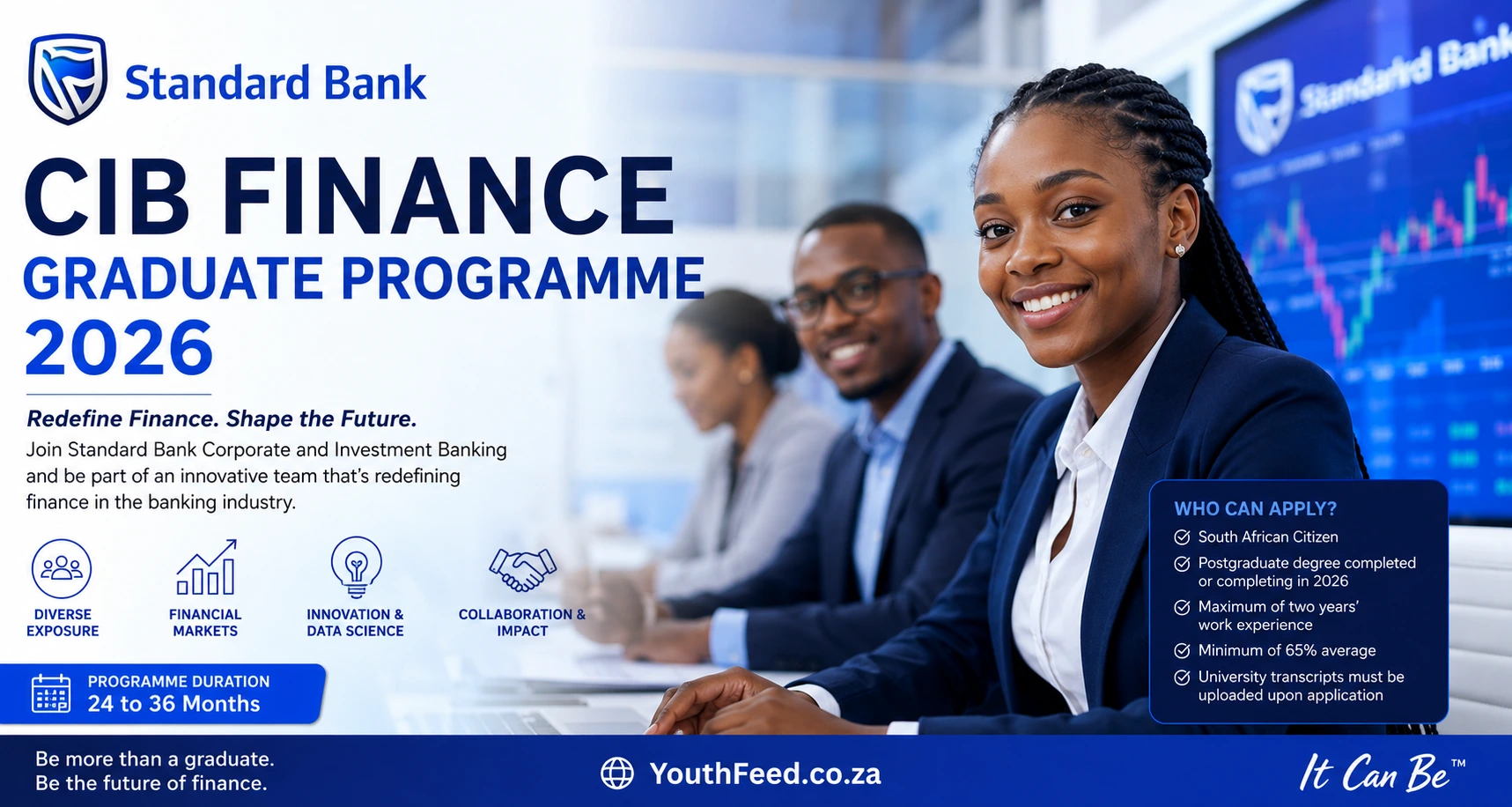
The programme runs between 24 and 36 months, giving participants relatively extended exposure compared to shorter internship models. During that time, graduates are expected to contribute meaningfully while developing technical and strategic skills.
Some of the programme’s core themes include:
- Financial resource management
- Risk and control implementation
- Business advisory exposure
- Financial markets understanding
- Innovation and data science integration
- Collaborative problem-solving
This positions the programme closer to a modern strategic finance pipeline rather than a conventional graduate rotation alone.
The minimum eligibility requirements include:
- South African citizenship
- A completed or completing postgraduate degree in 2026
- Maximum two years of work experience
- Minimum 65% academic average
- Uploaded university transcripts during application
Interestingly, Standard Bank also highlights resilience, curiosity, collaboration, and self-confidence among the key traits they are seeking.
That focus reflects a wider recruitment trend where soft skills are increasingly evaluated alongside technical qualifications.
Also apply for Sage Intern: Customer Support 2026
The Bigger Picture Behind the Graduate Recruitment Push
The rising interest in programmes like this cannot be separated from the broader South African graduate employment climate.
Youth unemployment remains one of the country’s most pressing challenges, even for degree holders. At the same time, industries such as banking and technology are becoming more selective and specialised.
That combination creates intense competition for structured graduate opportunities tied to major employers.
But there is another layer to the story.
Financial institutions themselves are facing pressure to future-proof their talent pipelines. The banking sector is changing faster than many traditional corporate systems can comfortably handle.
Digital disruption has altered customer expectations dramatically. Cybersecurity threats continue increasing. Data analytics now influence everything from lending decisions to fraud detection and customer engagement.
As a result, graduate programmes are no longer simply recruitment exercises. They are strategic investments.
Large organisations want graduates who can eventually help shape the future direction of the institution — especially within high-impact divisions like Corporate and Investment Banking.
Public Reaction: Why Students Are Paying Attention
Online discussions around graduate opportunities often reveal what students are really prioritising.
In recent years, there has been growing frustration among graduates about entry-level jobs requiring experience they do not yet have. Structured programmes backed by major institutions therefore carry strong appeal because they promise mentorship, exposure, and skill development simultaneously.
The Standard Bank CIB Finance Graduate Programme also benefits from the reputation associated with one of Africa’s largest banking groups. Brand recognition still matters heavily in graduate recruitment.
For many students, a programme attached to a major financial institution represents:
- Career credibility
- Professional network access
- Better long-term mobility
- Exposure to high-level projects
- Potential international relevance
There is also growing public interest in programmes that appear more inclusive academically.
The fact that diverse postgraduate degrees are being considered may encourage applications from students who previously assumed they would not qualify for finance-related opportunities.
That could widen the applicant pool significantly in 2026.
Why This Matters Right Now
The timing of the Standard Bank CIB Finance Graduate Programme matters because it intersects with several major shifts happening simultaneously.
First, graduate recruitment itself is changing.
Companies are increasingly prioritising adaptability over narrow specialisation. The rise of AI, automation, and data analytics means technical knowledge alone is no longer enough. Employers want graduates who can learn continuously and work across disciplines.
Second, banking is undergoing structural transformation.
Corporate and investment banking divisions are no longer operating as isolated finance units. They are becoming deeply integrated with technology, data science, sustainability strategy, and digital infrastructure.
Graduates entering the industry now may experience a completely different banking environment within five years.
Third, South African graduates are becoming more selective about opportunities.
Many students now evaluate programmes based not only on salary potential, but also on:
- Skills development
- Long-term relevance
- Internal mobility
- Work culture
- Exposure to innovation
The Standard Bank CIB Finance Graduate Programme appears carefully positioned around those priorities.
Finally, the programme reflects a broader reality about the future workforce: employers increasingly value curiosity, resilience, and collaborative thinking as much as academic performance.
That signals an important cultural shift in corporate hiring.
Read more about How NSFAS Funding Works: A Practical Guide for South African Students
The Finance Industry’s Growing Identity Shift
One of the more interesting aspects of the programme description is how it reframes finance itself.
Traditionally, finance departments were often viewed as compliance-driven support functions focused heavily on controls, reporting, and budgeting.
But modern finance teams inside large organisations are becoming strategic intelligence centres.
Today’s finance professionals are expected to interpret complex market conditions, advise leadership teams, support investment decisions, analyse operational performance, and contribute to innovation strategy.
That transformation explains why programmes like this increasingly mention data science and problem-solving alongside financial expertise.
The finance graduate of 2026 may need to understand automation tools, predictive analytics, digital banking systems, and behavioural market trends — not just accounting frameworks.
For graduates preparing to enter the sector, that evolution creates both opportunity and pressure.
Competition Is Likely to Be Intense
Given the programme’s structure and visibility, competition is expected to be high.
Large graduate programmes attached to reputable employers often attract thousands of applicants across South Africa.
The minimum 65% academic average requirement may filter some candidates, but competition usually extends far beyond academic marks alone.
Applicants will likely need to demonstrate:
- Strong communication skills
- Commercial awareness
- Leadership potential
- Problem-solving ability
- Adaptability
- Understanding of financial trends
The inclusion of online filtering and skills assessments also reflects how recruitment processes are becoming increasingly data-driven.
Graduate recruitment today often combines:
- Psychometric testing
- Behavioural analysis
- Video interviews
- Scenario-based assessments
- Cognitive evaluations
That means preparation now extends beyond CV writing.
What Could Happen Next
Several outcomes could emerge as programmes like the Standard Bank CIB Finance Graduate Programme continue attracting attention.
One possibility is that more financial institutions will broaden eligibility requirements to attract multidisciplinary talent. As banking evolves, employers may increasingly recruit candidates from economics, engineering, mathematics, computer science, psychology, and even non-traditional fields.
Another likely trend is deeper integration between finance and technology training.
Future graduate programmes may place even greater emphasis on:
- Artificial intelligence
- Data analytics
- Financial technology systems
- Digital risk management
- Automation strategy
There is also a strong chance that graduate programmes become more globally competitive.
South African banks increasingly operate across African markets and international financial systems. Graduates entering these programmes may eventually work on cross-border projects or multinational initiatives.
At the same time, competition for opportunities may intensify further as economic uncertainty continues affecting youth employment levels.
That could place greater pressure on students to build stronger portfolios, leadership experience, and technical skills before graduation.
Also Apply for Motorola Solutions Project Management Intern 2026
What Applicants Should Realistically Expect
While programmes like this generate excitement, applicants should also approach them realistically.
Corporate and investment banking environments are known for being fast-paced and performance-oriented. Graduates entering these spaces often face steep learning curves, demanding deadlines, and high expectations.
But those same environments can also accelerate professional growth significantly.
The programme’s emphasis on resilience and adaptability likely reflects the realities of working inside complex financial institutions.
For graduates genuinely interested in finance, markets, strategy, and problem-solving, the exposure could be extremely valuable.
However, applicants mainly chasing prestige without genuine interest in the work itself may struggle with the demands of the programme environment.
Final Thoughts
The growing attention surrounding the Standard Bank CIB Finance Graduate Programme reveals more than simple graduate recruitment interest.
It reflects a wider shift in how finance careers are evolving, how banks are adapting, and how young professionals are thinking about the future of work.
In many ways, the programme represents the direction modern banking is moving toward: interdisciplinary, technology-aware, strategically focused, and increasingly innovation-driven.
For South African graduates navigating a competitive and rapidly changing economy, opportunities like this naturally stand out.
But perhaps the bigger story is this: finance itself is changing identity. And graduate programmes are becoming one of the clearest indicators of where the industry is headed next.
APPLY HERE: Standard Bank CIB Finance Graduate Programme 2026
FAQ: Standard Bank CIB Finance Graduate Programme
1. Who can apply for the Standard Bank CIB Finance Graduate Programme?
South African citizens with a completed or completing postgraduate degree in 2026 can apply, provided they meet the programme requirements.
2. What academic average is required?
Applicants need a minimum overall average of 65% across all years of study.
3. Does the programme only accept finance-related degrees?
No. Standard Bank states that diverse degrees are considered, except auditing qualifications.
4. How long does the programme last?
The programme duration ranges between 24 and 36 months.
5. What skills does Standard Bank look for?
The programme highlights collaboration, resilience, curiosity, creative problem-solving, communication skills, and willingness to learn.