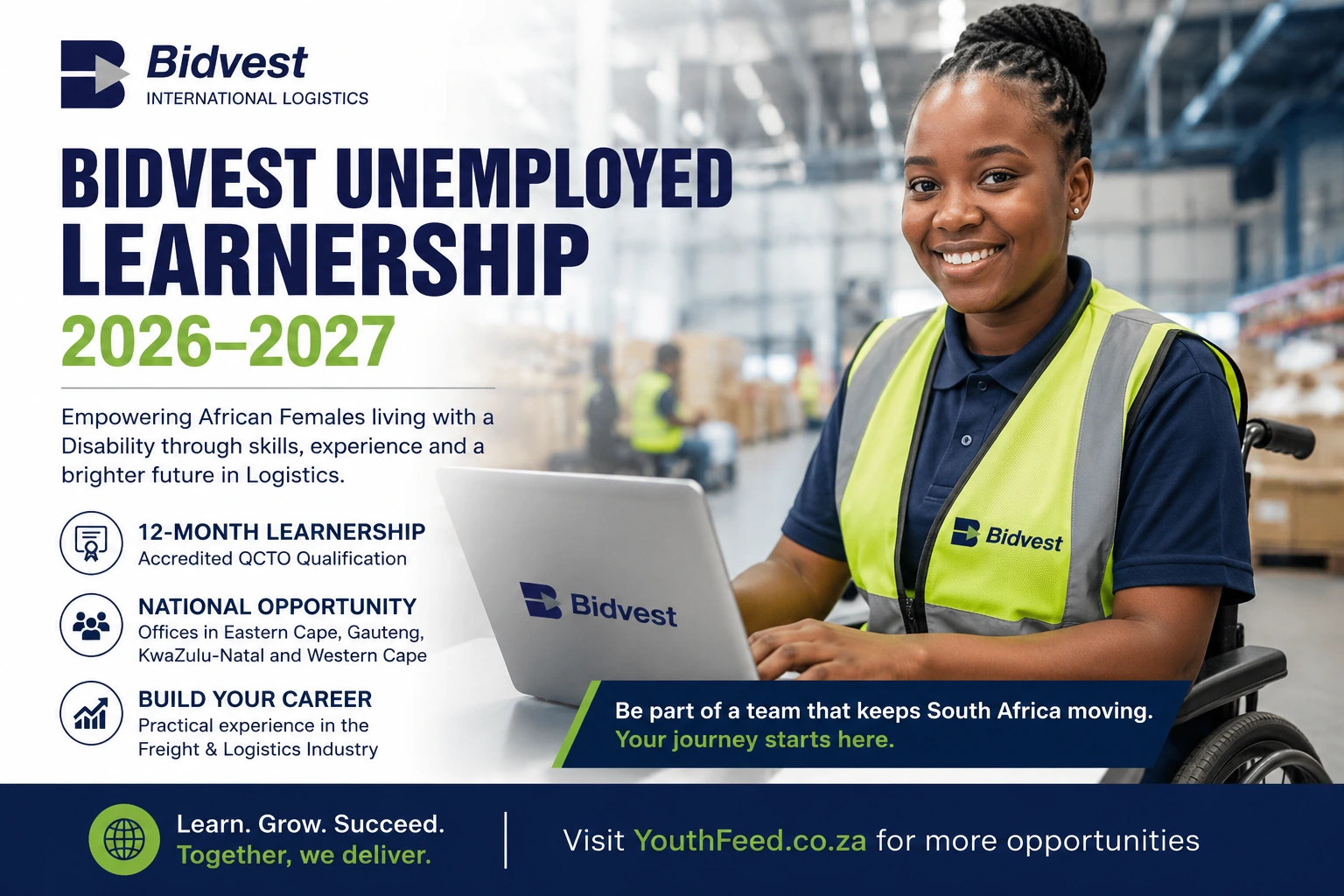
For thousands of unemployed young South Africans, the phrase “entry-level opportunity” has started to feel almost meaningless. Too many vacancies demand experience that applicants simply do not have, while many internships remain concentrated in a few industries or major urban centres. That is part of the reason the Bidvest Unemployed Learnership for 2026–2027 is suddenly attracting widespread interest online.
The programme arrives at a moment when logistics, freight, warehousing, and supply chain careers are becoming increasingly important in South Africa’s economy. At the same time, youth unemployment remains one of the country’s most urgent social and economic challenges. Against that backdrop, opportunities that combine structured training, workplace exposure, and an accredited qualification are standing out far more than they did a few years ago.
What makes this specific learnership especially notable is its targeted focus. Bidvest International Logistics has opened the programme specifically for African females living with disabilities a demographic that often faces multiple barriers to entering the formal economy. In an environment where conversations about inclusion are growing louder in both public and corporate spaces, the programme has become more than just another recruitment post. It is now part of a broader discussion about accessibility, representation, and practical skills development in South Africa.
And with the closing date set for 22 May 2026, interest has accelerated rapidly among job seekers looking for credible opportunities with recognised companies.
A Closer Look at the Bidvest Unemployed Learnership
The Bidvest Unemployed Learnership is being offered through the Human Capital division of Bidvest International Logistics (BIL), one of South Africa’s established logistics and freight companies.
The programme is a 12-month learnership that combines theory and practical workplace training. Learners will complete modules through the BIL eLearning platform while also gaining exposure across three divisions within the organisation.
Importantly, the qualification is registered through the QCTO (Quality Council for Trades and Occupations), which adds legitimacy and formal recognition to the experience gained during the programme.
The learnership is available nationally, with opportunities linked to BIL offices in:
- Eastern Cape
- Gauteng
- KwaZulu-Natal
- Western Cape
For many applicants, the national availability matters almost as much as the qualification itself. Youth-focused programmes are often criticised for being overly concentrated in a handful of cities, especially Johannesburg and Cape Town. A wider provincial footprint changes the accessibility conversation significantly.
Why Learnerships Are Suddenly More Valuable in 2026
Over the past few years, South Africa’s employment landscape has shifted in ways that have made learnerships more attractive than traditional entry-level job searches.
Employers increasingly want candidates who already understand workplace systems, digital communication tools, and industry operations. Even junior positions now often expect practical exposure. That has created a difficult cycle for unemployed youth: companies want experience, but many young people cannot gain experience without first being hired.
This is where programmes like the Bidvest Unemployed Learnership become relevant.
Unlike ordinary short courses, learnerships create a structured bridge between education and employment. Participants are not only studying theory. They are also entering a corporate environment, learning professional behaviour, adapting to workplace culture, and developing industry-specific skills.
In sectors like logistics, supply chain management, freight forwarding, and transport coordination, that practical exposure matters enormously.
South Africa’s logistics industry has also gained renewed attention following ongoing discussions around port efficiency, trade movement, infrastructure challenges, and regional commerce across Southern Africa. Companies within the sector are increasingly investing in talent pipelines because logistics skills are becoming more strategic to economic growth.
That broader industry context partly explains why this learnership is resonating beyond the usual audience for graduate programmes.
Read more about Complete Guide to Learnerships in South Africa (2026–2027)
The Focus on Women Living With Disabilities Is Significant
One of the most discussed aspects of the programme is its focus on African females living with disabilities.
Corporate South Africa has spoken extensively about diversity and inclusion over the past decade, but critics often argue that meaningful opportunities remain limited for people with disabilities — particularly young women entering the workforce for the first time.
The Bidvest programme directly addresses that gap.
While the learnership still includes standard eligibility requirements such as:
- South African citizenship
- Ages between 18 and 35
- Grade 12 or equivalent
- Full-time availability for 12 months
…the targeted recruitment approach has sparked broader conversations online about economic participation and workplace accessibility.
For some observers, the programme reflects a growing recognition that inclusion cannot exist only in corporate reports or policy documents. It must also appear in hiring pipelines and skills development initiatives.
Others point out that disability-focused programmes can help challenge long-standing assumptions about who belongs in industries traditionally perceived as highly operational or physically demanding.
Logistics, after all, is no longer limited to warehouse labour or transport coordination. Modern freight and logistics operations rely heavily on administration, digital systems, customer support, planning, compliance management, and data-driven processes.
That evolution is opening doors to a much wider range of participants.
What Applicants Need to Know
The learnership requires candidates to demonstrate more than academic eligibility. Bidvest International Logistics also highlights behavioural and professional expectations.
Applicants are expected to be:
- Self-reliant
- Committed and determined
- Accountable in managing studies and stipend responsibilities
- Professional in communication and workplace conduct
- Computer literate
These requirements may seem straightforward, but they reflect a larger trend in employer expectations. Many companies now place heavy emphasis on adaptability, professionalism, and self-management — especially in learnership and graduate environments.
The programme also includes portfolio-based assessments, meaning participants must complete and submit evidence of learning throughout the qualification process.
That structure suggests the programme is designed to produce genuinely workplace-ready candidates rather than simply offering temporary placement.
Public Reaction Has Been Strong And Revealing
Online responses to the Bidvest Unemployed Learnership reveal a mix of optimism, urgency, and frustration.
On one hand, many young South Africans see programmes like this as increasingly rare opportunities attached to respected corporate names. In a difficult labour market, accredited learnerships with national reach naturally attract attention.
On the other hand, public reactions also expose deeper anxieties about employment access.
Under social media posts discussing the programme, recurring themes continue to emerge:
- Concerns about the competitiveness of applications
- Questions about whether rural applicants have equal chances
- Frustration over limited opportunities for unemployed graduates
- Hope that learnerships can lead to permanent employment
There is also growing awareness among applicants about recruitment scams. That makes Bidvest’s warning especially important.
The company clearly states that it does not use WhatsApp or Telegram for recruitment and will never request payment or personal financial information during hiring processes.
That warning reflects a troubling reality in South Africa’s job market. Fake recruitment schemes targeting desperate job seekers have become increasingly common, particularly around learnerships and internships.
As a result, applicants are becoming more cautious about verifying legitimate opportunities.
Why This Matters Right Now
The timing of the Bidvest Unemployed Learnership matters for several reasons.
First, youth unemployment remains critically high, particularly among women and people living with disabilities. Opportunities that combine accredited training with workplace exposure are therefore carrying greater social and economic importance than ever before.
Second, South Africa’s logistics industry is undergoing gradual transformation driven by technology, eCommerce growth, infrastructure investment discussions, and changing supply chain demands. Skills shortages in operational and administrative logistics functions continue to create demand for structured training pathways.
Third, the national nature of the programme aligns with growing calls for broader geographic inclusion. Employment initiatives limited to a few economic hubs often exclude talented candidates from other provinces.
But perhaps most importantly, the programme reflects a larger shift in how companies are approaching workforce development.
Instead of relying only on external recruitment, more organisations are investing in talent cultivation through learnerships, internships, and graduate programmes. That approach not only helps businesses build future skills pipelines but also creates entry points for candidates who might otherwise remain excluded from formal employment systems.
In practical terms, programmes like this can shape long-term career trajectories.
A 12-month learnership may not guarantee permanent employment, but it can significantly strengthen a candidate’s employability profile by adding:
- Workplace experience
- Accredited qualifications
- Professional references
- Corporate exposure
- Industry-specific skills
For many young applicants, those factors can become turning points.
Read more about The Best CV Format for Learnerships 2026
The Freight and Logistics Industry Is Quietly Becoming a Career Hotspot
For years, industries like finance, marketing, and IT dominated career conversations among young professionals. Logistics rarely generated the same excitement.
That is beginning to change.
Global supply chain disruptions over the past few years exposed how essential freight and logistics operations are to economies worldwide. South Africa’s own infrastructure and trade discussions have pushed logistics further into the spotlight.
As a result, more young people are starting to view logistics as a long-term professional pathway rather than simply a support industry.
Modern logistics careers now intersect with:
- Technology
- Data management
- Procurement
- International trade
- Customer service
- Compliance
- Supply chain analytics
This broader evolution makes learnerships within companies like Bidvest more strategically valuable than they may initially appear.
Participants are not just learning isolated operational tasks. They are entering an industry that continues to expand and modernise.
What Could Happen Next
The strongest possibility is that competition for programmes like the Bidvest Unemployed Learnership will continue intensifying over the next few years.
As traditional entry-level hiring becomes more selective, structured workplace training programmes are likely to become even more important for young job seekers.
There is also a realistic chance that other major companies may increase disability-focused recruitment and learnership initiatives in response to both policy pressures and public expectations around inclusion.
Another likely development is the continued digitisation of learnership training. Since BIL already uses an eLearning platform for module completion, future programmes across industries may rely even more heavily on blended learning models combining online and practical training.
For applicants, this means digital literacy will become increasingly important regardless of industry.
The larger question, however, is whether programmes like this can scale meaningfully against South Africa’s unemployment crisis. While learnerships create valuable opportunities, demand still vastly exceeds supply.
That reality explains why each major programme announcement generates such intense interest online.
Final Thoughts
The Bidvest Unemployed Learnership for 2026–2027 is attracting attention for reasons that go far beyond a single recruitment process.
Yes, it offers a recognised qualification. Yes, it provides workplace experience in a growing industry. But it also represents something larger: a reminder that meaningful workforce inclusion requires structured opportunities, not just promises.
For many applicants, the programme could become an important first step into formal employment and long-term career development within the logistics industry.
At a time when economic uncertainty continues shaping the experiences of young South Africans, opportunities that combine skills development, accessibility, and real corporate exposure are naturally standing out.
Whether this learnership becomes a direct pathway to employment for participants remains to be seen. But its visibility already reflects a broader national conversation about opportunity, inclusion, and the changing future of work in South Africa.
APPLY HERE: Bidvest Unemployed Learnership 2026–2027

FAQ: Bidvest Unemployed Learnership 2026–2027
Who can apply for the Bidvest Unemployed Learnership?
The programme is open to African females living with disabilities who are South African citizens between the ages of 18 and 35 with a Grade 12 certificate or equivalent qualification.
How long is the learnership programme?
The learnership runs for 12 months and includes both theoretical and practical workplace training.
Which provinces are included in the programme?
The programme is available nationally, including offices in Gauteng, KwaZulu-Natal, Western Cape, and Eastern Cape.
Does the programme offer an accredited qualification?
Yes. The qualification is registered through the QCTO (Quality Council for Trades and Occupations).
What is the closing date for applications?
Applications close on 22 May 2026.