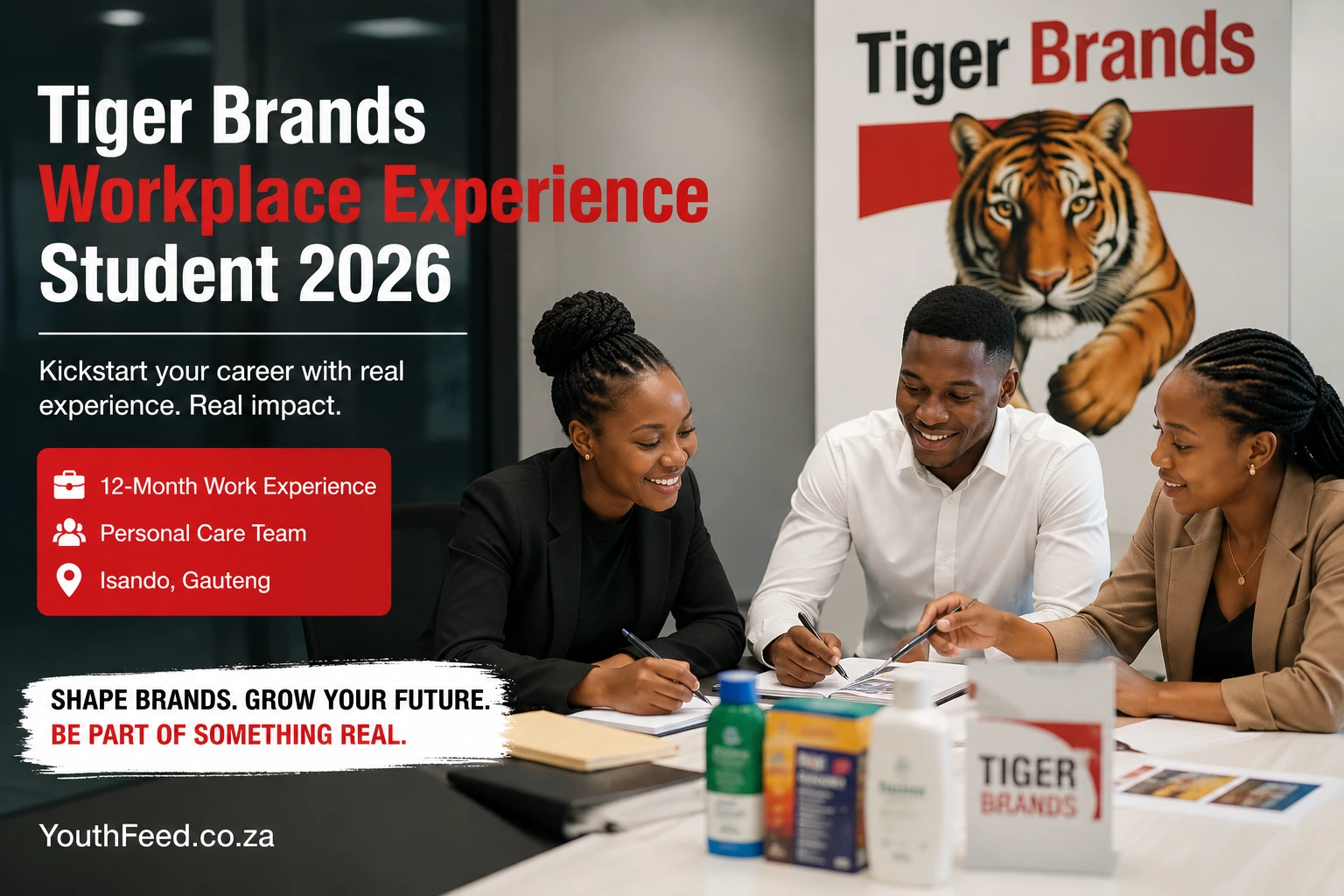
The conversation around the Tiger Brands Workplace Experience Student programme is growing rapidly among South African graduates and not only because graduate jobs remain highly competitive in 2026. What is making this opportunity stand out is the way it combines practical brand management exposure, real corporate responsibility, and access to one of South Africa’s most recognizable FMCG environments.
At a time when many graduates are struggling to move from qualifications to meaningful workplace experience, programmes like this are increasingly viewed as career launchpads rather than temporary internships. The 12-month workplace experience opportunity within Tiger Brands’ Personal Care Team in Isando arrives during a period when employers are placing greater emphasis on hands-on commercial exposure, adaptability, and cross-functional business skills.
For students and recent graduates in marketing and commercial studies, this is more than another entry-level opening. It reflects a broader shift in how large South African companies are trying to develop future talent pipelines after years of economic pressure, digital transformation, and changing consumer behavior.
And that is exactly why the Tiger Brands Workplace Experience Student programme is attracting attention now.
A Graduate Opportunity That Feels Closer to Real Corporate Work
One reason this programme is resonating online is because the responsibilities listed go beyond basic administrative support.
Instead of shadowing teams from a distance, selected candidates will actively participate in projects, support consumer-facing brand activities, assist with budget management, collaborate with agencies, and work alongside Brand Managers on insight-driven strategies.
That distinction matters.
Graduates increasingly want exposure that helps them build employable skills immediately. Many internship-style programmes in the market still focus heavily on observation rather than ownership. Tiger Brands appears to be positioning this experience differently encouraging candidates to become contributors within the Personal Care division.
The wording of the programme itself reinforces this approach. Applicants are expected to be proactive, challenge-driven, and willing to take ownership of tasks. That language aligns with how modern FMCG companies are reshaping graduate development around initiative and commercial agility.
For many students, the appeal is obvious: this is not framed as passive learning. It is framed as preparation for the “next level of brand management.”
Why FMCG Experience Still Carries Weight in South Africa
The FMCG sector remains one of the most influential training grounds for commercial graduates in South Africa.
Companies operating in fast-moving consumer goods expose young professionals to areas such as:
- Consumer psychology
- Retail dynamics
- Marketing strategy
- Budget management
- Shopper insights
- Agency coordination
- Product positioning
That kind of exposure often translates well into broader business careers later on.
Tiger Brands, as one of South Africa’s largest consumer goods companies, holds particular brand recognition among graduates because its products are embedded in everyday household life. Working inside that environment can give graduates insight into how large-scale brands are built, protected, and adapted in competitive markets.
The Personal Care Team specifically adds another interesting layer. Consumer behavior in personal care categories has evolved significantly in recent years, especially as younger shoppers increasingly prioritize affordability, identity-driven branding, wellness positioning, and digital influence.
Graduates entering this environment are likely to encounter a faster-moving marketing landscape than previous generations experienced.
Also Apply for Sage Intern: Customer Support 2026
The Isando Location Also Matters More Than People Think
The programme is based in Isando, an important industrial and commercial area in Gauteng.
For some applicants, location becomes a deciding factor in whether opportunities are realistically accessible. Gauteng continues to dominate corporate graduate recruitment in South Africa, particularly within FMCG, finance, logistics, and retail sectors.
The requirement that applicants should either already live in the city of hire or be willing to relocate reflects the ongoing concentration of opportunities around Johannesburg and surrounding economic hubs.
This also speaks to a larger employment reality in South Africa: graduates are increasingly expected to show geographic flexibility in exchange for career mobility.
For ambitious candidates, relocation is often viewed less as a burden and more as an investment into future employability.
The Real Importance of Work-Integrated Learning in 2026
One of the most significant parts of the programme is the requirement for a Work Integrated Learning (WIL) letter from the applicant’s institution.
This detail may seem administrative, but it reflects a major trend shaping graduate employment.
Universities and employers are under increasing pressure to close the gap between academic learning and workplace readiness. Across South Africa, many graduates leave university with theoretical knowledge but limited exposure to professional systems, communication structures, and commercial operations.
Work-integrated learning programmes aim to solve that problem.
The Tiger Brands Workplace Experience Student programme fits directly into this national conversation around employability. It is designed not simply as employment, but as a transition mechanism between education and professional work.
That distinction matters because employers are becoming more selective about “experience readiness,” even for junior roles.
Public Reaction: Why Young South Africans Are Paying Attention
Graduate opportunities consistently generate strong engagement online, but opportunities linked to recognized brands often receive especially high attention.
Part of the public reaction surrounding this programme comes from economic anxiety. Youth unemployment remains one of South Africa’s most pressing issues, and graduates frequently express frustration about the “experience paradox” — needing experience to get work while struggling to access opportunities that provide it.
Programmes like this create hope because they offer structured entry into a respected corporate environment.
There is also growing awareness among students that employer reputation can significantly influence future career opportunities. A recognizable company name on a CV still carries weight, particularly in competitive industries like marketing and brand management.
On social media and graduate-focused forums, discussions around programmes like this often revolve around:
- Whether candidates without prior internships stand a realistic chance
- The value of FMCG exposure
- Competition levels
- Relocation concerns
- Long-term employment prospects after programme completion
Another point attracting attention is Tiger Brands’ emphasis on continuous learning and ownership. Younger professionals increasingly prioritize workplace environments where growth feels possible rather than purely hierarchical.
Also apply for Motorola Solutions Project Management Intern 2026
What the Responsibilities Reveal About the Future of Marketing Careers
The listed responsibilities provide an interesting snapshot of how modern marketing roles are evolving.
This is no longer just about advertising campaigns.
Candidates may work on:
- Consumer insight analysis
- Shopper behavior
- Budget tracking
- Brand promotions
- Agency management
- Cross-functional collaboration
That combination reflects how marketing today intersects with analytics, operations, finance, and customer experience.
In many ways, the Tiger Brands Workplace Experience Student programme mirrors the reality of modern brand management: marketers are expected to understand both creativity and commercial execution.
The inclusion of budget reconciliations and purchase order management is particularly notable. It signals that graduates are expected to develop operational discipline alongside creative thinking.
For candidates hoping to build long-term careers in FMCG, these practical commercial skills may prove just as valuable as traditional marketing knowledge.
Why This Matters Right Now
The timing of this programme matters because graduate hiring expectations are changing rapidly in 2026.
Companies are increasingly looking for adaptable early-career talent capable of handling:
- Fast-changing consumer behavior
- Digital communication environments
- Data-informed decision-making
- Cross-functional teamwork
- Commercial accountability
At the same time, graduates are becoming more strategic about choosing opportunities that offer genuine development instead of generic internship titles.
The Tiger Brands Workplace Experience Student programme sits directly at the intersection of these two realities.
For employers, programmes like this help strengthen future leadership pipelines.
For graduates, they offer something increasingly valuable: structured experience linked to a recognizable national brand.
This also matters because South Africa’s graduate employment landscape remains highly uneven. Opportunities connected to established corporations are often viewed as more stable, more credible, and more likely to lead to future advancement.
Even candidates who do not remain permanently within Tiger Brands could potentially leverage the experience into broader FMCG, retail, or commercial careers later on.
Employment Equity and Representation Remain Part of the Conversation
Tiger Brands also notes that preference may be given to candidates from under-represented designated groups in line with employment equity goals.
Employment equity continues to shape recruitment conversations across South Africa, particularly in corporate graduate development programmes.
Supporters argue that these policies remain necessary to improve representation and create more equitable access to professional opportunities.
Critics sometimes raise concerns around competitiveness and fairness perceptions.
Regardless of viewpoint, employment equity remains a central feature of South African corporate hiring structures, especially within large organizations operating under transformation frameworks.
For applicants, understanding this context is important because it influences how recruitment processes are structured and communicated.
The Bigger Career Question: What Happens After the 12 Months?
One of the biggest questions graduates ask about workplace experience programmes is whether they lead to permanent employment.
Tiger Brands does not explicitly promise long-term placement after completion. However, the programme’s wording suggests it is intended to prepare participants for progression within brand management and commercial environments.
In practice, outcomes can vary.
Some participants in corporate graduate programmes secure internal opportunities afterward. Others use the experience to strengthen their profiles for external roles.
Either way, structured corporate exposure often improves employability significantly compared to candidates with academic qualifications alone.
This is particularly true in marketing-related industries where portfolio experience, project participation, and practical execution matter heavily during recruitment.
What Could Happen Next
Several possible outcomes could emerge from the growing interest surrounding the Tiger Brands Workplace Experience Student programme.
First, competition for placements may intensify significantly as awareness spreads across graduate communities. Well-known corporate programmes often attract thousands of applications, particularly in Gauteng.
Second, companies in similar industries may continue expanding work-integrated learning opportunities as competition for skilled young talent increases. Large employers are increasingly realizing that graduate development programmes are not just recruitment tools — they are long-term workforce investments.
Third, the programme may help reinforce a broader shift toward commercially integrated marketing careers. Graduates entering the workforce today are expected to balance strategy, analytics, operations, and creativity simultaneously.
Finally, the visibility of programmes like this could encourage more universities to strengthen partnerships with employers to improve student workplace readiness before graduation.
That may become increasingly important as the line between education and employability continues to narrow.
Final Thoughts
The Tiger Brands Workplace Experience Student opportunity represents more than a single graduate programme.
It reflects changing expectations in South Africa’s graduate employment market — where practical exposure, adaptability, and commercial understanding are becoming just as important as academic achievement.
For ambitious marketing and commercial graduates, the opportunity offers a rare combination of structured learning, corporate exposure, and real participation within a major FMCG environment.
At a time when many young professionals are searching for meaningful entry points into the workforce, programmes that provide both credibility and hands-on experience naturally attract attention.
Whether this specific programme becomes a long-term career gateway for successful applicants remains to be seen. But its growing visibility already highlights something important about the 2026 employment landscape:
Graduates are no longer only looking for jobs.
They are looking for opportunities that genuinely move their careers forward.
APPLY HERE: Tiger Brands Workplace Experience Student 2026

FAQ: Tiger Brands Workplace Experience Student 2026
1. What is the Tiger Brands Workplace Experience Student programme?
It is a 12-month work experience opportunity within Tiger Brands’ Personal Care Team designed to provide practical exposure in marketing and brand-related functions.
2. Where is the programme located?
The opportunity is based in Isando, Gauteng.
3. What qualifications are required?
Applicants need a Bachelor’s Degree in Marketing or a related commercial field.
4. Can graduates with work experience apply?
The programme is intended for candidates who have not worked full-time for more than one year in their field of study.
5. What documents are needed when applying?
Candidates must submit a CV, Matric Certificate, ID, Academic Transcripts, and a Work Integrated Learning requirement letter from their institution.