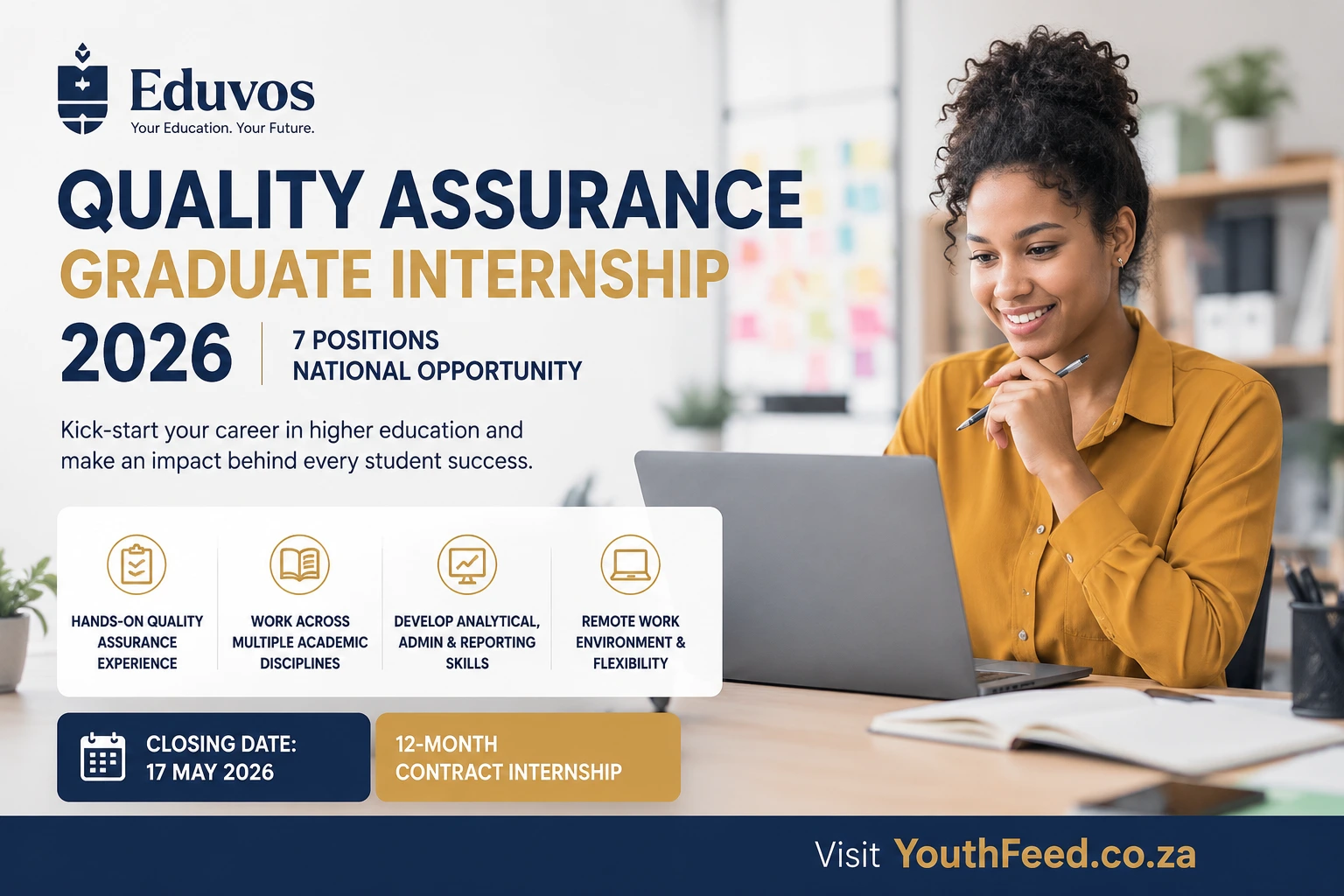
The search for graduate opportunities in South Africa has become more intense than ever in 2026, which is exactly why the Eduvos Quality Assurance Graduate internship is beginning to attract attention far beyond the higher education sector.
At first glance, it may look like another standard graduate programme. Seven internship positions. A 12-month contract. Administrative and assessment support responsibilities. But beneath the surface, the role reflects something much bigger happening in South African higher education and the graduate job market right now.
As universities and private institutions face growing pressure to improve academic credibility, assessment integrity, and student outcomes, quality assurance roles are no longer operating quietly in the background. They are becoming central to how institutions protect their reputation and maintain trust.
That shift is turning internships like the Eduvos Quality Assurance Graduate Internship 2026 into more than entry-level opportunities. For many graduates, they are becoming strategic stepping stones into education management, academic operations, compliance, learning development, and even corporate governance careers.
And with the closing date set for 17 May 2026, interest around the programme is building quickly among graduates looking for practical experience in a highly competitive employment environment.
Understanding the Eduvos Internship Opportunity
Eduvos is recruiting seven Quality Assurance Graduate Interns to work across its national campus network.
The internship falls under the institution’s Academic Development division and focuses on supporting assessment-related quality assurance processes across disciplines including:
- Humanities
- Commerce
- Law
- Applied Science
- Information Technology
- Copy Editing
Unlike many internships that limit graduates to repetitive support tasks, this programme appears designed to expose interns to operational systems that directly influence academic delivery and institutional standards.
That distinction matters.
South African graduates increasingly want internships that provide transferable skills instead of generic workplace exposure. Eduvos seems to understand this shift by emphasizing process coordination, analytical thinking, tracking systems, academic quality standards, and stakeholder communication.
Those are skills that remain relevant well beyond the education sector.
Why Quality Assurance Is Becoming More Important in Higher Education
For years, quality assurance in higher education operated mostly behind the scenes. Students rarely thought about the systems ensuring assessments were accurate, properly reviewed, or consistently moderated.
But the rapid expansion of digital learning, remote assessment systems, and hybrid education models changed everything.
Institutions now face growing scrutiny around:
- Assessment credibility
- Academic integrity
- Student performance consistency
- Administrative efficiency
- Online learning standards
- Accreditation compliance
In practical terms, this means institutions cannot afford assessment errors, inconsistent grading systems, or poorly managed workflows.
That is where quality assurance teams come in.
The Eduvos internship description strongly reflects this broader transformation. The organisation specifically highlights the importance of ensuring that assessments are “accurate, consistent, and of the highest quality.”
That language signals a growing institutional focus on operational accountability rather than simply academic delivery.
In other words, modern higher education is no longer only about teaching. It is increasingly about systems management, compliance structures, data coordination, and quality monitoring.
Graduates entering this environment today may gain exposure to functions that are becoming essential across the wider knowledge economy.
Also apply for Sage Intern: Customer Support 2026
The Internship Reflects a Bigger Graduate Employment Trend
One reason the Eduvos Quality Assurance Graduate programme is attracting attention is because it aligns with a major employment trend developing across South Africa.
Traditional graduate pathways are shrinking.
Many graduates expected to move directly into permanent junior roles after university. Instead, companies and institutions increasingly prefer candidates who already understand workplace systems, digital workflows, reporting structures, and collaborative operations.
That has pushed internships into a new category altogether.
They are no longer viewed merely as temporary experience opportunities. For many graduates, they have become the unofficial gateway into long-term employment.
This is especially true in sectors tied to administration, compliance, education technology, governance, and project coordination.
The Eduvos programme fits directly into that reality because it combines:
- Administrative exposure
- Remote working experience
- Process management
- Reporting skills
- Cross-disciplinary collaboration
- Professional communication
These capabilities are becoming highly valuable in modern workplaces where organisations depend on structured workflows and accountability systems.
A Closer Look at What Interns Will Actually Do
The internship focuses heavily on assessment workflow coordination and quality assurance support.
That may sound technical, but in practice it involves ensuring that academic processes move efficiently and accurately from one stage to another.
Interns will reportedly assist with:
- Administrative quality assurance checks
- Assessment tracking processes
- Coordination workflows
- Monitoring deliverables
- Following up on corrections and outstanding actions
- Supporting reporting systems
This is important because it suggests interns will work within operational ecosystems rather than isolated administrative tasks.
Employers increasingly value graduates who understand process management because nearly every modern industry relies on coordinated systems.
Even outside education, experience in tracking workflows, maintaining standards, and managing deadlines translates into sectors such as:
- Corporate training
- Compliance management
- Human resources
- Operations coordination
- Project administration
- Learning and development
- Governance support
That broader relevance may explain why internships like this are gaining more visibility online.
The Remote Work Component Could Be More Valuable Than It Looks
One of the more understated aspects of the internship is the emphasis on working effectively within a remote environment.
That requirement reflects how workplace expectations have permanently shifted since the widespread adoption of hybrid and remote systems.
Today, employers increasingly expect graduates to manage:
- Independent workflows
- Digital communication
- Online collaboration tools
- Virtual accountability systems
- Self-managed deadlines
For graduates entering the workforce in 2026, remote work readiness is no longer considered a bonus skill. It is becoming a baseline expectation.
The Eduvos internship appears designed to develop precisely those competencies.
This may especially benefit graduates from smaller towns or regions outside traditional corporate hubs, where remote and hybrid opportunities are creating new pathways into professional careers.
Read more about How NSFAS Funding Works: A Practical Guide for South African Students
Public Reaction: Why Graduates Are Paying Attention
Graduate opportunities in South Africa regularly generate strong online engagement, but internships linked to structured development and transferable skills often attract the most sustained interest.
Part of the attention surrounding the Eduvos internship comes from the broader frustration many graduates face after completing degrees without practical workplace exposure.
The internship’s “no experience required” requirement immediately widens accessibility.
At the same time, the programme still emphasizes professional competencies such as:
- Attention to detail
- Critical thinking
- Organisational ability
- Communication skills
- Accountability
- Time management
That balance matters because graduates increasingly want opportunities that remain accessible while still offering meaningful career development.
There is also growing public awareness that operational and coordination roles can evolve into stable long-term careers.
In previous years, many graduates focused almost exclusively on highly visible career paths like marketing, finance, or software development. Now, there is increasing recognition that behind-the-scenes operational roles often provide stronger long-term growth opportunities.
Why This Matters Right Now
The timing of the Eduvos Quality Assurance Graduate Internship 2026 is especially relevant because South Africa’s graduate employment landscape is under significant pressure.
Many young professionals are competing for fewer entry-level opportunities while employers simultaneously raise expectations around workplace readiness.
This creates a difficult contradiction:
- Graduates need experience to get hired
- But they need opportunities to gain that experience first
Internships like this attempt to bridge that gap.
At the same time, higher education institutions themselves are navigating increasing demands around academic credibility, digital transformation, and operational efficiency.
That means graduates entering quality assurance environments today may gain exposure to sectors that are likely to expand rather than contract over the next decade.
The internship also highlights another important shift: administrative and operational roles are becoming more strategic.
Modern organisations increasingly depend on systems coordination, compliance tracking, and process integrity. Graduates who understand those systems may find themselves better positioned for future management opportunities.
In a market where many graduates are searching for stable entry points into professional careers, that relevance becomes extremely important.
Also Apply for Motorola Solutions Project Management Intern 2026
The Skills Development Angle Is Significant
Eduvos specifically highlights several areas interns will gain exposure to, including:
- Quality assurance procedures
- Academic quality standards
- Tracking systems
- Analytical skills
- Reporting systems
- Stakeholder engagement
- Multi-disciplinary collaboration
This matters because employers increasingly prioritize adaptable graduates over narrowly specialized candidates.
Someone who understands coordination systems, reporting structures, communication processes, and workflow management can potentially transition across multiple industries.
That flexibility is becoming essential in a labour market where career paths are evolving rapidly.
For graduates uncertain about long-term specialization, internships like this may provide broader professional exposure than traditional narrowly defined roles.
What Could Happen Next
Several possible outcomes could emerge from programmes like the Eduvos Quality Assurance Graduate internship over the next few years.
First, institutions may continue expanding quality assurance and operational support functions as digital education systems grow more complex.
Second, graduate programmes focused on coordination, compliance, and process management could become more competitive as employers prioritize operational efficiency.
Third, internships that offer cross-functional exposure may increasingly outperform traditional entry-level roles in terms of long-term career value.
There is also a possibility that higher education institutions begin competing more aggressively for graduates who can combine analytical thinking with administrative precision.
That combination is becoming harder to find.
Another likely development is that remote operational roles may continue expanding beyond urban centres, creating wider access to professional experience opportunities across South Africa.
If that trend continues, internships like this could become especially attractive to graduates looking for nationally connected career pathways without immediate relocation requirements.
The Broader Message Behind This Opportunity
The biggest takeaway from the Eduvos internship may not simply be the opportunity itself.
It is what the programme says about where the professional world is heading.
Modern organisations increasingly value:
- Coordination
- Accuracy
- Systems thinking
- Communication
- Accountability
- Process management
These are no longer secondary workplace skills. They are becoming foundational to how institutions operate.
The internship reflects a growing reality that successful organisations depend not only on specialists, but also on professionals who can maintain structure, consistency, and operational quality across complex systems.
For graduates entering the workforce during a period of economic uncertainty and technological change, that lesson could prove extremely valuable.
Final Thoughts
The Eduvos Quality Assurance Graduate Internship 2026 may not generate the same immediate buzz as high-profile corporate graduate programmes, but its relevance is difficult to ignore.
It sits at the intersection of several important trends shaping South Africa’s employment landscape:
- The rise of operational careers
- The growing importance of quality assurance
- Remote work transformation
- Graduate employability challenges
- Skills-based hiring models
- Institutional accountability pressures
For graduates looking beyond traditional career paths, this internship could offer something increasingly valuable: practical exposure to systems that modern organisations rely on every day.
And in a labour market where adaptability matters more than ever, that kind of experience may carry far more weight than many realise.
APPLY HERE: Eduvos Quality Assurance Graduate Internship 2026
FAQ: Eduvos Quality Assurance Graduate Internship 2026
What is the closing date for the Eduvos Quality Assurance Graduate Internship 2026?
The closing date is 17 May 2026.
How many internship positions are available?
Eduvos is recruiting seven graduate interns nationally.
Do applicants need previous work experience?
No experience is required, although administrative or training-related exposure may be advantageous.
Which qualifications are accepted?
Applicants need a degree or advanced diploma in fields such as Commerce, Humanities, Law, Applied Science, or Information Technology.
Is the internship permanent?
No. The programme is a 12-month contract internship.