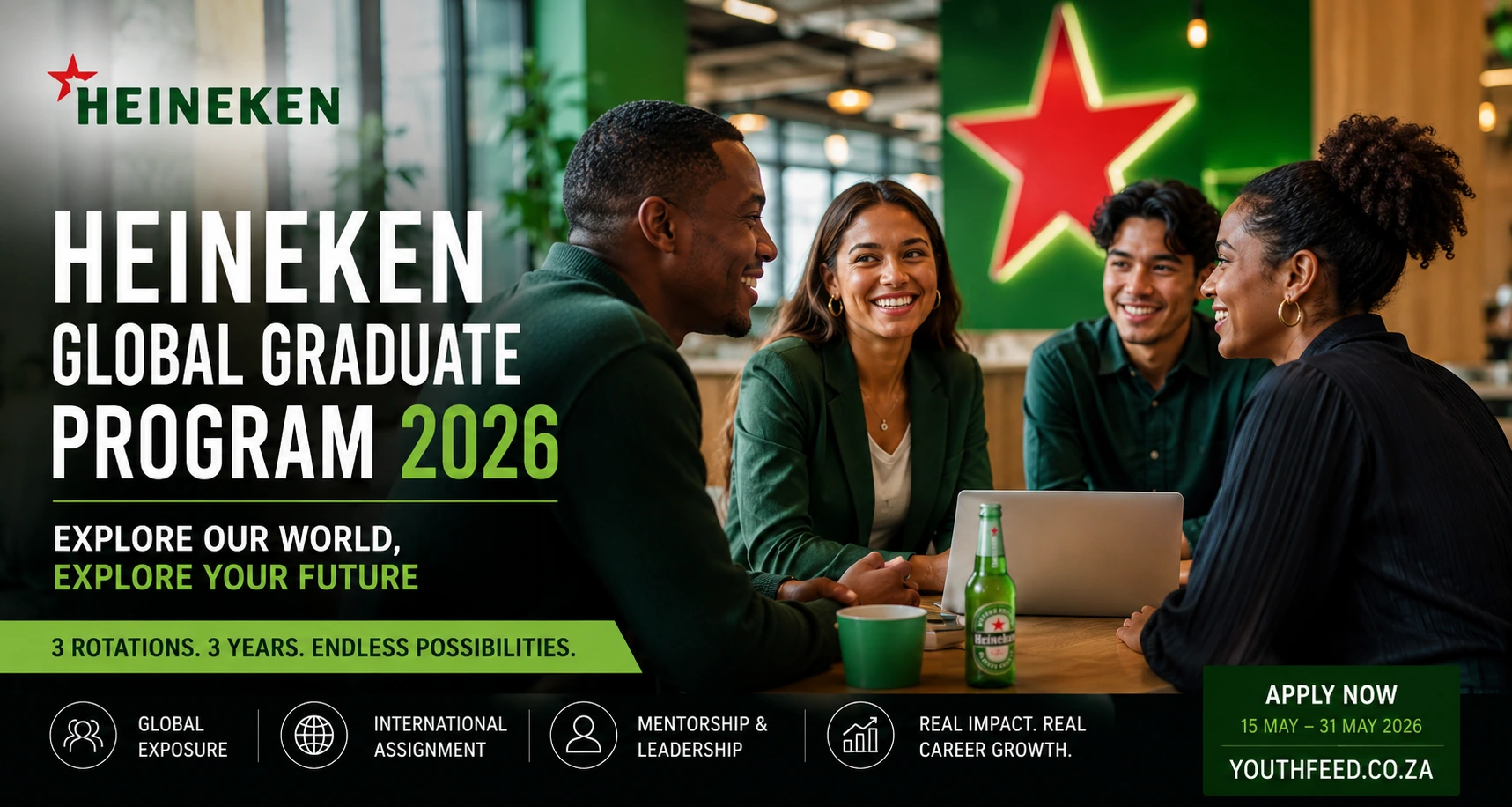
The HEINEKEN Global Graduate Program 2026 is arriving at a moment when many graduates are questioning whether corporate graduate schemes still offer real long-term value.
That uncertainty is exactly why the program is generating attention now.
Across South Africa, conversations about youth unemployment, skills shortages, and the growing pressure on graduates to gain international exposure have intensified in 2026. Against that backdrop, the Heineken Global Graduate Program suddenly feels bigger than just another corporate recruitment campaign. It is being positioned as a structured leadership pipeline one that promises international mobility, management training, and real operational exposure inside one of the world’s most recognized beverage companies.
And unlike many graduate opportunities that quietly disappear into crowded HR portals, this one arrives with a clear narrative: exploration, leadership development, and global career acceleration.
For graduates trying to figure out what a stable future looks like in a rapidly shifting economy, that message lands differently now than it might have a few years ago.
Why the Heineken Global Graduate Program Is Drawing Attention in 2026
The graduate recruitment landscape has changed dramatically since the pandemic years and subsequent economic slowdowns.
Many young professionals no longer see traditional entry-level jobs as enough. They want mobility. They want mentorship. They want skills that can travel internationally. Companies know this, and major employers are increasingly redesigning graduate programs to feel more immersive and future-focused.
The Heineken Global Graduate Program appears designed around exactly that shift.
The three-year structure combines local operational exposure with cross-functional assignments and eventually an international placement. For South African graduates based in Stellenbosch, Durbanville, or Sandton, the program offers something increasingly rare: a direct route from graduate status into leadership-oriented corporate development.
That international component is especially important.
In recent years, global graduate schemes have become more competitive because they represent more than employment. They symbolize access access to global networks, executive mentorship, and career mobility that many graduates struggle to find through ordinary entry-level roles.
For a generation entering the workforce during economic instability, those opportunities matter more than ever.
A Program Built Around Commerce and Leadership
The Commerce stream of the Heineken Global Graduate Program focuses on developing future commercial leaders within the business.
Candidates with degrees in marketing, sales, commerce, or business management are being targeted for roles that go beyond routine administrative work. Instead, participants are expected to contribute to projects, stakeholder management, and business transformation initiatives.
That distinction matters.
Many graduate programs still operate as glorified internships with limited influence or progression. Heineken’s messaging, however, places strong emphasis on leadership exposure from the beginning.
Participants rotate through three major phases:
- A foundational operational role
- A cross-functional business assignment
- An international placement
The structure reflects a broader corporate trend where companies increasingly want adaptable employees who understand multiple parts of the business ecosystem rather than remaining locked into one department.
In practice, that means graduates could gain exposure to sales strategy, consumer behaviour, operations, and project management within a relatively short period.
For ambitious graduates, that kind of acceleration can significantly shape future earning potential and career progression.
The Timing Reflects a Bigger Shift in Graduate Hiring
The launch window with applications opening from 15 May to 31 May arrives during a highly competitive graduate recruitment cycle in South Africa.
Corporate employers are increasingly narrowing their intake requirements while simultaneously demanding stronger soft skills, adaptability, and digital awareness.
Interestingly, the Heineken Global Graduate Program still maintains one feature that stands out positively: it accepts candidates with little or no formal work experience.
That matters because one of the biggest frustrations among graduates has become the “experience paradox” — employers demanding prior experience for supposedly entry-level positions.
By focusing on leadership potential instead of extensive experience, Heineken is positioning itself differently from employers that prioritize already-polished candidates.
At the same time, the program is clearly selective.
Global mobility requirements, behavioural assessments, cognitive testing, and assessment centres indicate the company is searching for high-potential candidates capable of working in international environments.
This mirrors a growing trend among multinational companies that increasingly value adaptability and emotional intelligence alongside technical qualifications.
Also apply for Sage Intern: Customer Support 2026
Why International Exposure Still Carries Weight
There was a period when international assignments were viewed as corporate luxuries.
Today, they are increasingly viewed as strategic career assets.
The Heineken Global Graduate Program leans heavily into this reality by making global mobility part of the experience rather than an optional bonus.
For South African graduates, that exposure can be transformative.
Working across markets often changes how young professionals understand leadership, communication, consumer behaviour, and innovation. It also strengthens long-term employability in multinational environments.
In an economy where many graduates worry about stagnation, international assignments offer something psychologically powerful: momentum.
That global angle also aligns with broader workforce trends.
Companies increasingly want leaders who can operate across cultures, manage geographically dispersed teams, and navigate international business dynamics. Graduate schemes with overseas exposure naturally become more attractive because they build those capabilities early.
Public Reaction: Excitement Mixed With Realistic Concerns
Online discussions around multinational graduate programs tend to follow two emotional tracks simultaneously: aspiration and skepticism.
The same is happening here.
Many graduates are enthusiastic about the opportunity because the program offers structured growth at a globally recognized company. The promise of mentorship, leadership development, and future management roles resonates strongly with young professionals who feel traditional career ladders have become less predictable.
But there are also realistic concerns.
The global mobility requirement may create challenges for candidates with financial, family, or personal constraints. International travel sounds exciting in theory, but relocating — even temporarily — is not equally accessible for everyone.
There is also growing awareness among graduates that corporate leadership programs can be intense and highly demanding.
Rotational assignments often require rapid adaptation, long hours, and continuous performance evaluation. For some candidates, that pressure becomes a valuable growth experience. For others, it can feel overwhelming.
Still, the overall reaction appears largely positive because opportunities of this scale remain relatively limited in South Africa’s graduate market.
Why This Matters Right Now
The relevance of the Heineken Global Graduate Program goes beyond one recruitment cycle.
South Africa continues to face serious youth employment challenges, and graduate unemployment remains a major concern even among degree holders. Programs that combine structured learning with long-term leadership pathways naturally attract attention because they address a growing fear among graduates: getting stuck.
At the same time, multinational companies are rethinking how they develop future leaders.
Traditional career progression models are evolving. Employers increasingly want commercially aware professionals who can think globally, adapt quickly, and lead change inside fast-moving industries.
The beverage and FMCG sectors are also undergoing transformation.
Consumer behaviour is shifting. Sustainability pressures are rising. Digital commerce is reshaping how brands connect with customers. Companies therefore need younger professionals capable of navigating modern commercial environments.
The Heineken Global Graduate Program reflects that broader shift toward leadership pipelines built around agility and adaptability rather than purely technical specialization.
For graduates, the opportunity represents more than employment.
It represents access to systems, mentorship, and international experience that can influence an entire career trajectory.
Read more about How NSFAS Funding Works: A Practical Guide for South African Students
The Selection Process Signals High Expectations
The structure of the application process itself says a lot about what Heineken values.
Candidates are expected to complete:
- Online behavioural assessments
- Cognitive testing
- Multiple interviews
- An in-person assessment centre
That layered recruitment model is increasingly common among global employers because it allows companies to assess not just academic ability, but also resilience, communication, collaboration, and decision-making under pressure.
Interestingly, the company specifically advises candidates to apply for only one Global Graduate Program stream per country because assessment results are linked to the first application submitted.
That detail may sound administrative, but it highlights how streamlined and centralized modern graduate recruitment has become.
Large companies increasingly rely on standardized assessment systems to identify scalable leadership potential across international markets.
The Commerce Industry Is Changing Faster Than Many Graduates Realize
One reason this program feels particularly relevant in 2026 is because commerce itself is changing rapidly.
The old model of sales and marketing has evolved into something far more data-driven, digital, and globally interconnected.
Commercial leaders today are expected to understand:
- Consumer analytics
- Brand storytelling
- Digital engagement
- Stakeholder management
- Cross-market strategy
- Organizational change
Graduate programs that expose candidates to multiple business functions therefore carry more value than narrowly specialized roles.
Heineken’s focus on cross-functional assignments reflects that reality.
Instead of developing graduates in isolation, the company appears to be prioritizing broader commercial awareness something increasingly necessary in multinational environments where departments constantly intersect.
What Could Happen Next
The success of programs like the Heineken Global Graduate Program may influence how other multinational employers structure future graduate recruitment in South Africa.
If leadership-focused rotational schemes continue attracting strong candidates, more companies could shift away from rigid departmental graduate hiring toward integrated development models.
There is also the possibility that global graduate schemes become even more competitive over the next few years.
As economic uncertainty continues internationally, graduates may increasingly prioritize employers offering structured progression, mentorship, and international mobility over companies offering only short-term contracts or uncertain development pathways.
For Heineken itself, programs like this help strengthen long-term talent pipelines.
Instead of recruiting external managers years later, the company can develop future leaders internally from graduate level onward shaping employees around company culture, operational systems, and leadership expectations from the start.
For applicants, the immediate next step is clear: preparation.
Because behavioural assessments and assessment centres now play such a central role in recruitment, candidates who understand collaboration, leadership communication, and adaptability often stand out more than those relying purely on academic performance.
Also Apply for Motorola Solutions Project Management Intern 2026
A Bigger Conversation About Opportunity
Perhaps the biggest reason the Heineken Global Graduate Program is resonating right now is because it taps into a wider emotional reality among graduates.
Young professionals today are searching for stability, growth, and meaning in a labour market that often feels fragmented and uncertain.
Graduate schemes that offer structure, mentorship, and international possibility naturally attract attention because they provide something many entry-level jobs do not: a visible pathway forward.
That does not guarantee success.
Programs like these remain highly competitive and demanding. Not every applicant will progress through the recruitment process, and not every participant will ultimately thrive in a multinational corporate environment.
But the broader significance remains important.
In a period where graduates increasingly fear underemployment and stalled progression, opportunities tied to leadership development still carry enormous symbolic and practical value.
And that may explain why the Heineken Global Graduate Program is becoming one of the more closely watched graduate opportunities of 2026.
APPLY HERE: Heineken Global Graduate Program 2026
FAQ About the Heineken Global Graduate Program 2026
Who can apply for the Heineken Global Graduate Program?
Graduates with a bachelor’s degree in fields such as marketing, commerce, sales, business management, or related disciplines can apply. Candidates should generally have less than one year of post-graduation work experience.
Where will the South African placements be based?
The program includes placements in Stellenbosch, Durbanville, and Sandton, South Africa.
Does the program include international experience?
Yes. One of the rotations includes an international assignment designed to build global business exposure and cultural adaptability.
Is prior work experience required?
No extensive work experience is required. The program specifically targets recent graduates and early-career candidates.
What happens after completing the program?
Successful participants may transition into management roles within their home country or another Heineken operating company globally.