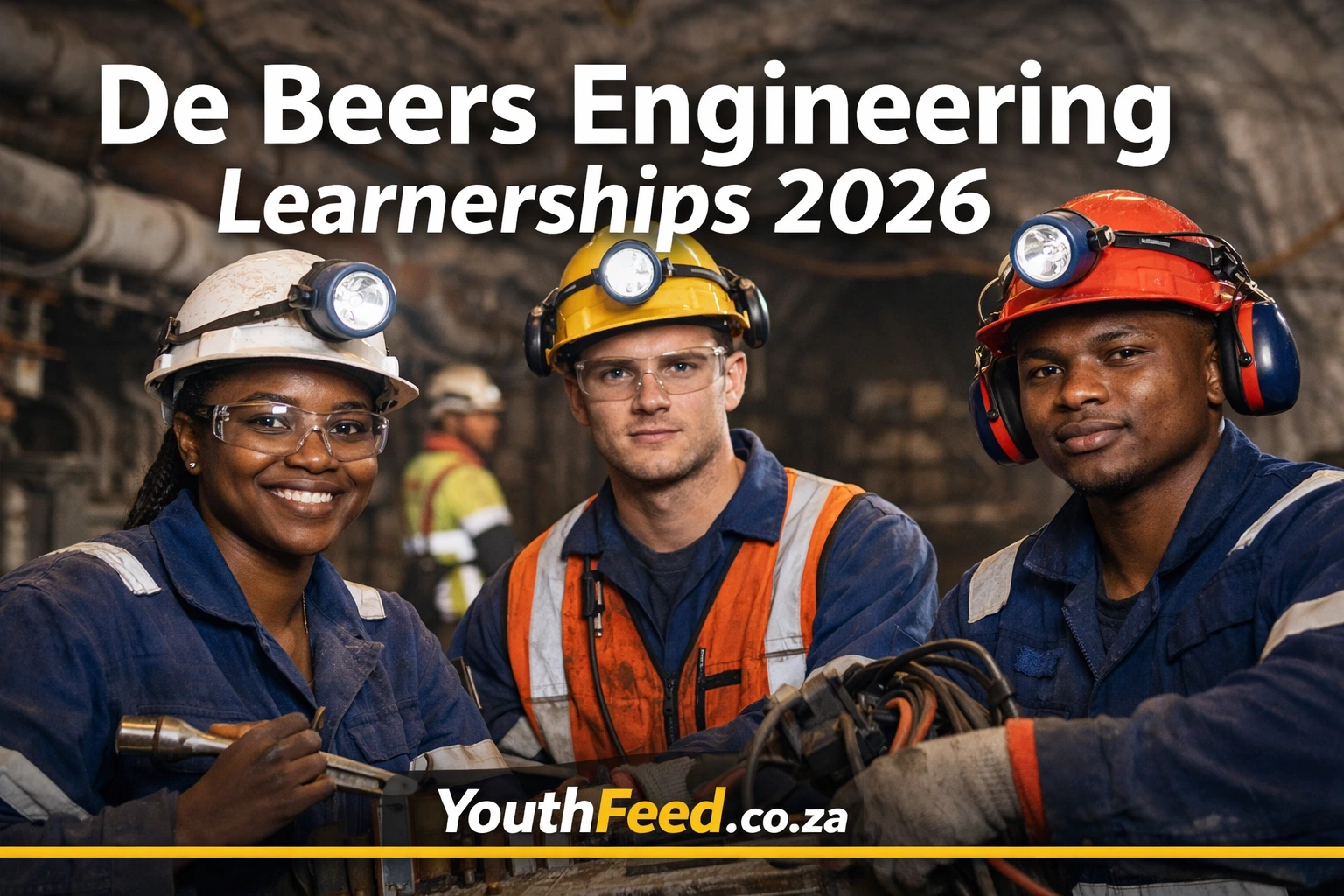
There’s a reason De Beers Engineering Learnerships 2026 are suddenly dominating conversations among South African youth, job seekers, and skills development advocates. It’s not just another intake announcement, it’s tied to one of the country’s most significant mining infrastructure developments and a growing urgency to address youth unemployment through practical, high-impact training.
At a time when many graduates are struggling to transition into the workforce, Learnerships like this are increasingly viewed as a lifeline. But beyond the surface, there’s a deeper story unfolding, one that reflects shifts in industry priorities, skills demand, and the future of work in South Africa.
A Learnership Linked to Something Bigger
The latest intake from De Beers Venetia Mine is not happening in isolation. It’s closely tied to the mine’s ongoing transition from open-pit to underground operations, one of the largest and most technically demanding mining projects in South Africa right now.
This matters because large-scale infrastructure projects typically require a new generation of technically skilled workers. In this case, artisans trained in trades such as:
- Boilermaking
- Electrical work
- Diesel mechanics
- Rigging
- Instrumentation
The learnership programme is designed to produce exactly that qualified artisans through structured training aligned with QCTO occupational qualifications and registered with the Mining Qualifications Authority (MQA).
Unlike short-term training programmes, this is a four-year Section 18.2 learnership, combining classroom instruction with real-world experience at one of the country’s most advanced mining operations.
READ MORE ABOUT: How Employers Benefit From Learnership Programmes in South Africa 2026
How the Opportunity Took Shape
To understand why this programme is gaining attention now, it helps to look at how learnerships have evolved in South Africa.
Over the past decade, government and private sector partnerships have increasingly emphasized skills-based pathways over purely academic ones. With youth unemployment consistently above 40%, industries like mining, energy, and manufacturing have stepped up efforts to train talent directly.
De Beers, with its long-standing presence in the country since 1888, has gradually expanded its role beyond mining into skills development and community upliftment.
The Venetia Mine project represents a turning point. As operations move underground, the technical complexity increases significantly requiring a workforce that is not only trained but adaptable and safety-conscious.
That’s where this learnership comes in.
What Sets These Learnerships Apart
While South Africa offers many learnership programmes each year, not all are created equal. The De Beers Engineering Learnerships 2026 stand out for a few key reasons.
1. Direct Industry Integration
Learners aren’t just trained in theory, they gain on-the-job experience at Venetia Mine, one of the most technologically advanced mining operations in the region.
2. Structured, Accredited Training
The programme leads to a formal Occupational Certificate, ensuring that participants leave with recognized qualifications that are portable across industries.
3. Access to Specialized Trades
Fields like instrument mechanician or transportation electrician (auto electrician) are highly specialized and in demand, offering stronger long-term career prospects.
4. Inclusion of Local Communities
A notable aspect is the focus on candidates from Blouberg and Musina Municipalities, reinforcing the role of mining companies in local economic development.
APPLY HERE FOR THE Thales Customer Services Intern – Banking & Payments 2026
The Requirements: Opportunity Meets Competition
As expected, the bar for entry is not low.
Applicants must have:
- Grade 12 with Mathematics (not Maths Literacy), Physical Science, and English
- Or N2 / NCV Level 3 in relevant engineering subjects
- Minimum 40% across required subjects
Additional requirements include:
- Medical fitness for mining work (Red Ticket)
- Psychometric and technical assessments
- Background checks and verification
There’s also a strong emphasis on discipline, teamwork, and analytical ability, reflecting the high-performance culture expected in mining environments.
In short, this is not an easy opportunity but it’s a meaningful one.
Public Reaction: Hope, Pressure, and Debate
The announcement has sparked a mix of reactions across social media and job-seeker communities.
Optimism Among Youth
Many see this as a rare, credible pathway into a stable career, especially given the shortage of artisan skills in South Africa.
Concerns About Accessibility
At the same time, some have raised concerns:
- The Mathematics requirement excludes many applicants
- The focus on specific municipalities limits access
- The application process is rigorous and documentation-heavy
A Broader Debate on Skills vs Degrees
The programme has also reignited discussion around whether South Africa should prioritize vocational training over traditional university pathways a debate that continues to gain traction.
Why This Matters Right Now
South Africa is at a crossroads when it comes to employment and skills development.
The timing of the De Beers Engineering Learnerships 2026 aligns with several critical trends:
1. Rising Demand for Technical Skills
Industries are increasingly seeking practical, job-ready skills, not just academic qualifications.
2. Youth Unemployment Crisis
With millions of young people unemployed, structured programmes like this provide real, measurable impact, not just temporary relief.
3. Infrastructure-Led Growth
As large projects expand, there’s a growing need for locally trained talent rather than imported expertise.
4. Shift Toward Work-Based Learning
Learnerships represent a shift toward earning while learning, making education more accessible and relevant.
In this context, the programme is more than an opportunity, it’s part of a larger solution.
The Bigger Picture: Mining’s Role in Skills Development
Mining companies have long been central to South Africa’s economy, but their role is evolving.
Today, there’s increasing pressure on companies like De Beers to:
- Contribute to local development
- Invest in human capital
- Promote inclusive growth
The Venetia learnership programme reflects this shift, blending corporate responsibility with operational necessity.
It also highlights a key reality: the future of mining will depend not just on technology, but on people who can operate, maintain, and innovate within that technology.
READ MORE ABOUT Learnership vs Internship vs Apprenticeship 2026
What Could Happen Next
Looking ahead, several possible outcomes could shape the future of programmes like this.
Expansion of Learnership Models
If successful, similar programmes could be expanded across other mines and industries, increasing access to vocational training.
Increased Competition
As awareness grows, these opportunities may become even more competitive, requiring higher levels of preparation from applicants.
Policy Influence
Government may further incentivize companies to invest in learnerships, strengthening public-private partnerships.
Career Pathways Beyond Mining
Graduates of the programme may find opportunities beyond mining, including in:
- Manufacturing
- Energy
- Infrastructure development
This could make the learnership a launchpad rather than a destination.
A Word of Caution: Avoiding Scams
As with many high-demand opportunities, there is a risk of scams.
De Beers has clearly stated:
- No payment is required for applications
- Applicants should report suspicious activity via official channels
This reminder is crucial, especially as desperate job seekers are often targeted.
Final Thoughts: Opportunity With Responsibility
The De Beers Engineering Learnerships 2026 represent more than just a training programme. They reflect a shift in how South Africa is approaching employment, education, and economic growth.
For applicants, it’s a chance to gain real skills and build a sustainable career.
For the industry, it’s an investment in future capability.
And for the country, it’s a small but significant step toward addressing one of its biggest challenges.
But like all opportunities, it comes with responsibility, both for those offering it and those applying.
FAQ: De Beers Engineering Learnerships 2026
1. Who can apply for the De Beers Engineering Learnerships 2026?
Applicants must have Grade 12 with Mathematics and Physical Science, or relevant N2/NCV qualifications, and meet additional technical and medical requirements.
2. How long is the learnership programme?
It is a structured four-year Section 18.2 learnership combining training and workplace experience.
3. Which trades are available?
Trades include boilermaking, electrical work, diesel mechanics, rigging, fitter and turner, and instrumentation.
4. Is the programme paid?
Yes, learners typically receive a stipend during the programme, as it is linked to a fixed-term employment contract.
5. When is the closing date?
Applications close on 27 March 2026, with only shortlisted candidates contacted.
Conclusion: A Turning Point for Skills and Opportunity
The De Beers Engineering Learnerships 2026 arrive at a moment when South Africa is actively rethinking how young people enter the workforce. More than just a training programme, this initiative represents a bridge between potential and real, hands-on opportunity, where learning is directly tied to doing, and ambition is matched with structure.
What makes this moment stand out is not only the scale of the Venetia underground project, but the intention behind it: to build a pipeline of skilled artisans who can sustain critical industries well into the future. In a country where unemployment remains a pressing challenge, programmes like this signal a shift toward solutions that are practical, targeted, and impactful.
Yet, the real value of this opportunity will depend on who steps forward, and how prepared they are. For applicants, it’s a chance to step into a demanding but rewarding environment that can shape long-term careers. For the industry, it’s an investment in resilience and capability. And for the broader economy, it’s a reminder that meaningful change often starts with skills.
As the closing date approaches, the spotlight on this learnership reflects something bigger: a growing recognition that South Africa’s future will be built not only in boardrooms or lecture halls, but also in workshops, training centres, and worksites where real skills are forged.
In that sense, this isn’t just another opportunity, it’s part of a much larger story still unfolding.