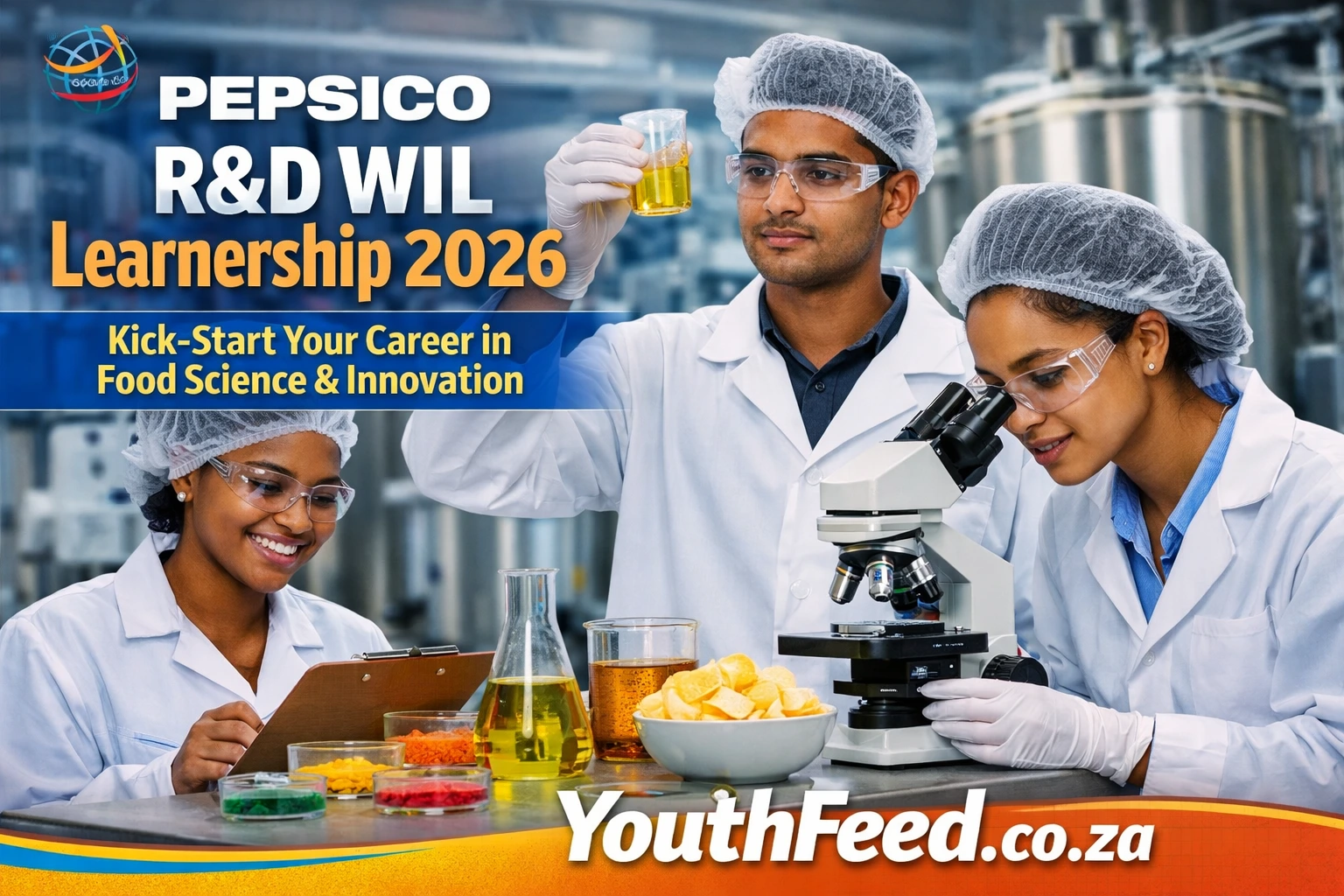
There is a reason the Pepsico R&D WIL Learnership is getting attention right now.
Not because it is flashy. Not because it promises overnight success. And definitely not because “learnership” has suddenly become a glamorous word online.
It is trending because it sits at the intersection of three things South African students are desperately looking for in 2026: real workplace exposure, technical relevance, and a clearer route from theory into employability.
That matters.
At a time when thousands of students are finishing degrees and diplomas only to discover that “qualified” does not automatically mean “work-ready,” opportunities like this hit differently. The Pepsico R&D WIL Learnership 2026 is not just another corporate listing buried on a careers page. It speaks directly to one of the biggest frustrations in youth employment right now: How do you get experience when every opportunity asks for experience first?
And when the company involved is PepsiCo, a business with a significant footprint in South Africa and a visible R&D, manufacturing, and product ecosystem people pay attention. PepsiCo says its South African operation spans iconic household brands and more than 40 production locations, while its global careers platform continues to position Research & Development as a key function in innovation and product delivery.
So yes, this opportunity is worth discussing. But not with hype.
With context.
What the Pepsico R&D WIL Learnership Actually Looks Like
Strip away the corporate language and the role becomes much clearer.
This is essentially a science-to-industry bridge role.
The learnership is designed for students who have completed the theoretical part of their studies and now need practical exposure, especially in fields like:
- Biochemistry
- Food Technology
- Engineering
That alone tells you what kind of candidate PepsiCo is looking for: someone who is not just “good at school,” but someone who can step into an applied environment where food science, product quality, trial work, data, process control, and teamwork all collide.
And the tasks are not superficial.
This is not a coffee-run internship disguised as technical development.
The role touches practical areas such as:
- supporting trial protocols
- helping execute research and development projects
- assisting with pilot plant and production trials
- carrying out routine analytical and product quality tests
- working with seasoning applications
- performing tests like salt, oil, moisture, particle size, and bulk density analysis
- helping with technical reporting, timelines, and project support
- collaborating with product developers, regulatory teams, operations, and manufacturing stakeholders
That is the kind of exposure many graduates only wish they had by the time they attend their first serious interview.
And that is why this role is getting traction.
Because if you are trying to build a career in food science, FMCG innovation, product development, process engineering, or quality-led manufacturing, this kind of experience is not random. It is highly strategic.
ALSO APPLY FOR: CIPC Internships 2026
Why This Role Feels Bigger Than a “Typical Learnership”
In South Africa, “learnership” can mean very different things.
Some are useful stepping stones. Others are little more than CV placeholders. A few are genuinely career-shaping.
The Pepsico R&D WIL Learnership has the ingredients to fall into the third category.
Why?
Because it is attached to real operational complexity.
Research and development inside a major food company is not abstract laboratory work floating in isolation. It connects directly to:
- consumer products
- manufacturing systems
- ingredient performance
- compliance
- shelf-life expectations
- quality control
- commercialization timelines
That means even an entry-level learner is not simply “learning science.” They are learning how science survives in the real world — where deadlines, costs, factory realities, and product consistency all matter.
That is a different kind of education.
And arguably, it is the kind employers increasingly value more than polished academic language alone.
A lot of graduates know definitions.
Far fewer know how to translate data into action, how to communicate trial outcomes, or how to work inside a cross-functional product environment without getting overwhelmed.
This role appears built to expose candidates to exactly that.
The Bigger Backstory: Why Opportunities Like This Are Getting More Attention in 2026
The interest around this learnership is not happening in a vacuum.
It is part of a much bigger shift in the graduate market.
For years, South African students were told a familiar story: get the qualification, graduate, and doors will open.
Then reality arrived.
Now the market is more demanding, more skills-focused, and more skeptical of academic achievement that has not been tested in real settings. Companies increasingly want people who can prove they understand processes, systems, documentation, quality standards, communication, and execution — not just coursework.
That is why WIL (Work Integrated Learning) opportunities have become so valuable.
They solve a structural problem.
They give students the chance to move from:
theory → application → employability
And in sectors like food production, manufacturing, and product development, that jump is especially important because employers want evidence that you can function in environments where precision matters.
One bad assumption in an R&D or quality-related setting is not just a small mistake. It can affect trial outcomes, production quality, compliance, or resource use.
That is why roles like this are not just “nice opportunities.”
They are becoming career infrastructure.
ALSO APPLY FOR: NEF Graduate Internship Programme 2026
Recent Developments Making This Opportunity More Relevant
Part of what makes this opportunity stand out is the timing.
PepsiCo continues to position itself globally and locally as a company investing in capability, early careers, and functional growth, while its South African presence remains substantial through food and beverage brands familiar to millions of consumers. The company’s public-facing career and workforce materials emphasize learning, development, and functional skills across areas including R&D.
That context matters because candidates are no longer just applying for any role.
They are looking for roles inside ecosystems where they can imagine a second step.
And that is one of the hidden strengths of this learnership.
It is not just about what you do during the programme.
It is about what that experience can signal afterward.
If you spend a meaningful period inside a large R&D-linked operation, working on trials, testing, reporting, compliance support, pilot activities, and cross-functional coordination, you are no longer applying as someone who “studied food science.”
You are applying as someone who has seen how technical work moves inside a real business.
That distinction can be everything.
Public Reaction: Why Students and Graduates Are Paying Close Attention
The reaction to opportunities like this tends to follow a familiar pattern.
First comes excitement.
Then comes scrutiny.
And honestly, that is healthy.
Students are paying more attention now to whether a programme actually offers:
- credible practical work
- transferable technical exposure
- recognizable employer value
- a realistic chance at future opportunities
The Pepsico R&D WIL Learnership seems to tick enough of those boxes to spark genuine interest.
Why students like the sound of it:
- It is linked to a major employer.
- It aligns with science and technical qualifications.
- It includes exposure to lab, pilot plant, and factory environments.
- It offers experience that is easier to explain in future interviews than generic internship tasks.
But there is also caution.
Because applicants have learned the hard way that not every “development opportunity” leads somewhere meaningful.
That is why the real question students are asking is not just:
“Can I get in?”
It is:
“If I get in, will this actually move me forward?”
In this case, the answer looks more promising than average — provided the learner treats the opportunity seriously.
That last part is important.
This is not the kind of role where you can drift.
Why This Matters Right Now
This matters right now because South Africa is in a moment where practical employability has become just as important as academic completion.
And for many students in scientific and technical disciplines, that is the hardest gap to close.
You can complete your modules.
You can pass your exams.
You can understand the theory.
And still find yourself stuck because you have never worked inside a plant, a development environment, a quality testing process, or a regulated product workflow.
That is the bottleneck.
The Pepsico R&D WIL Learnership matters because it targets exactly that bottleneck.
It gives learners a chance to build the kind of evidence employers respond to:
- exposure to technical processes
- understanding of GMP and hygiene practices
- familiarity with lab testing
- participation in trial execution
- experience with cross-functional communication
- insight into how innovation becomes a product
And in 2026, those are not “nice extras.”
They are competitive advantages.
For many applicants, the difference between being overlooked and being shortlisted will come down to one thing:
Can you show that you have already operated in a real technical environment?
This programme could help answer that with a yes.
What Makes a Strong Applicant for This Learnership
A lot of candidates will focus only on the qualification line.
That is a mistake.
Yes, the academic background matters. But this role is also clearly built for a certain type of person.
The strongest applicants will likely be those who can show signs of being:
- methodical
- curious
- reliable
- comfortable with data
- able to communicate clearly
- organized under pressure
- eager to learn without needing constant supervision
That last one is especially important.
PepsiCo’s listed preferences strongly suggest they want someone who can function as a self-starter while still being a supportive team player.
That is not easy.
But it is exactly how modern technical workplaces operate.
The best candidates will also understand that “R&D” is not just about ideas.
It is about discipline.
You are not there to daydream about cool snack flavors all day.
You are there to help run controlled processes, support product work, gather useful results, and contribute to technical execution that actually stands up in production environments.
That is much less romantic.
And much more valuable.
The Possible Career Implications If You Land It
This is where the opportunity becomes genuinely interesting.
A role like this can help build pathways into areas such as:
- Food Technologist
- R&D Technician
- Product Development Assistant
- Quality Assurance / Quality Control
- Process Development
- Pilot Plant Support
- Regulatory Support
- Manufacturing Technical Roles
- Commercialization Support
And even if the learner does not stay at PepsiCo long term, the exposure can still carry serious weight elsewhere.
Because FMCG and food manufacturing employers tend to value candidates who already understand the language of:
- trials
- testing
- specifications
- quality systems
- process conditions
- production environments
That means this role can be useful beyond one company.
That is what makes it strategically smart.
What Could Happen Next
There are a few realistic outcomes to watch.
1) Competition could increase sharply
As more students realize how useful WIL opportunities are, programmes like this are likely to attract more serious applicants — not just casual submissions.
2) Employers may keep favoring “work-ready” graduates
If the broader job market continues moving toward practical capability over paper qualifications alone, learners who complete programmes like this may gain an edge.
3) More science students may shift toward industry-facing careers
Not every science student wants to stay in pure academic or lab-only pathways. Roles like this expose learners to commercial product environments, which can reshape career ambitions fast.
4) PepsiCo could become a stronger target employer for technical graduates
If learners and graduates increasingly view the company as a place where applied technical growth is possible, demand for these opportunities will only rise.
5) Candidates will need to get smarter about how they apply
In 2026, generic CVs are getting punished. Applicants who tailor their documents around lab skills, analytical methods, project exposure, teamwork, and technical reporting will almost certainly perform better.
In short: this learnership may look like a single opening, but it reflects a much bigger employment trend.
And that trend is not slowing down.
APPLY HERE: Pepsico R&D WIL Learnership 2026
FAQ: Pepsico R&D WIL Learnership 2026
1) What does WIL mean in the Pepsico R&D WIL Learnership?
WIL stands for Work Integrated Learning, which means the programme combines academic learning with real workplace experience.
2) Who should apply for the Pepsico R&D WIL Learnership?
Students who have completed the theoretical part of studies in fields like Biochemistry, Food Technology, or Engineering are the most relevant fit.
3) Is the Pepsico R&D WIL Learnership good for future jobs?
Yes — especially if you want to build a career in food science, R&D, quality, manufacturing, or product development.
4) What kind of work is involved?
The role includes lab testing, pilot plant support, production trial exposure, technical reporting, project support, and collaboration across teams.
5) Is a driver’s license required?
It is listed as an advantage, not necessarily a strict requirement — but it could strengthen your application.
Final Take
The Pepsico R&D WIL Learnership is not exciting because it is trendy.
It is exciting because it is useful.
For the right candidate, this could be one of those rare opportunities that actually changes the texture of a CV — from “student with potential” to “candidate with practical relevance.”
That is a powerful shift.
And in a year where employability is becoming more evidence-based, opportunities like this matter more than ever.
Not every applicant will get in.
Not every learnership leads somewhere.
But this one has the structure, the technical depth, and the industry context to make people stop scrolling and pay attention.
And honestly?
That attention is deserved.