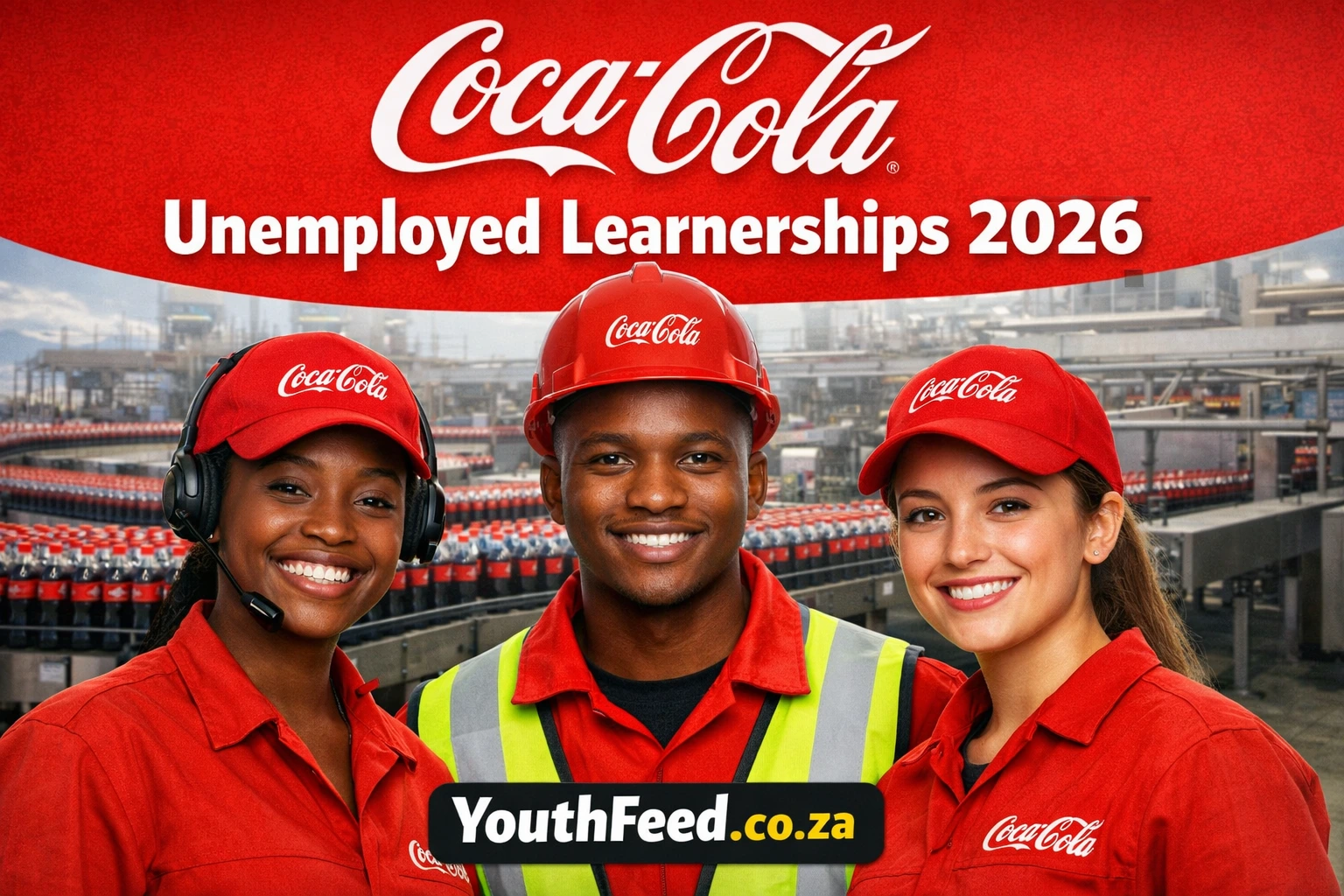
There’s a reason Coca-Cola Unemployed Learnerships are suddenly showing up in WhatsApp groups, student forums, job pages, and youth opportunity websites across South Africa.
It’s not just the brand name.
At a moment when thousands of young people are refreshing careers pages more than they refresh Instagram, opportunities linked to a company as recognizable as Coca-Cola Beverages South Africa instantly carry weight. But in 2026, these learnerships are attracting attention for something deeper: they sit at the intersection of employability, skills development, inclusion, and the very real frustration many unemployed South Africans are facing right now. Recent listings tied to Coca-Cola Beverages South Africa highlight a 12-month Visual Merchandiser learnership and a Human Resources Business Administration learnership for candidates living with disabilities, both closing on 31 March 2026.
And that’s exactly why this matters.
Because this is no longer just another “apply now” opportunity post. It reflects a bigger story about what employers are prioritizing, what entry-level talent pipelines look like in 2026, and where South African youth may still find a realistic path into formal work.
Why This Opportunity Is Standing Out
South Africa is not short on graduates, school leavers, or job seekers.
It is short on bridges.
That’s what makes learnerships different from ordinary vacancies. They’re not designed only for people who already have years of experience. In theory, they’re built to help people gain a recognized qualification, practical workplace exposure, and enough structure to move from “unemployed” to “employable.”
That promise doesn’t always play out perfectly in the real world. But when a major FMCG employer opens multiple learnership pathways at once, people notice.
The current Coca-Cola programmes being discussed most heavily are two very different but equally relevant routes:
- A Human Resources / Business Administration learnership aimed at people with disabilities
- A Visual Merchandiser learnership focused on commercial, in-store execution, customer support, and brand visibility
On paper, they look like simple entry-level opportunities. In practice, they reflect where the labour market is placing value: administration, retail execution, customer-facing skills, adaptability, and measurable operational performance.
That’s not accidental.
It tells us something important about how companies are hiring in 2026.
How the Situation Developed
To understand why Coca-Cola Unemployed Learnerships are trending, you have to look beyond Coca-Cola itself.
For years, learnerships in South Africa have occupied a strange space. They are often promoted as gateways to work, yet many applicants experience them as lotteries—high demand, low transparency, and fierce competition for limited placements.
Still, they remain one of the few structured options available to unemployed youth who don’t yet have the “2 years’ experience” employers somehow expect from first-time workers.
That’s especially true in sectors like:
- FMCG
- logistics
- sales support
- admin
- retail operations
- HR support
- customer service
These are the kinds of roles where employers still need large numbers of trainable, adaptable people—not just polished professionals with already-built CVs.
And that’s where Coca-Cola’s position matters.
As one of the country’s most visible beverage employers, the company sits inside a business ecosystem that depends on distribution, merchandising, sales execution, compliance, admin coordination, and people operations. So when it recruits learners, it’s not doing charity. It’s feeding a real talent pipeline. Background reporting and reposted opportunity summaries have also emphasized that these programmes are structured 12-month pathways tied to practical workplace learning.
That’s the difference many applicants are picking up on.
This isn’t only about “getting something.” It’s about getting something that may actually connect to the labour market.
ALSO APPLY FOR: CIPC Internships 2026
What the Learnerships Actually Offer
Strip away the corporate wording, and the two main opportunities are fairly clear.
1) Human Resources Learnership (for people with disabilities)
This stream is especially significant because it is not just another general admin programme. It explicitly targets equity disabled candidates, which means it is also part of a broader inclusion and access conversation in South African hiring.
The programme centers on Business Administration and workplace support functions. That may sound modest, but admin experience remains one of the most transferable forms of entry-level work in the country.
Why?
Because admin teaches the habits employers quietly value most:
- reliability
- organization
- communication
- process discipline
- document handling
- professional workplace behavior
And unlike glamorous-sounding programmes that leave learners with vague exposure and little practical value, administrative training often translates across industries.
2) Visual Merchandiser Learnership
This is where things get more physically active and commercially practical.
The Visual Merchandiser pathway is less about sitting behind a desk and more about understanding how products move, how shelves influence buying, and how field-based commercial teams support sales performance.
In simple terms: it teaches how brands win in stores.
That includes:
- stock rotation
- in-store display execution
- customer-facing support
- promotional implementation
- product visibility
- basic retail sales discipline
That might sound “small,” but in FMCG, it is not small at all.
Retail execution is where strategy becomes money.
And that’s exactly why employers continue to invest in these kinds of roles.
The Requirements Tell a Bigger Story
One of the most revealing parts of these postings is not the job title.
It’s the eligibility criteria.
At first glance, they seem familiar:
- South African citizenship
- Grade 12
- age range around 18–35
- unemployment at time of appointment
- not currently in full-time study
- no previous completion of the same qualification
- supporting documents required
But look closer and a pattern emerges.
These are not just screening conditions. They reflect how tightly employers are now trying to define “entry-level readiness.”
In other words, companies are no longer just asking: “Do you need a chance?”
They’re asking: “Can you function in a structured, accountable environment from day one?”
That’s why even learnerships now often mention things like:
- communication ability
- flexibility
- attention to detail
- willingness to commit for 12 months
- verification checks
- criminal or credit screening
- readiness to travel or work across locations
This is where many applicants underestimate what a learnership really is.
It’s not simply free training.
It’s a low-risk way for employers to observe future talent.
And that means candidates are being evaluated long before interviews even happen.
Public Reaction: Why Young People Are Paying Attention
The public response to Coca-Cola opportunities is usually immediate for one obvious reason: brand trust.
A lot of South African job seekers have grown tired of vague “youth empowerment” opportunities that lead nowhere. So when a known company posts a structured programme with a clear duration, clear requirements, and recognizable locations, it feels more credible than the average online listing.
That doesn’t mean everyone is optimistic.
There’s also a growing realism in how people talk about these opportunities.
Among young applicants, the conversation is increasingly split into two camps:
The hopeful view:
“This could be the one that finally gets my foot in the door.”
The skeptical view:
“Thousands will apply. Will anyone actually hear back?”
Both reactions are valid.
And that dual response says a lot about South Africa’s current youth employment mood: hopeful enough to keep applying, but disillusioned enough not to romanticize the process.
That tension is exactly why articles about Coca-Cola Unemployed Learnerships perform so well on Discover and social platforms right now. They’re not just job posts. They tap into a national emotional reality.
ALSO APPLY FOR: NEF Graduate Internship Programme 2026
Why This Matters Right Now
This matters right now because 2026 is becoming a year of practical employability pressure.
Not theoretical employability.
Practical.
That means South Africans are increasingly asking:
- What can I apply for today?
- What can give me experience within 12 months?
- What can move me from “unemployed” to “shortlistable”?
And in that environment, learnerships are no longer viewed as “backup options.”
For many people, they are the main strategy.
The Coca-Cola opportunities also matter because they highlight two themes that are becoming more important in the labour market:
1) Inclusion is becoming more visible
The HR learnership for candidates with disabilities is significant in a country where many talented job seekers still struggle to access genuinely structured opportunities.
2) Commercial skills are still highly bankable
The Visual Merchandiser route reinforces that South Africa’s retail and FMCG economy still values execution-heavy, customer-adjacent skills.
That means these programmes are relevant not just for today’s stipend—but for what they may represent on a CV next year.
And that is the real story here.
Not just whether someone gets selected.
But whether these programmes still function as meaningful ladders in an economy where first chances are painfully scarce.
The Bigger Implications for Applicants
If these learnerships tell us anything, it’s that applicants need to stop treating opportunities like this casually.
That means:
- no rushed CVs
- no blurry attachments
- no missing certificates
- no generic “To whom it may concern” approach
- no assumption that “they’ll call me if they need anything”
Because they won’t.
At this level, the first elimination often happens before a human being ever reads your name properly.
And there’s another implication many people miss: learnerships are becoming more competitive because they now sit between education and employment in a way that both sides no longer do well on their own.
That’s why a single Coca-Cola opening can trigger huge attention.
It’s not only about prestige.
It’s about scarcity.
What Smart Applicants Should Take Seriously
If you’re writing about this for a youth audience, this is the part worth saying clearly:
The best candidates are not always the most qualified.
They are often the most prepared.
That means applicants who:
- match the requirements exactly
- attach every requested document
- use a clean, readable CV
- understand the role they’re applying for
- apply before the last-minute traffic crush
- don’t copy-paste nonsense into application forms
This sounds basic, but it’s where a lot of applications quietly collapse.
A role like Visual Merchandiser, for example, may look “entry-level,” but it actually favors candidates who can demonstrate discipline, mobility, communication, and stamina.
Likewise, an HR/Business Administration learnership may look straightforward, but it still rewards candidates who come across as organized, consistent, and professionally serious.
That’s the hidden competition.
Not just who wants the role.
But who already behaves like they belong in it.
What Could Happen Next
There are a few realistic outcomes from here.
Scenario 1: Strong application volumes push even more competition
This is the most likely outcome. Big-name learnerships usually attract a flood of applications, especially when they’re countrywide or tied to major urban nodes.
Scenario 2: More employers may quietly follow this model
If programmes like these continue to attract strong candidate pools, more companies may lean into structured, skills-based entry pipelines rather than traditional junior hiring.
Scenario 3: Applicants may start prioritizing “employability pathways” over degrees alone
This is already happening. Many young South Africans are becoming more strategic: they are chasing workplace relevance, not just qualifications.
Scenario 4: The inclusion conversation could deepen
The disability-focused HR opportunity may also push more discussion around whether enough employers are creating pathways that are genuinely accessible rather than merely symbolic.
That last point matters more than it may seem.
Because if inclusion remains limited to a handful of visible postings, it stays exceptional instead of becoming normal.
And South Africa needs it to become normal.
APPLY HERE: Coca-Cola Human Resources Learnership 2026
APPLY HERE: Coca-Cola Visual Merchandiser Learnership 2026
FAQ: Coca-Cola Unemployed Learnerships 2026
1) What is the closing date for the Coca-Cola Unemployed Learnerships 2026?
The opportunities referenced here list 31 March 2026 as the closing date.
2) Who can apply for the Coca-Cola Unemployed Learnerships?
Generally, applicants must be South African citizens, unemployed, within the stated age range, and must meet the specific qualification and document requirements for each role.
3) Are these Coca-Cola learnerships paid?
The HR learnership notes that a stipend will be offered in line with SETA requirements.
4) What is the duration of the programme?
These learnerships are structured as 12-month programmes combining theory and workplace learning.
5) Is prior work experience required?
Some requirements differ by role. The HR-related opportunity mentions 1 year work experience, while the Visual Merchandiser stream is more focused on eligibility, availability, and role readiness. Applicants should read each listing carefully.
Final Take
The reason Coca-Cola Unemployed Learnerships are getting so much attention in 2026 is not complicated.
They represent something rare.
Not certainty.
Not guaranteed employment.
But credible possibility.
And right now, that matters.
In a crowded, exhausting, often discouraging youth employment landscape, opportunities like these still cut through because they offer something many applicants are desperate for: structure, legitimacy, and a chance to build experience that actually counts.
That doesn’t mean every applicant will get in.
It does mean these openings deserve more than a quick glance and a lazy upload.
Because for the right candidate, this kind of opportunity can be more than a 12-month programme.
It can be the line between being overlooked and finally becoming visible.