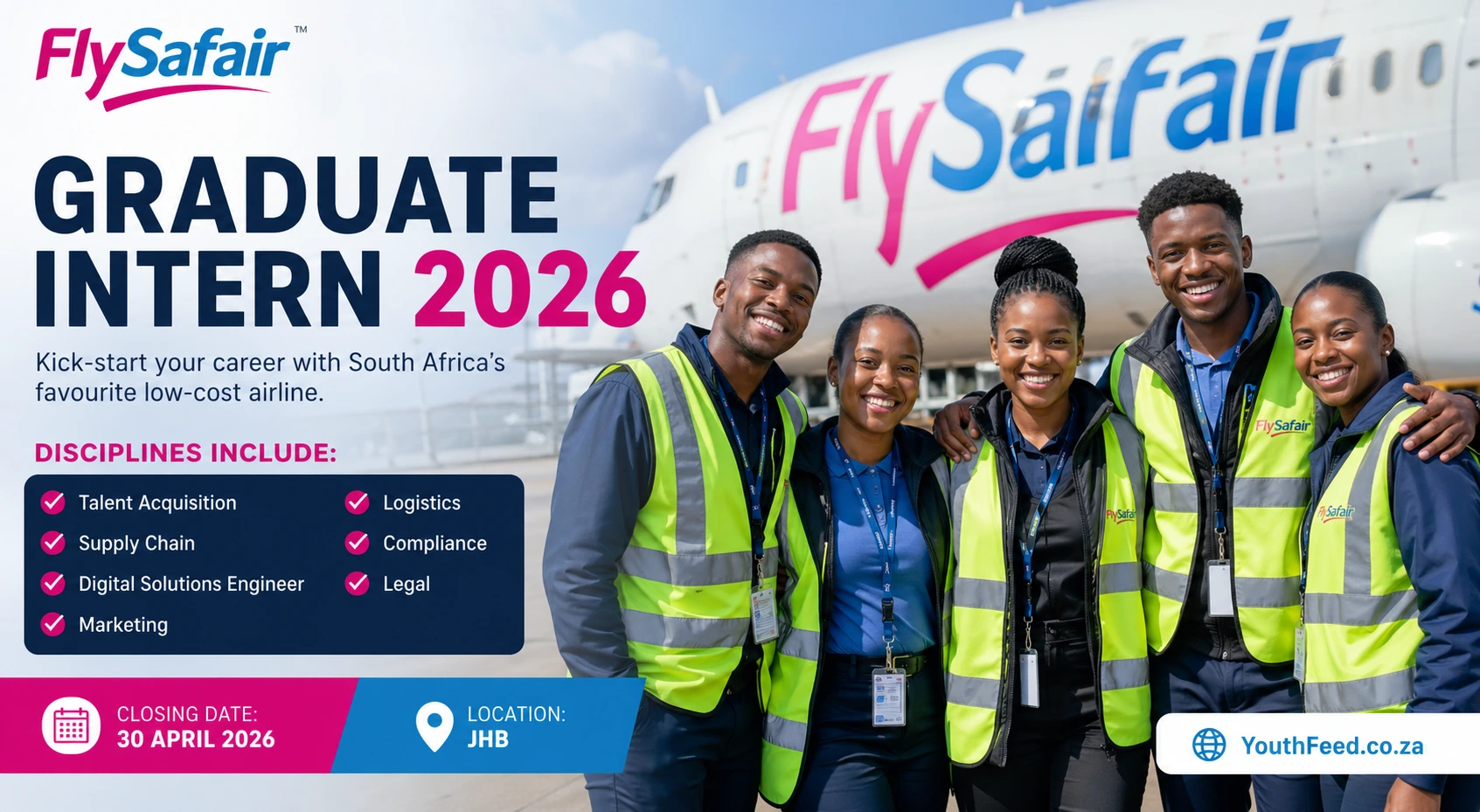
The conversation around the FlySafair Graduate Intern programme is growing quickly and not only because applications are now open.
At a time when graduate unemployment remains one of South Africa’s biggest economic concerns, opportunities connected to well-known national brands tend to generate immediate interest. But the FlySafair Graduate Intern 2026 intake feels different. It arrives during a moment when aviation, logistics, digital operations, and customer-focused industries are evolving rapidly, creating pressure for companies to develop younger talent pipelines faster than before.
That is partly why this internship announcement has started gaining traction among graduates on LinkedIn, student networks, and career-focused online communities. The programme is not limited to one department or one narrow technical field. Instead, it stretches across talent acquisition, supply chain, digital solutions engineering, marketing, logistics, compliance, and legal functions — giving applicants from multiple academic backgrounds a possible entry point into one of South Africa’s most recognizable airline brands.
For many graduates, that breadth matters.
The modern internship market has become intensely competitive. Employers increasingly look for adaptable candidates who can work across systems, manage pressure, and contribute quickly inside fast-paced environments. FlySafair’s requirements and personality expectations reflect exactly that shift.
And in 2026, career programmes linked to operational industries are becoming more attractive again.
The Bigger Story Behind the Opportunity
To understand why the FlySafair Graduate Intern programme is receiving attention, it helps to look at how the graduate employment landscape has changed over the past few years.
South African graduates are entering a market where experience often matters almost as much as qualifications. Many entry-level positions now expect candidates to already understand workplace systems, communication workflows, reporting structures, and digital collaboration tools.
That creates a difficult cycle:
Graduates need experience to get jobs, but they need jobs to gain experience.
Internship programmes have increasingly become the bridge between education and long-term employment. Companies that offer structured graduate exposure are often viewed as more desirable because they give young professionals a chance to build practical credibility early.
FlySafair’s internship intake appears designed around that exact reality.
The programme emphasizes operational support, administrative coordination, research, compliance, project assistance, and cross-team collaboration. These are not glamorous buzzwords. They are the types of responsibilities that teach graduates how organizations actually function day-to-day.
In many industries, especially aviation and logistics, those foundational skills matter enormously.
The Roles Available in the FlySafair Graduate Intern Programme
The 2026 intake includes opportunities in several disciplines:
- Talent Acquisition Graduate
- Supply Chain Graduate
- Digital Solutions Engineer
- Marketing
- Logistics
- Compliance
- Legal
That range is significant because it reflects how modern airlines operate far beyond aircraft alone.
Aviation businesses today function as complex ecosystems involving technology systems, regulatory compliance, customer communication, logistics coordination, staffing operations, and digital infrastructure.
For graduates, this means the internship may offer exposure to industries that are interconnected with aviation itself — including operations management, analytics, digital transformation, and workforce planning.
The inclusion of Digital Solutions Engineering is particularly interesting.
As airlines increasingly depend on automation, digital customer systems, operational software, and data-driven decision-making, technology-focused graduates are becoming central to operational efficiency. The aviation industry globally has been investing heavily in digital modernization, and internship roles connected to these areas may become more valuable over time.
Meanwhile, supply chain and logistics functions continue to gain importance across South Africa’s broader economy.
ALSO APPLY FOR : Fraser Alexander SHEQ Programme 2026
Why the Internship Is Resonating With Graduates
Part of the interest surrounding the FlySafair Graduate Intern opportunity comes from the company’s public reputation.
FlySafair has built a strong identity around affordability, operational efficiency, and visibility within the domestic travel market. For graduates, recognizable employers can carry career value even beyond the internship itself.
A well-known company name on a CV can influence future applications, especially for candidates attempting to establish credibility early in their careers.
But reputation alone is not enough anymore.
Graduates are increasingly evaluating opportunities based on workplace exposure, learning potential, and adaptability. Many young professionals now want roles that help them build transferable skills rather than locking them into narrow functions too early.
The internship’s focus on:
- collaboration,
- administrative support,
- research,
- operational assistance,
- compliance awareness,
- and analytical thinking
suggests that successful candidates may develop broadly applicable workplace experience.
That matters in an economy where career paths are becoming less predictable.
A Fast-Paced Environment Is Not for Everyone
One detail in the internship description stands out clearly: the emphasis on pressure management and urgency.
FlySafair specifically highlights the ability to thrive in fast-paced and high-pressure environments.
That wording is important because it signals the likely pace of the workplace culture.
Airline operations are deeply time-sensitive. Delays, scheduling changes, operational disruptions, staffing coordination, and customer expectations all create environments where efficiency matters constantly.
For graduates accustomed to academic environments, the transition into operational workplaces can sometimes be challenging.
However, employers increasingly value adaptability over perfection. The programme’s emphasis on learning orientation suggests that FlySafair may be prioritizing candidates who demonstrate growth potential and willingness to learn quickly.
In practice, that could benefit graduates who may not have extensive prior experience but can show initiative, professionalism, and communication ability.
ALSO APPLY FOR: Afrimat Sales Internship 2026
Why This Matters Right Now
The timing of the FlySafair Graduate Intern programme matters for several reasons.
First, South Africa’s graduate employment environment remains highly competitive. Many students completing diplomas and degrees are actively searching for structured workplace entry opportunities.
Second, industries connected to transport, logistics, and digital operations are continuing to evolve quickly. Businesses increasingly need graduates who can adapt to technology-driven workflows while also managing operational realities.
Third, internship programmes are no longer viewed merely as short-term learning experiences. For many companies, internships have become talent pipelines.
Graduates know this.
A strong internship can sometimes lead to permanent employment, industry connections, references, or future opportunities elsewhere. Even where permanent placement is not guaranteed, practical exposure often strengthens future employability.
There is also another factor influencing interest:
Many young South Africans are becoming more strategic about career positioning. Instead of waiting for “perfect” opportunities, graduates are increasingly pursuing roles that provide recognizable experience, exposure to structured systems, and operational understanding.
The FlySafair Graduate Intern programme fits into that broader trend.
Public Reaction and Online Discussion
Although the programme itself is relatively straightforward, online reaction reflects larger frustrations and hopes around graduate employment.
Career-focused social media discussions frequently show graduates sharing opportunities rapidly, especially those connected to established employers.
Several themes typically emerge in conversations around internships like this:
- concern about limited graduate opportunities,
- competition between applicants,
- pressure to gain experience quickly,
- and optimism around recognizable employers.
There is also growing awareness among graduates that soft skills increasingly matter alongside academic qualifications.
FlySafair’s listed personality attributes reinforce that shift. The company highlights urgency, professionalism, communication, initiative, customer service orientation, and attention to detail.
Those qualities align closely with broader employer expectations across multiple sectors in 2026.
Interestingly, the internship does not appear to market itself through exaggerated promises. The description remains practical and operational rather than overly promotional. That restrained approach may actually increase credibility among applicants who are becoming more cautious about vague graduate programmes with unclear outcomes.
The Structure of the Opportunity
The internship runs on a 12-month employment contract.
That duration is long enough for graduates to gain meaningful workplace exposure while still functioning as an entry-level developmental opportunity.
The programme requires:
- Grade 12 or equivalent,
- a relevant diploma or degree,
- Microsoft Office proficiency,
- organizational skills,
- analytical ability,
- and strong communication.
These requirements may appear standard, but they reflect how administrative and digital fluency are now considered baseline expectations in many professional environments.
The continued importance of Microsoft Office proficiency also says something about workplace realities.
Despite growing interest in advanced digital tools and AI systems, many organizations still rely heavily on spreadsheets, presentations, reporting systems, and operational documentation. Graduates who combine technical adaptability with strong administrative execution often stand out.
The Importance of Compliance and Operational Discipline
One often-overlooked detail in graduate programmes linked to aviation is the importance of compliance culture.
FlySafair specifically mentions compliance responsibilities and adherence to company procedures.
That may sound routine, but in aviation-related industries, procedural discipline is critical. Operational systems depend heavily on consistency, documentation, communication accuracy, and regulatory alignment.
Graduates exposed to these environments may develop professional habits that remain valuable throughout their careers.
Even candidates working in marketing or talent acquisition within aviation businesses may still operate inside highly structured organizational systems compared to some other industries.
What Could Happen Next
The immediate next step is clear: applications close on 30 April 2026.
But the broader implications extend beyond this specific recruitment cycle.
If programmes like the FlySafair Graduate Intern intake continue attracting high interest, more companies may expand graduate pipelines to compete for emerging talent earlier. Employers increasingly understand that young professionals evaluate workplace culture, learning potential, and employer reputation carefully.
We may also see stronger integration between graduate internships and long-term workforce planning.
Several industries in South Africa are dealing with skills transitions linked to digital systems, operational modernization, and evolving customer expectations. Graduate programmes can help organizations develop talent internally rather than relying entirely on experienced external hires.
For applicants themselves, the next phase could involve increasingly competitive screening processes.
The internship description already emphasizes:
- analytical thinking,
- communication,
- urgency,
- initiative,
- and adaptability.
That suggests employers may continue prioritizing behavioural strengths alongside academic credentials.
Graduates who can demonstrate practical thinking, reliability, and learning agility may have stronger advantages moving forward.
The Growing Value of Operational Experience
One reason opportunities like this continue attracting attention is because operational exposure remains highly valuable across industries.
A graduate who understands:
- deadlines,
- reporting systems,
- team collaboration,
- documentation,
- customer interaction,
- and workplace accountability
often becomes more employable long-term.
Even if candidates eventually move into entirely different industries, early experience inside structured environments can shape professional confidence significantly.
That is especially relevant for graduates entering uncertain economic conditions where adaptability increasingly matters more than rigid specialization.
APPLY HERE: FlySafair Graduate Intern 2026
FAQ: FlySafair Graduate Intern 2026
1. What is the closing date for the FlySafair Graduate Intern programme?
The closing date for applications is 30 April 2026.
2. How long is the internship contract?
Successful candidates will enter into a 12-month employment contract.
3. Which fields are included in the programme?
The internship includes Talent Acquisition, Supply Chain, Digital Solutions Engineering, Marketing, Logistics, Compliance, and Legal.
4. What qualifications are required?
Applicants must have Grade 12 and a relevant diploma or degree qualification.
5. Where is the FlySafair Graduate Intern programme based?
The internship opportunity is located in Johannesburg (JHB).
Final Thoughts
The FlySafair Graduate Intern 2026 programme reflects more than a routine internship announcement.
It highlights several broader shifts happening across South Africa’s graduate employment landscape:
- the growing importance of practical exposure,
- the rise of operational and digital skill demands,
- the value of adaptability,
- and the increasing competition for credible workplace experience.
For many applicants, this opportunity may represent a first meaningful step into a professional environment that moves quickly, expects accountability, and rewards learning agility.
Not every graduate programme generates sustained attention. But internships connected to recognizable employers, multiple disciplines, and structured operational environments tend to stand out — especially during periods where young professionals are searching for stability, growth, and practical career momentum.
And that is precisely why the FlySafair Graduate Intern programme is drawing attention right now.
READY TO PUBLISH