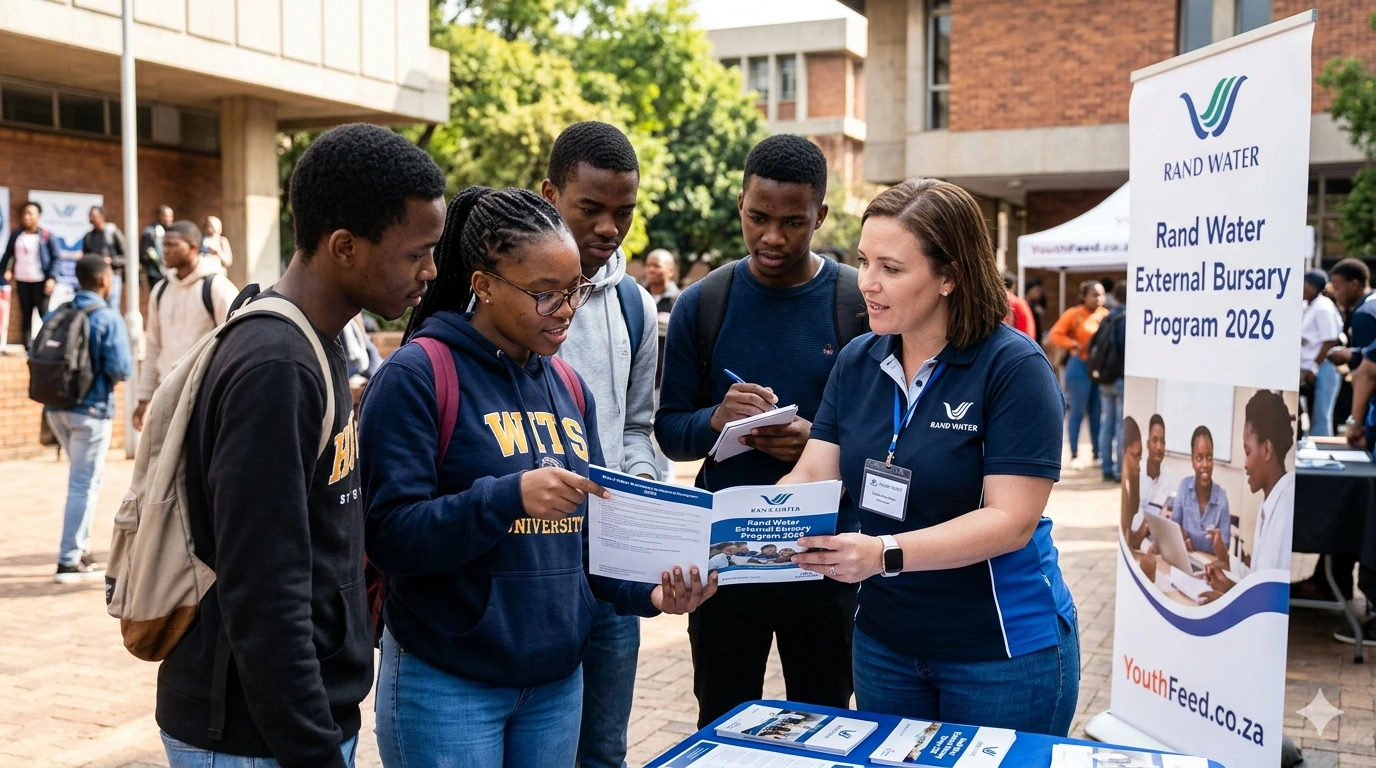
The conversation around the Rand Water External Bursary Program is growing rapidly among South African students and not only because funding opportunities remain limited in 2026.
What is making this bursary stand out is the combination of timing, sector relevance, and the broader pressure facing young graduates trying to enter technical industries linked to infrastructure, water security, engineering, and public service. At a moment when South Africa continues to debate service delivery, aging infrastructure, and skills shortages, Rand Water’s latest bursary intake feels connected to a much bigger national conversation.
Applications officially close on 7 May 2026, and the programme targets students in fields ranging from civil engineering and water science to accounting, microbiology, law, architecture, and public health. But beyond the application details themselves, the bursary reflects how state-linked entities are increasingly trying to secure future technical talent before shortages become even more severe.
That is one reason the programme is trending among university students, career pages, and graduate opportunity platforms right now.
A Bursary That Reflects South Africa’s Bigger Infrastructure Challenges
For years, South Africa’s water sector has faced mounting pressure.
Municipal infrastructure failures, water interruptions, aging pipelines, population growth, climate stress, and technical capacity shortages have all contributed to concerns about long-term sustainability. Water is no longer viewed only as a utility issue it has become an economic, environmental, and public health issue too.
Against that backdrop, the Rand Water External Bursary Program appears strategically designed.
The bursary focuses heavily on scarce and technically demanding disciplines:
- Civil Engineering
- Water Science and Sanitation Science
- Mechanical Engineering
- Electrical/Electronic Engineering
- Microbiology
- Chemistry
- Geomatics and Surveying
- Public Health
These are not random selections.
They align directly with the types of skills increasingly needed to maintain and modernize critical infrastructure systems across the country.
Rand Water, one of the largest bulk water utilities in Africa, has long played a central role in supplying water across Gauteng and surrounding areas. Its operational footprint means the organization depends on highly specialized professionals engineers, scientists, technicians, legal experts, planners, and analysts — to sustain its mandate.
The bursary programme therefore serves two purposes simultaneously:
- Supporting financially constrained students.
- Building a future pipeline of sector-specific talent.
That dual purpose explains why many students see this opportunity as more meaningful than a standard corporate bursary.
ALSO APPLY FOR ISACA Foundation 2026 Scholarships
Why Students Are Paying Close Attention
The reality for many South African students in 2026 is difficult.
University costs continue rising. Graduate unemployment remains high. Competition for internships and learnerships is intense. Even academically strong students often struggle to secure stable funding after first year.
That context matters when examining public reaction to this bursary.
The programme specifically targets undergraduate and postgraduate students already studying within approved disciplines, while requiring:
- A minimum average of 65%
- Full-time registration at a recognized institution
- South African citizenship
- Previously disadvantaged background consideration
- No existing bursary or funding support
- Applicants under 35 years old
For many students, those requirements feel attainable compared to highly restrictive funding programmes that demand exceptional distinctions or elite institutional backgrounds.
The bursary also spans multiple academic levels:
- First-year students
- Second-year students
- Honours students
- Master’s-level public health students
That broad academic coverage increases accessibility and widens the applicant pool significantly.
Another reason for strong interest is the perception of sector stability.
While many industries face automation fears or hiring slowdowns, infrastructure and water management are still viewed as essential long-term sectors. Students increasingly want qualifications linked to industries with durable demand rather than purely trend-driven career paths.
The Disciplines Receiving the Most Attention
Among the listed qualifications, engineering opportunities are generating particularly strong interest online.
The programme includes:
- BTech or BSc Civil Engineering
- Electrical/Electronic Engineering
- Mechanical Engineering
Engineering bursaries remain highly competitive nationwide because tuition costs are often substantial, while the long-term earning potential remains attractive.
But there is another interesting trend emerging: growing attention around water-related sciences.
The inclusion of:
- Water Science and Sanitation Science
- Water Science and Technology
- Microbiology
- Chemistry
signals how specialized environmental and scientific careers are becoming more important in public-sector planning.
In previous years, many students overlooked water-sector careers in favor of finance, IT, or traditional corporate pathways. But increasing environmental pressure and infrastructure investment discussions are slowly changing that perception.
There is also growing recognition that water security is directly connected to economic growth, healthcare systems, urban development, and climate resilience.
That broader awareness may partly explain why this bursary is attracting attention beyond engineering circles alone.
Read More: How NSFAS Funding Works: A Practical Guide for South African Students
Recent Developments Driving Interest in Public Sector Bursaries
Another factor shaping interest is the shifting perception of public-sector opportunities.
For a period, many graduates viewed private-sector employment as the only attractive route. But over the past few years, public entities tied to infrastructure, energy, transport, and utilities have increasingly repositioned themselves as spaces for meaningful technical careers.
This shift has happened for several reasons:
- Infrastructure renewal discussions have intensified.
- South Africa’s skills shortages have become more visible.
- Technical expertise is increasingly linked to national development goals.
- Public-sector engineering projects remain large-scale and impactful.
At the same time, graduate unemployment has encouraged students to prioritize opportunities connected to industries with long-term operational relevance.
Water utilities fall into that category.
Unlike trend-based industries that fluctuate quickly, water management remains permanently necessary. That creates a perception of stability that many students and families find reassuring.
Why This Matters Right Now
The Rand Water External Bursary Program matters beyond the immediate funding opportunity because it reflects a deeper issue confronting South Africa: the urgent need to rebuild technical capacity.
The country’s infrastructure future depends heavily on whether young professionals enter critical fields at sufficient scale.
Without new engineers, scientists, planners, and public health specialists, existing infrastructure challenges become harder to solve over time.
The bursary therefore represents more than student assistance.
It becomes part of a broader investment in national capability.
This matters especially now because South Africa faces simultaneous pressure points:
- Urban population growth
- Climate-related water risks
- Aging municipal systems
- Service delivery concerns
- Graduate unemployment
- Skills migration abroad
When viewed through that lens, bursary programmes tied to scarce skills carry broader economic importance.
There is also a symbolic aspect to programmes like this.
Many students want opportunities that feel connected to real-world impact. Water security, sanitation systems, and infrastructure maintenance are tangible public needs. Careers linked to those areas can feel more purposeful than purely commercial pathways.
That emotional factor should not be underestimated.
The Competitive Reality Applicants Should Understand
Despite growing excitement, applicants should remain realistic about competition levels.
The available placements are limited:
- Civil Engineering: 2
- Water Science and Sanitation Science: 1
- Chemistry Honours: 1
- Water Science and Technology Diploma: 1
- Architecture: 1
- Electrical/Electronic Engineering: 4
- Geomatics/Surveying: 1
- Mechanical Engineering: 1
- Accounting: 1
- LLB: 3
- Microbiology Honours: 1
- Master of Public Health: 1
Those numbers indicate a highly selective process.
The requirement for a minimum 65% average also means applicants need strong academic consistency rather than last-minute improvement.
Students are additionally expected to complete qualifications within record time under the bursary agreement, suggesting Rand Water prioritizes performance accountability.
The supporting documentation requirements include:
- Certified ID copy
- Certified matric certificate
- Latest academic record
- Proof of current registration
Administrative accuracy often matters more than applicants realize. Incomplete applications can eliminate otherwise qualified candidates early in the process.
Public Reaction and Online Discussion
Across student communities and opportunity-sharing platforms, the response has largely been positive.
Several themes repeatedly appear in discussions:
1. Relief Over Sector-Relevant Funding
Students appreciate bursaries directly aligned with high-demand careers rather than generic sponsorships lacking industry connection.
2. Increased Interest in Water Careers
There is visible curiosity around careers previously considered niche, especially sanitation science and water technology.
3. Concerns About Limited Spaces
Many students acknowledge the programme’s value while noting the relatively small intake numbers.
4. Appreciation for Academic Inclusivity
The inclusion of multiple qualification types — from diplomas to postgraduate study — is viewed favorably.
The overall tone surrounding the bursary has been more optimistic than cynical, which is notable in a climate where young people often express frustration about limited opportunities.
What Could Happen Next
The broader impact of programmes like this may become clearer over the next few years.
Several possible developments could emerge.
Greater Expansion of Infrastructure-Focused Funding
If technical skills shortages continue intensifying, more public entities may increase bursary investment in engineering, environmental science, and infrastructure-related disciplines.
Increased Competition for Scarce-Skills Programmes
As students recognize which industries offer stronger long-term employment prospects, competition for specialized bursaries could rise significantly.
Stronger Partnerships Between Universities and Utilities
Future programmes may involve deeper collaboration between tertiary institutions and infrastructure organizations to improve graduate readiness.
More Attention on Water Security Careers
Water-sector professions may gradually gain greater visibility among younger students, especially as climate and infrastructure discussions become more urgent globally.
Pressure for Better Graduate Placement Pathways
Students increasingly expect bursaries to connect with meaningful workplace opportunities afterward. Organizations may face growing pressure to strengthen transition pathways into employment.
APPLY HERE: Rand Water External Bursary Program 2026
FAQ: Rand Water External Bursary Program 2026
Who can apply for the Rand Water External Bursary Program?
South African students under 35 who are full-time students in approved fields and meet the academic requirements can apply.
What is the minimum academic requirement?
Applicants must generally maintain at least a 65% average, particularly in major subjects.
Does the bursary cover postgraduate studies?
Yes. Selected postgraduate qualifications like BSc Honours and Master of Public Health are included.
Can students with another bursary apply?
No. Applicants already receiving another bursary or funding support are not eligible.
When is the closing date?
Applications close on 7 May 2026.
The Bigger Picture Behind the Opportunity
The most interesting aspect of the Rand Water External Bursary Program may ultimately be what it represents symbolically.
At a time when many young South Africans feel uncertain about economic mobility, opportunities tied to practical national development carry unusual weight.
Engineering, water science, sanitation, and public health are not glamorous industries in the social-media sense. Yet they remain foundational to how cities function, how economies grow, and how communities stay healthy.
That creates an unusual contrast.
The sectors attracting the loudest online attention are not always the sectors most essential to long-term national stability.
This bursary quietly highlights that difference.
It points toward careers built around systems, infrastructure, sustainability, and technical problem-solving — areas that may become increasingly valuable in the coming decade.
For students already studying within these disciplines, the programme represents financial support.
For the broader public, it also serves as a reminder that solving infrastructure challenges ultimately depends on whether enough skilled young professionals are prepared to step into those roles.
And that may be the real reason this bursary is drawing attention right now.