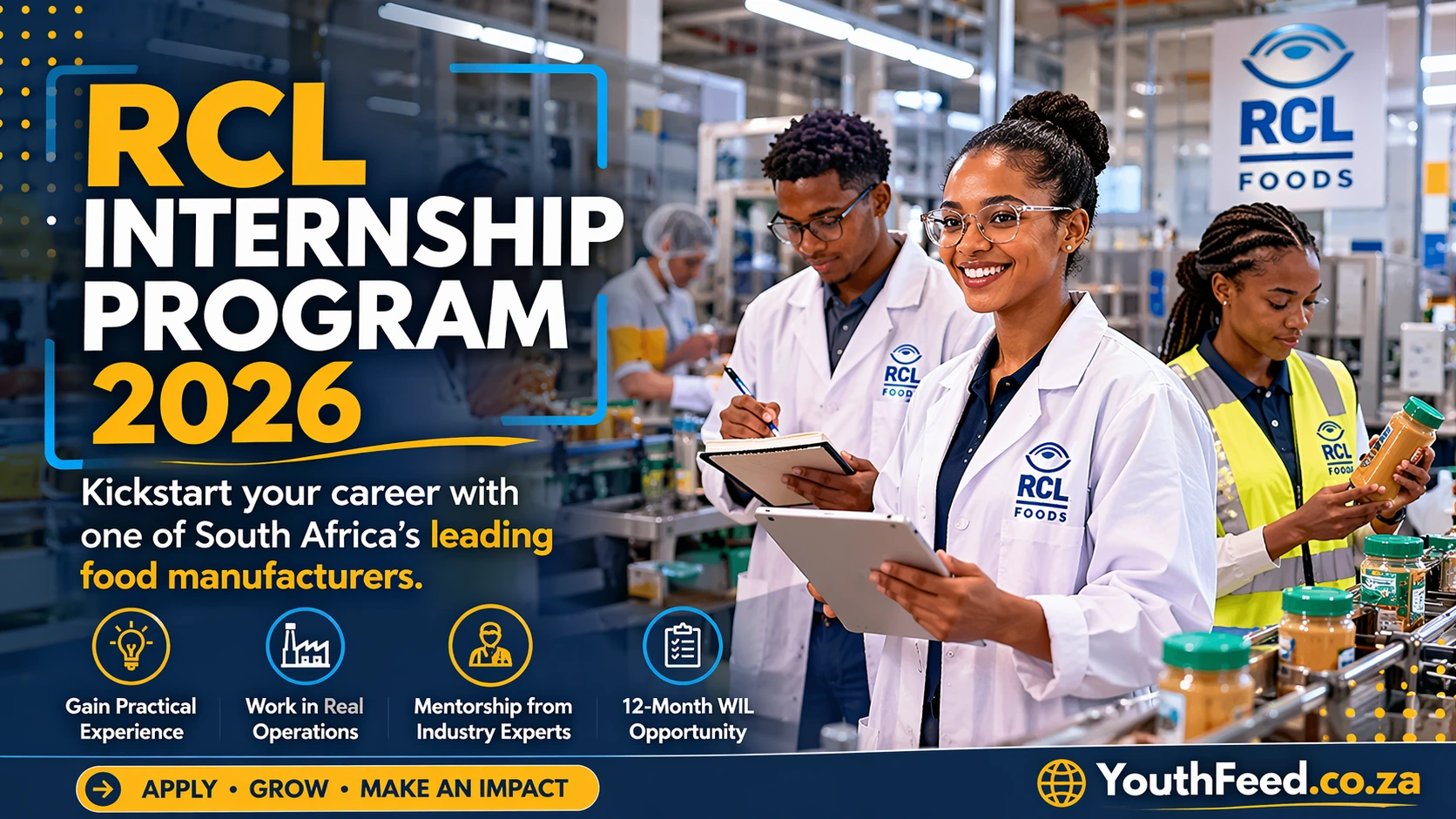
There’s a quiet shift happening in South Africa’s graduate landscape and it’s gaining momentum faster than many expected. The RCL Internship Program is emerging as one of the most talked-about opportunities among students in engineering, food science, and supply chain disciplines. Not because it’s flashy, but because it reflects something deeper: a renewed focus on practical, industry-rooted experience at a time when graduates are demanding more than just theory.
With applications for the 2026 intake recently closing on April 17, attention has turned from “how to apply” to “what this program really represents.” And that’s where things get interesting.
A Grounded Opportunity from a Household Name
At the center of this conversation is RCL Foods, a company deeply embedded in South Africa’s daily life. From pantry staples like Yum Yum peanut butter to Ouma rusks and Nola mayonnaise, its brands are familiar to millions.
But beyond supermarket shelves, RCL Foods has been steadily shaping something else: a talent pipeline aligned with its purpose—“We Grow What Matters.”
The RCL Internship Program 2026, based in Randfontein, Gauteng, is part of that long-term strategy. It targets students who are still completing their diplomas and require 12 months of Work Integrated Learning (WIL)—a requirement that has become increasingly difficult to fulfill in a competitive job market.
Unlike many internships that function as short-term exposure, this one is designed to be immersive. Interns enter the Groceries Operating Unit and engage directly with operations, manufacturing processes, and supply chain systems. It’s less about shadowing and more about contributing.
How We Got Here: The Rise of Work-Integrated Learning
To understand why the RCL Internship Program is trending now, you need to look at the broader evolution of South Africa’s education-to-employment pathway.
Over the past decade, universities and TVET colleges have placed increasing emphasis on WIL. The idea is simple: bridge the gap between classroom knowledge and real-world application. But the execution has been uneven.
Many students struggle to secure placements, leaving them unable to graduate despite completing academic requirements. This bottleneck has created a surge in demand for structured internship programs—especially those tied to reputable companies.
RCL Foods’ approach stands out because it aligns closely with academic requirements:
- It specifically targets students who must complete WIL
- It offers structured mentorship
- It integrates interns into actual business operations
In a landscape where some internships are criticized for being superficial, this model feels more intentional—and that’s a big part of why it’s gaining traction.
Also APPLY HERE: Digby Wells Environmental GIS Internships 2026
What Makes This Internship Different?
There’s no shortage of internships advertised each year, so what’s driving attention toward this one?
First, the disciplines it targets are highly practical and industry-critical:
- Food Technology and Biotechnology
- Chemistry and Microbiology
- Chemical and Industrial Engineering
- Operations Management
- Procurement and Supply Chain
These aren’t abstract fields—they’re directly tied to production, efficiency, and quality control. In other words, interns aren’t just observing; they’re entering environments where precision and performance matter.
Second, the program emphasizes on-the-job training over theoretical assignments. Interns are exposed to:
- Manufacturing processes
- Quality assurance systems
- Supply chain logistics
- Operational problem-solving
This kind of exposure is increasingly valued by employers, who often prioritize experience over academic results alone.
And yet, academic performance still matters here. Strong records, analytical thinking, and communication skills are all part of the minimum requirements. It’s a reminder that while experience is critical, foundational knowledge still counts.
Recent Developments: Why the Buzz Now?
The timing of the RCL Internship Program 2026 has amplified its visibility.
Several factors have converged:
1. Increased Competition for WIL Placements
Students across South Africa are reporting greater difficulty in securing placements. As a result, programs like this are being shared widely across student networks and platforms.
2. Shift Toward Industry-Relevant Skills
There’s growing awareness that degrees alone are no longer enough. Programs offering tangible, measurable experience are becoming more attractive.
3. Employer Branding Strategies
Companies like RCL Foods are investing more in early talent engagement. Internships are no longer just HR functions—they’re strategic tools for building future workforces.
4. Digital Amplification
Opportunities like this are being discussed more actively on platforms focused on youth employment and career development, increasing their reach.
Together, these trends have pushed the RCL Internship Program into the spotlight—not as a one-off opportunity, but as part of a larger shift in how careers begin.
ALSO APPLY FOR:Dis-Chem Dispensary Support Learnerships 2026
Public Reaction: Optimism with a Dose of Realism
Among students, the response has been largely positive—but not without nuance.
Many see the program as a rare chance to gain meaningful experience in a structured environment. The emphasis on mentorship and real projects resonates strongly, especially for those in technical fields.
At the same time, there’s an underlying awareness of how competitive these opportunities are. Requirements such as strong academic records and the condition that applicants must not have completed WIL before create a narrow entry point.
There’s also a broader conversation about access. While programs like this are valuable, they highlight the ongoing challenge: there simply aren’t enough placements to meet demand.
Still, the general sentiment leans toward optimism. Opportunities that combine credibility, structure, and real-world exposure are seen as stepping stones—not guarantees, but meaningful progress.
Why This Matters Right Now
The relevance of the RCL Internship Program goes beyond a single intake cycle.
South Africa is facing a persistent youth unemployment challenge, and one of the critical gaps lies between education and employment. Graduates often leave institutions with theoretical knowledge but limited practical experience.
Programs like this address that gap directly.
They:
- Provide hands-on exposure in key industries
- Help students meet graduation requirements
- Build confidence and professional readiness
- Create pathways into long-term employment
In the context of 2026, where economic pressures and technological shifts are reshaping industries, the ability to adapt quickly is crucial. Internships that simulate real working environments are becoming essential—not optional.
This is why the conversation around the RCL Internship Program feels bigger than the program itself. It represents a model that could influence how companies approach talent development across the country.
What Could Happen Next
Looking ahead, several possibilities emerge.
Expansion of Similar Programs
If initiatives like this continue to gain attention, more companies may adopt similar models. Structured WIL internships could become a standard offering rather than a limited opportunity.
Stronger Industry-Academic Partnerships
There’s potential for deeper collaboration between companies and educational institutions. Aligning curricula with industry needs could make transitions smoother for students.
Increased Competition—and Specialization
As more students recognize the value of these programs, competition will intensify. This could lead to more specialized internships targeting niche skills.
Greater Focus on Measurable Outcomes
Companies may begin tracking the long-term impact of internships—such as conversion to full-time roles or career progression—making programs more outcome-driven.
Policy-Level Attention
Given the scale of youth unemployment, there’s a possibility that government and industry stakeholders will place greater emphasis on expanding WIL opportunities nationwide.
None of these outcomes are guaranteed. But the direction is clear: internships are no longer peripheral—they’re central to workforce development.
APPLY HERE: RCL Internship Program 2026
FAQ: RCL Internship Program 2026
1. Who can apply for the RCL Internship Program 2026?
Students currently studying toward a diploma in fields like Food Technology, Engineering, Chemistry, or Supply Chain Management who require 12 months of WIL.
2. Where is the internship located?
The program is based in Randfontein, Gauteng, within RCL Foods’ Groceries Operating Unit.
3. What is the duration of the internship?
It typically runs for 12 months to fulfill Work Integrated Learning requirements.
4. What skills are required?
Strong academic performance, analytical thinking, problem-solving ability, and good communication skills.
5. When did applications close?
Applications for the 2026 intake closed on April 17, 2026.
The Bigger Picture
What the RCL Internship Program 2026 ultimately highlights is a shift in expectations.
Students are no longer satisfied with passive learning. They want engagement, exposure, and experience that translates into real opportunities.
Employers, on the other hand, are recognizing the value of investing early in talent. Internships are becoming a way to shape future employees rather than simply evaluate them.
And somewhere in between, programs like this are creating a bridge.
It’s not a perfect system. Access remains limited, competition is high, and outcomes vary. But it’s a step toward something more aligned—where education and industry are not separate worlds, but connected stages of the same journey.