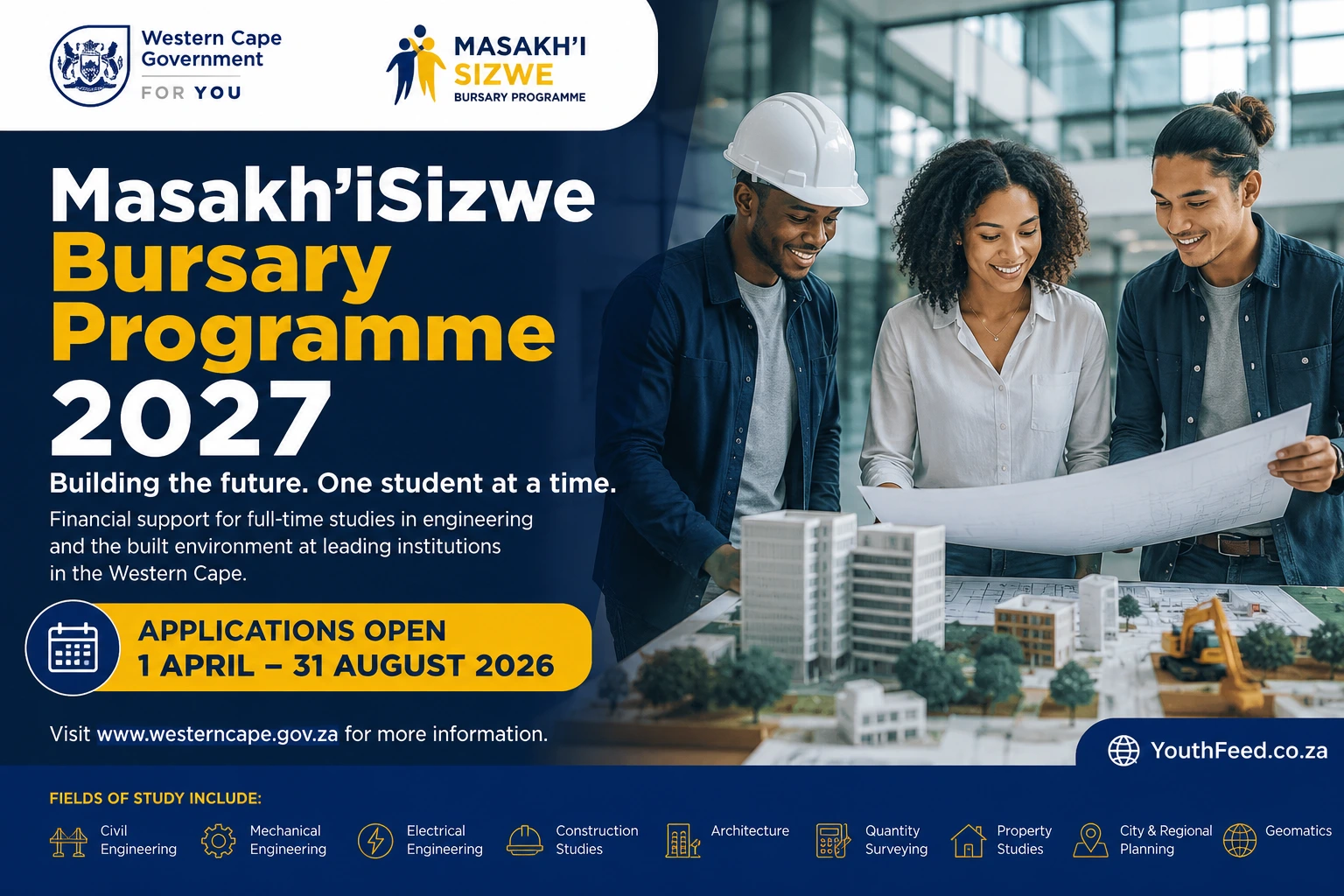
The Masakh’iSizwe Bursary Programme is already generating attention among students planning their 2027 academic journey and for good reason. At a time when university costs continue to rise and South Africa’s youth unemployment crisis remains a national concern, bursaries linked to scarce skills and employment pathways are attracting far more interest than they did just a few years ago.
But what makes this programme stand out is not simply the financial support.
The Masakh’iSizwe Bursary Programme has increasingly become part of a bigger conversation about infrastructure development, professional skills shortages, and how provinces are trying to build long-term talent pipelines from within their own communities. In the Western Cape especially, engineering and built environment careers are being positioned as essential to future economic growth, public infrastructure delivery, and urban expansion.
Now that applications for the 2027 intake officially open from 1 April 2026 and close on 31 August 2026, students across the province are paying close attention particularly those hoping to study at institutions like University of Cape Town, Stellenbosch University, and Cape Peninsula University of Technology.
And unlike many bursaries that quietly disappear into university funding lists, this one continues to attract public discussion because of its direct link to government infrastructure careers.
Why the Masakh’iSizwe Bursary Programme Is Trending Again
The renewed interest around the Masakh’iSizwe Bursary Programme comes at a moment when thousands of students are reassessing which qualifications actually lead to sustainable employment.
Degrees alone are no longer viewed as guarantees.
That shift has changed how families evaluate bursary opportunities. Increasingly, programmes tied to industries with long-term demand engineering, construction, urban planning, infrastructure, and technical services are seen as more strategic investments.
The Western Cape Department of Infrastructure has positioned the bursary accordingly. Rather than funding a broad range of qualifications, the programme focuses heavily on engineering and built environment disciplines that are considered critical to future development projects.
These include:
- Civil Engineering
- Mechanical Engineering
- Electrical Engineering (Heavy Current)
- Quantity Surveying
- Construction Studies
- Architecture
- Property Studies
- Geomatics
- City and Regional Planning
In practical terms, the bursary is designed to produce graduates who may eventually contribute to public infrastructure delivery in the province.
That bigger purpose is one reason the programme continues to stand out.
The Bigger Story Behind the Programme
South Africa’s infrastructure challenges are not new. Roads, transport systems, public buildings, housing projects, water systems, and energy infrastructure all require skilled professionals to plan, manage, and maintain them.
Yet across the country, government departments and private firms have repeatedly warned about shortages in technical and engineering fields.
The Masakh’iSizwe Bursary Programme emerged partly as a response to that reality.
Rather than relying only on recruiting professionals later, the province has increasingly focused on developing students earlier through bursaries, mentorship exposure, and professional development pipelines.
That strategy also reflects another challenge: access.
Many talented students from rural towns or financially disadvantaged households never enter engineering or built environment careers because of the high cost of tuition, accommodation, books, and transport. Technical qualifications are often more expensive than standard degree pathways due to equipment, materials, software, and practical training requirements.
By covering tuition fees, prescribed books, accommodation or transport costs, meals, and support programmes, the bursary attempts to reduce some of those barriers.
Importantly, the programme also gives preference to:
- Financially disadvantaged applicants
- Female learners
- Persons with disabilities
- Applicants from outside the Cape Metro
That priority system reflects ongoing attempts to diversify industries historically dominated by unequal access patterns.
Also apply for Power Construction Civil Engineering Bursaries 2026
What the Bursary Actually Covers
One reason students continue discussing the Masakh’iSizwe Bursary Programme online is because the funding package is relatively comprehensive compared to partial bursaries.
The programme covers:
- Tuition fees
- Prescribed books and study materials
- Accommodation and meals or transport costs
- Support programmes
For students entering demanding fields like engineering or architecture, that support can make a major difference.
Many bursary recipients in technical programmes struggle not only with tuition but with software costs, project materials, transportation to campuses, and living expenses. Full support structures are becoming increasingly important as the cost of higher education continues rising.
However, applicants should understand that the bursary is highly structured.
Successful candidates may be required to:
- Attend workshops and meetings
- Participate in outreach programmes
- Complete experiential training during studies
After graduation, bursars employed by the Department of Infrastructure may also undergo professional development training aimed at professional registration.
In other words, the programme is not simply financial aid — it functions more like a long-term professional pipeline.
Strict Eligibility Requirements Mean Competition Will Be High
One of the biggest realities students should prepare for is competitiveness.
The Masakh’iSizwe Bursary Programme is not open to all universities nationwide. It applies specifically to students studying or intending to study full-time at:
- University of Cape Town
- Stellenbosch University
- Cape Peninsula University of Technology
Applicants must also:
- Be South African citizens
- Study within approved engineering or built environment disciplines
- Intend to study full-time in the Western Cape
And the document requirements are extensive.
Applicants must submit certified copies of IDs, academic records, proof of registration or application, study cost estimates, proof of address, financial documentation, and a motivation letter.
Additional supporting documents may also be required for financial aid status, disability status, or existing debt.
That level of detail signals how carefully bursary allocations are assessed.
It also reflects growing pressure on government bursary programmes to demonstrate accountability and transparent selection processes.
Public Reaction: Hope, Anxiety, and Growing Competition
Among students, the reaction to the 2027 application announcement has been mixed but highly engaged.
For many matric learners and university students, the bursary represents a realistic opportunity to continue studies that might otherwise become financially impossible.
Social media discussions around bursaries increasingly reveal how students are comparing funding opportunities based not just on money, but also career outcomes and institutional reputation.
Because the Masakh’iSizwe Bursary Programme is linked to major Western Cape universities and technical careers, it tends to generate strong interest every year.
At the same time, anxiety around competition remains high.
The number of bursaries awarded depends on available funding and departmental priority study fields. That means even qualified students may not receive support if demand exceeds available allocations.
The programme’s warning that unsuccessful applicants may receive no response after 12 February 2027 also highlights just how large the applicant pool can become.
For many students, that uncertainty has become a normal part of South Africa’s bursary landscape.
Also apply for Shoprite Retail Business Management Bursary 2026
Why This Matters Right Now
The timing of the 2027 bursary cycle matters because South Africa is entering a period where technical and infrastructure skills are becoming economically and politically important again.
Government infrastructure investment remains a recurring national priority discussion. Energy systems, transport upgrades, housing delivery, and municipal development all depend heavily on engineering and built environment expertise.
At the same time, youth unemployment continues placing pressure on policymakers to create pathways into stable professions.
That intersection infrastructure needs plus youth employment pressure is exactly where programmes like Masakh’iSizwe become relevant.
There is also a broader shift happening among students themselves.
Many young South Africans are increasingly looking beyond traditional degree prestige and focusing more on qualifications linked to employability, scarce skills, and practical industries.
Engineering, construction management, quantity surveying, urban planning, and technical infrastructure careers are benefiting from that shift.
The Masakh’iSizwe Bursary Programme fits directly into this changing mindset.
The Importance of Provincial Talent Development
Another reason the programme matters is its provincial focus.
Unlike some national bursaries, this initiative is closely tied to Western Cape development priorities and institutions.
That matters because provinces increasingly compete for technical talent. Retaining skilled graduates within regional economies has become strategically important, especially in sectors where professional shortages affect service delivery.
The bursary effectively creates an ecosystem:
- Local students receive support
- Universities train scarce-skill professionals
- Infrastructure sectors gain future talent pipelines
It is a model many policymakers view as more sustainable than reactive hiring alone.
Whether it fully solves long-term shortages is another debate but the direction is clear.
Read More about How to Write a Motivational Letter for Bursaries 2026
What Applicants Should Pay Attention To
For students planning to apply, small details could determine whether an application succeeds or fails.
The Department specifically warns that incomplete applications will not be considered.
Applicants should also remember:
- Separate applications are required for different universities or study disciplines
- Applications close strictly at midnight on 31 August 2026
- Late submissions are not accepted
Students not residing at home are also expected to apply for on-campus accommodation.
These administrative details may sound minor, but bursary programmes frequently reject applications because of missing documents or incomplete submissions.
That is especially important in highly competitive funding cycles.
What Could Happen Next
Looking ahead, several developments could shape the future of the Masakh’iSizwe Bursary Programme.
One possibility is expansion.
As infrastructure and technical skills remain high-priority sectors, there may be pressure to increase bursary allocations or broaden institutional partnerships over time.
Another possibility is even greater competition.
As awareness grows around scarce-skills funding opportunities, more students may begin targeting engineering and built environment pathways specifically because they offer clearer employment potential than oversaturated sectors.
There is also the question of workforce absorption.
Funding students is one step. Ensuring enough professional placement opportunities after graduation is another. Much will depend on infrastructure investment trends and broader economic conditions in the coming years.
Finally, the programme may increasingly become part of conversations around transformation in technical professions.
With preference given to financially disadvantaged applicants, women, and persons with disabilities, the bursary reflects broader efforts to diversify industries historically shaped by unequal access.
How successful those efforts become will likely remain part of the public discussion surrounding the programme.
Final Thoughts
The Masakh’iSizwe Bursary Programme 2027 is attracting attention because it sits at the intersection of education, infrastructure, employability, and opportunity.
For some students, it could become the difference between abandoning a technical qualification and completing it.
For policymakers, it represents an attempt to build future professional capacity in industries that directly shape public infrastructure and economic growth.
And for the broader public, it reflects a larger reality about South Africa’s future: the demand for technical, engineering, and built environment skills is unlikely to disappear anytime soon.
As applications open for the 2027 cycle, interest is expected to remain high particularly among students looking for qualifications tied not just to study opportunities, but to long-term career relevance.
APPLY HERE: Masakh’iSizwe Bursary Programme 2027
FAQ: Masakh’iSizwe Bursary Programme 2027
Who can apply for the Masakh’iSizwe Bursary Programme?
South African citizens studying or intending to study full-time in approved engineering or built environment fields at eligible Western Cape institutions can apply.
Which universities are part of the programme?
The bursary applies to University of Cape Town, Stellenbosch University, and Cape Peninsula University of Technology.
What expenses does the bursary cover?
It covers tuition fees, prescribed books, study materials, accommodation and meals or transport costs, plus support programmes.
When do applications close for 2027?
Applications close at midnight on 31 August 2026. Late applications will not be considered.
Which study fields qualify?
Fields include Civil Engineering, Mechanical Engineering, Electrical Engineering, Architecture, Construction, Quantity Surveying, Property Studies, Geomatics, and City and Regional Planning.