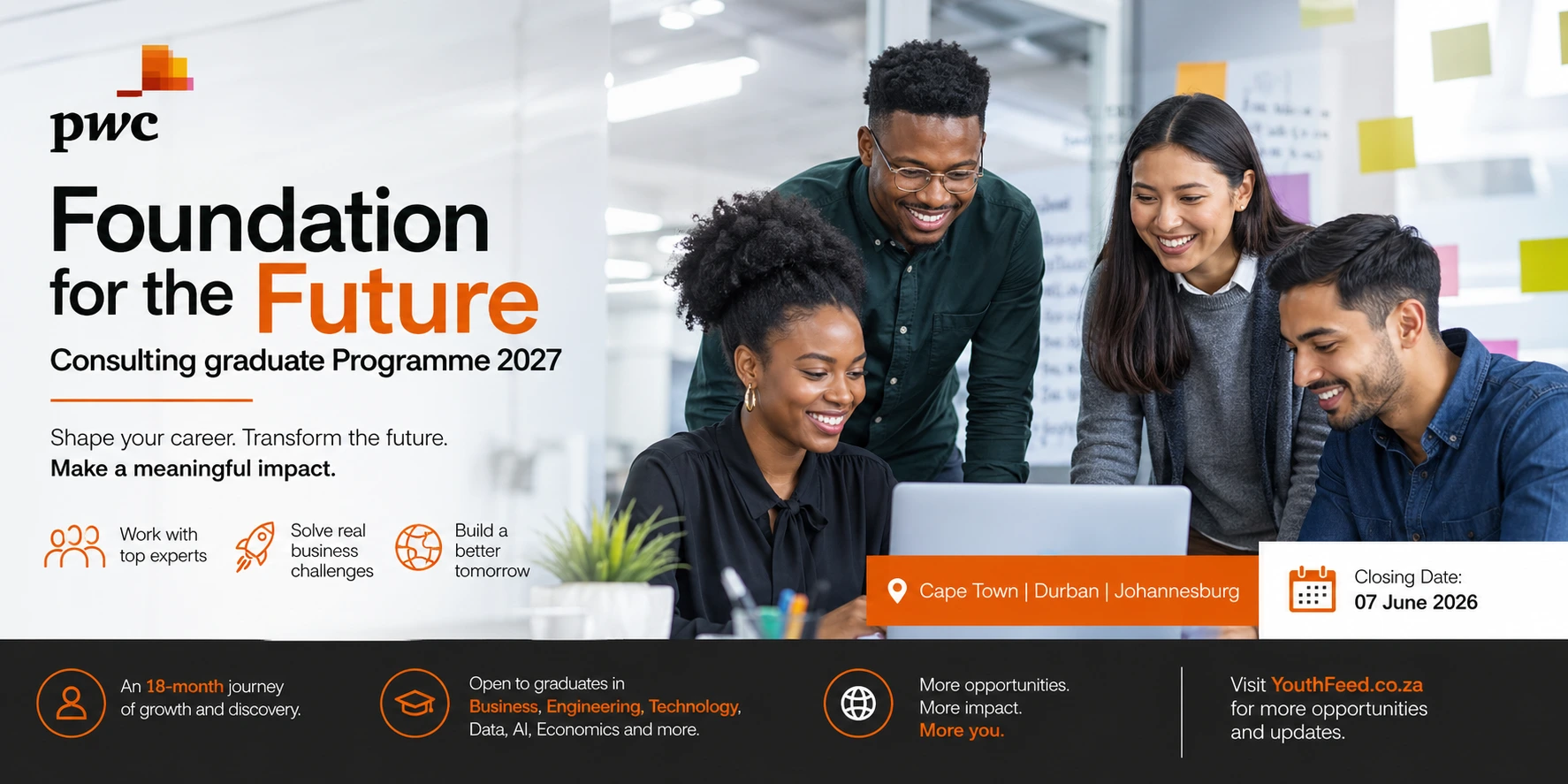
The race for graduate opportunities in South Africa has become more competitive than ever, and that is exactly why the Foundation for the Future Consulting graduate Programme is suddenly attracting major attention online.
With graduate unemployment remaining one of the country’s biggest concerns, programmes tied to globally recognised firms continue to dominate conversations among students and young professionals. But this particular opportunity from PwC is standing out for a different reason: it reflects how consulting careers themselves are changing.
This is no longer just about spreadsheets, boardrooms and corporate presentations. The consulting industry is shifting toward digital transformation, AI integration, sustainability strategy, operations redesign and human-centred problem-solving. The 2027 intake of the Foundation for the Future programme arrives at a moment when companies are searching for graduates who can think across disciplines rather than fit into one narrow technical lane.
That broader approach is part of why the programme is generating momentum among students in business, engineering, technology, economics and data-focused fields.
Applications officially close on 7 June 2026, and the programme will be hosted across major South African offices including Cape Town, Durban and Johannesburg.
For many graduates, it represents more than a job application. It signals where the future of professional work may be heading.
A Consulting Industry That Looks Very Different in 2026
Consulting has traditionally been viewed as one of the most elite corporate career paths globally. Large firms built reputations around advising governments, multinational corporations and financial institutions on strategy, risk and operations.
But the environment around consulting has changed rapidly over the past few years.
Artificial intelligence has altered expectations around productivity. Businesses are under pressure to modernise operations faster. Sustainability reporting is no longer optional for many organisations. At the same time, economic uncertainty has forced companies to rethink costs, talent structures and digital capabilities.
This has reshaped what firms now expect from graduates entering the sector.
The Foundation for the Future Consulting graduate Programme reflects that shift clearly. Rather than recruiting only traditional commerce students, the programme is intentionally multidisciplinary.
Eligible fields include:
- Business and Economics
- Engineering disciplines
- Geoinformatics
- Industrial Psychology
- Mathematics and Statistics
- Supply Chain and Logistics
- Technology, Data, AI and Information Systems
That mix tells an important story.
Modern consulting increasingly relies on people who can bridge business strategy with technology, analytics and behavioural insight. A graduate who understands supply chains, data modelling or AI systems may now be just as valuable as someone with a traditional finance background.
In many ways, the programme mirrors the changing structure of the global economy itself.
What Makes the Programme Different
One reason the Foundation for the Future Consulting graduate Programme is attracting attention is its rotational-style exposure across consulting competencies.
According to the programme overview, participants spend 18 months gaining hands-on experience across multiple consulting areas rather than remaining confined to a single niche from day one.
That includes exposure to:
- Digital enablement and customer growth strategies
- Operations transformation
- Procurement and supply chain solutions
- Analytics and AI transformation
- HR and finance transformation
- Cloud transformation
- Organisational reinvention and growth strategy
For graduates, this type of structure matters.
One of the biggest frustrations among young professionals entering the workforce is discovering that entry-level roles can become highly repetitive very quickly. Rotational exposure potentially offers broader learning and stronger long-term career flexibility.
It also aligns with how major firms are trying to build adaptable talent pipelines instead of highly rigid career tracks.
The emphasis on transformation, AI and business reinvention is particularly notable. Many graduate programmes still frame technology as a support function. Here, technology appears central to the consulting model itself.
That reflects where corporate investment is moving globally.
ALSO APPLY FOR : Fraser Alexander SHEQ Programme 2026
Why Students Are Paying Attention
Graduate programmes always generate interest, but some opportunities create wider discussion because they align with current anxieties in the labour market.
This programme arrives during a period where many South African graduates are asking difficult questions:
- Which industries are still hiring?
- Which careers are future-proof?
- Which skills will remain relevant as AI expands?
- How can graduates gain meaningful experience quickly?
The Foundation for the Future Consulting graduate Programme intersects with all of those concerns.
First, the association with PwC gives the programme strong brand recognition. Large multinational firms continue to carry weight in graduate recruitment because they offer structured training, exposure to complex projects and internationally recognised experience.
Second, the programme’s broad eligibility criteria make it accessible to students outside traditional accounting pipelines. That is important because many graduates in STEM and technology-related fields are increasingly exploring consulting careers.
Third, the programme speaks directly to the language dominating the global economy right now: digital transformation, AI, sustainability and operational efficiency.
These are not temporary buzzwords anymore. They are shaping hiring patterns across multiple sectors.
The Skills PwC Appears to Be Prioritising
Beyond academic qualifications, the programme also highlights something increasingly common in graduate recruitment: behavioural capability frameworks.
PwC refers to this as the “Evolved PwC Professional” framework.
The framework focuses on qualities such as:
- Leadership and influence
- Collaboration
- Adaptability
- Integrity
- Coaching and teamwork
- Business-minded thinking
- Delivering client experiences
This matters because employers are moving away from hiring solely based on technical competence.
In today’s workplace, graduates are expected to combine technical knowledge with communication, adaptability and emotional intelligence.
That is especially true in consulting, where client interaction and collaborative problem-solving are central to daily work.
The inclusion of “inclusive behaviour” and “quality” within the framework also reflects broader corporate trends. Many global firms are under pressure to demonstrate ethical leadership, workplace inclusion and sustainable business practices.
Graduates entering these environments are increasingly evaluated on how they work with people, not only on what they know academically.
ALSO APPLY FOR: Afrimat Sales Internship 2026
Why This Matters Right Now
The timing of this programme is significant for several reasons.
South Africa’s youth employment challenges remain severe, and competition for structured graduate programmes has intensified dramatically over recent years. Opportunities that provide formal development, mentorship and exposure to large-scale projects are becoming increasingly valuable.
At the same time, employers are sending a clear signal about the direction of future work.
The Foundation for the Future Consulting graduate Programme is not built around one single profession. Instead, it reflects a blended economy where technology, analytics, business strategy and human-centred leadership overlap constantly.
That has implications beyond one intake programme.
Students choosing degrees today are paying closer attention to versatility. Employers are prioritising adaptability. And firms are restructuring around transformation rather than static operational models.
The consulting industry itself is also under pressure to evolve.
Clients no longer want only theoretical recommendations. They increasingly expect consultants to help implement technological systems, improve operational performance and deliver measurable transformation outcomes.
As a result, graduate programmes are evolving into talent incubators for future-facing skills.
The attention around this opportunity reflects a larger shift happening inside corporate South Africa.
Public Reaction and Online Interest
Graduate opportunities linked to major firms consistently trend on student-focused platforms and career communities, but this programme has generated particular interest because of its multidisciplinary positioning.
Many online discussions around graduate recruitment now centre on accessibility and relevance.
Students often criticise programmes that appear too narrow, overly experience-dependent or disconnected from modern career realities. In contrast, opportunities that include AI, transformation and technology exposure tend to generate stronger engagement.
There is also growing interest in consulting among engineering and data-focused graduates who previously may have targeted only technical industries.
The inclusion of fields like Geoinformatics and AI-related disciplines signals that consulting firms are expanding the kinds of expertise they consider valuable.
For students, that can feel encouraging in a difficult employment environment.
At the same time, competition is expected to be intense.
Large graduate programmes attached to multinational firms routinely attract thousands of applications nationally. The requirement of a minimum 50% cumulative average may appear accessible on paper, but recruitment processes at this level are often highly selective beyond academic results alone.
Candidates who demonstrate leadership, adaptability, problem-solving ability and strong communication skills are likely to stand out.
The Bigger Picture Behind Consulting Recruitment
There is another reason programmes like this are becoming more visible.
Consulting firms are increasingly positioning themselves as technology-driven transformation partners rather than purely advisory businesses.
That evolution has accelerated because companies across industries are dealing with overlapping disruptions:
- AI integration
- Economic volatility
- Sustainability requirements
- Changing consumer behaviour
- Cybersecurity risks
- Supply chain instability
Clients want faster solutions and measurable outcomes.
As a result, firms are recruiting graduates who can operate across technical, strategic and operational environments simultaneously.
This is changing the identity of consulting itself.
In the past, consulting was often associated with finance-heavy or management-only career paths. Today, the field is attracting technologists, analysts, engineers, psychologists and data specialists.
The Foundation for the Future Consulting graduate Programme reflects that transformation clearly.
ALSO APPLY FOR FlySafair Graduate Intern 2026
What Could Happen Next
Several possible trends could emerge from programmes like this over the next few years.
First, multidisciplinary recruitment may become the standard rather than the exception. Employers increasingly need graduates who can work across functions instead of remaining locked into rigid departmental silos.
Second, graduate programmes may continue shifting toward transformation-focused work rather than traditional corporate administration.
That means more emphasis on:
- AI implementation
- Cloud systems
- Data analytics
- Sustainability consulting
- Digital operations
- Organisational redesign
Third, competition for these programmes will likely intensify further as graduates seek stable career entry points in uncertain economic conditions.
There is also the possibility that consulting firms become even more influential in shaping future workforce skills. Large organisations often influence broader hiring trends because other companies follow their recruitment models and capability frameworks.
For students currently completing degrees, this creates both opportunity and pressure.
The opportunity lies in the growing demand for versatile, future-oriented skills.
The pressure comes from the expectation that graduates must now combine academic performance with adaptability, communication ability and digital awareness.
Key Details at a Glance
Programme
Foundation for the Future (FftF) – Consulting 2027
Contract Type
Fixed-term graduate programme
Duration
18 months
Locations
- Cape Town
- Durban
- Johannesburg
Closing Date
7 June 2026
Eligible Fields
- Business
- Economics
- Econometrics
- Engineering
- Geoinformatics
- Industrial Psychology
- Mathematics and Statistics
- Supply Chain and Logistics
- Technology and Information Systems
- AI and Data-related disciplines
Minimum Academic Requirement
50% cumulative average across all years of study
APPLY HERE: Foundation for the Future Consulting graduate Programme 2027
Frequently Asked Questions
1. What is the Foundation for the Future Consulting graduate Programme?
It is an 18-month graduate programme offered by PwC South Africa that provides exposure across multiple consulting disciplines including operations, AI transformation, analytics and business strategy.
2. Who can apply for the programme?
Students with undergraduate degrees in fields such as business, engineering, economics, technology, statistics, logistics and related disciplines can apply.
3. When is the closing date?
Applications close on 7 June 2026.
4. Where will the programme take place?
The programme is available in Cape Town, Durban and Johannesburg.
5. Does the programme require an honours degree?
An honours degree is not mandatory, but it is listed as preferential.
Final Thoughts
The Foundation for the Future Consulting graduate Programme is attracting attention because it reflects something much bigger than one graduate intake.
It represents how professional careers are evolving in real time.
Consulting firms are no longer recruiting only for traditional business roles. They are building multidisciplinary teams designed for a rapidly changing economy shaped by AI, sustainability, transformation and operational reinvention.
For graduates trying to position themselves in an uncertain labour market, that shift matters.
And for many students watching the corporate world change around them, programmes like this offer an early glimpse into what the future of work may actually look like
READY TO PUBLISH