There is a growing sense among South African students that opportunities in technology are becoming harder to access not because ambition is lacking, but because affordability keeps standing in the way.
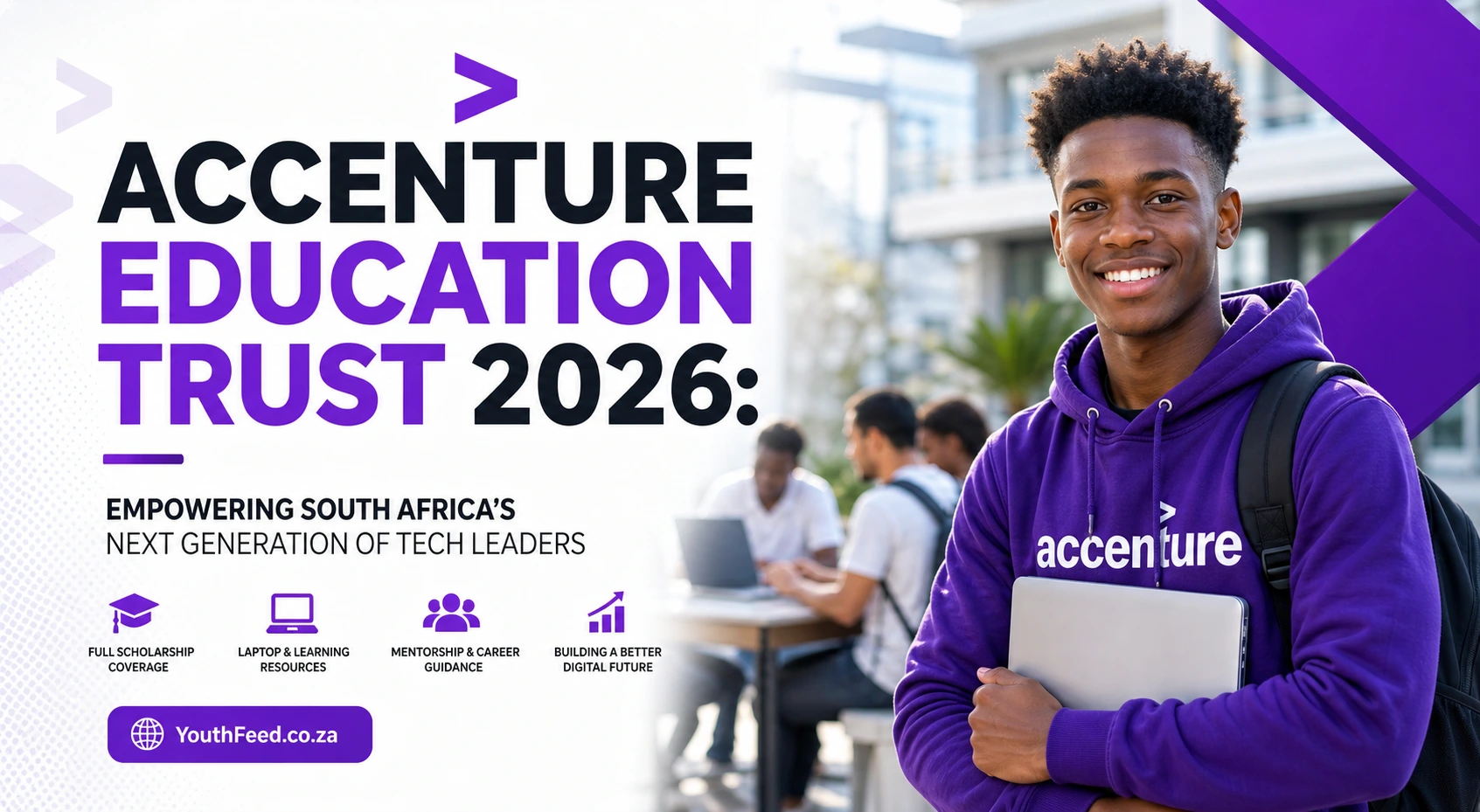
That is one reason the ACCENTURE EDUCATION TRUST is drawing renewed attention in 2026.
At a time when university costs continue rising, graduate unemployment remains a national concern, and demand for digital skills is accelerating across industries, the bursary programme has started standing out for a different reason: it targets the gap that many students say has been ignored for years.
Not every struggling student qualifies for NSFAS. Not every middle-income family can realistically afford tuition either. The space between those two realities has created pressure on thousands of households across South Africa. The Accenture Education Trust appears designed specifically for that space — and students are noticing.
The programme offers full scholarships to academically strong students pursuing technology-aligned degrees at some of South Africa’s leading universities. Beyond tuition support, it also includes mentorship, accommodation assistance, meals, prescribed books, and even laptops.
That combination has sparked widespread interest online, especially among students studying computer science, information systems, data science, engineering, and analytics-related fields.
But the growing conversation around the programme says something bigger about where South Africa’s education and technology sectors may be heading next.
Why the ACCENTURE EDUCATION TRUST Is Trending in 2026
The timing matters.
South Africa’s technology sector has entered another intense growth phase. Businesses across banking, retail, telecoms, healthcare, logistics, and consulting are increasingly investing in artificial intelligence, cloud computing, cybersecurity, automation, and data analytics.
At the same time, companies continue warning about a shortage of highly skilled tech graduates.
That creates a strange contradiction: there is demand for digital talent, but many capable students still struggle to complete their studies because of financial pressure.
The ACCENTURE EDUCATION TRUST enters the conversation at exactly that intersection.
The programme specifically supports students pursuing technology-focused qualifications, including:
- Computer Science
- Information Systems
- Data Engineering
- Big Data Analytics
- Industrial Engineering
- Mechanical Engineering with Mechatronics
- Informatics
- Electrical and Electronic Engineering
- Statistics and Data Science
The focus is clearly aligned with the future direction of the global economy.
In many ways, this is no longer just a bursary conversation. It is becoming part of a larger national discussion about whether South Africa can produce enough high-level digital talent to remain globally competitive.
The “Missing Middle” Problem Is Back in Focus
One of the most discussed aspects of the programme is its income threshold structure.
The bursary targets students whose household income ranges between R350,000 and R1 million annually, while also supporting NSFAS postgraduate students with household incomes below R300,000.
That detail matters more than it may initially appear.
For years, the so-called “missing middle” — students who earn too much for NSFAS but too little to comfortably afford university has remained one of the biggest unresolved issues in South African higher education.
Many families in this category face enormous financial pressure:
- Tuition increases
- Residence fees
- Transport costs
- Textbooks and devices
- Food and daily living expenses
Even households earning what appears to be a moderate income often struggle to support university students in practice.
This is partly why commentary around the ACCENTURE EDUCATION TRUST has become so strong online. Students increasingly see programmes like this as filling a critical funding gap rather than simply offering another bursary.
ALSO APPLY FOR ISACA Foundation 2026 Scholarships
A Scholarship Designed Around Tech Talent
The structure of the programme reflects how aggressively industries are competing for future digital skills.
Successful applicants receive coverage for:
- Registration fees
- Tuition fees
- Examination fees
- Residence costs
- Meals
- Prescribed books
- Laptop support
- Ongoing mentorship
That mentorship component may become increasingly important.
Across graduate employment discussions, employers frequently mention that academic performance alone is no longer enough. Students are expected to develop workplace readiness, communication skills, adaptability, and professional exposure before graduation.
Mentorship-driven bursaries attempt to bridge that transition between university and industry.
For many students, this is where the programme feels different from traditional funding models that focus only on tuition support.
The Universities Involved Add Weight to the Programme
Another reason the bursary is attracting attention is the list of participating institutions.
The programme includes students studying at:
- Rhodes University
- Stellenbosch University
- University of Cape Town
- University of Johannesburg
- University of Pretoria
- University of the Witwatersrand
- University of KwaZulu-Natal
- University of the Western Cape
These institutions are widely associated with competitive technology and engineering programmes.
That selective approach reinforces the programme’s positioning as a high-performance academic opportunity rather than broad financial aid.
Applicants are also expected to maintain strong academic performance, with a cumulative average above 65%.
In a highly competitive graduate environment, this emphasis on academic consistency signals how employers are increasingly prioritising specialised technical capability.
Read More: How NSFAS Funding Works: A Practical Guide for South African Students
Why Students Are Responding So Strongly
Public reaction around the bursary reflects more than excitement about funding.
For many students, programmes like the ACCENTURE EDUCATION TRUST represent access to stability in an uncertain economy.
South Africa’s youth unemployment crisis continues affecting graduates across multiple sectors. Yet technology-related careers have remained one of the few areas consistently associated with long-term growth potential.
Students are paying close attention to fields linked to:
- Artificial intelligence
- Data science
- Software development
- Cybersecurity
- Business intelligence
- Cloud technologies
- Automation
As global companies expand digital operations, students increasingly see tech qualifications as pathways toward international competitiveness and remote-work opportunities.
This partly explains why bursaries tied directly to future-facing industries generate far more engagement than general financial aid announcements.
The Application Process Reflects Corporate Recruitment Trends
The application process itself has also generated conversation because it resembles professional recruitment systems rather than traditional bursary forms.
Applicants must:
- Create an account
- Apply manually
- Complete detailed information sections
- Include work experience where applicable
- Upload multiple certified documents
- Complete disclosure sections
- Submit a final review application
Required documents include:
- Certified ID copy
- Academic records
- Grade 12 results
- Household income proof
- Curriculum vitae
That CV requirement stands out.
Even students still completing degrees are increasingly expected to present themselves professionally long before graduation.
This reflects a broader shift happening globally: employers want early exposure to high-potential students before they formally enter the workforce.
Why This Matters Right Now
The relevance of the ACCENTURE EDUCATION TRUST goes beyond one scholarship cycle.
South Africa is entering a period where digital capability may determine economic competitiveness more than ever before.
Companies are investing heavily in:
- AI implementation
- Data infrastructure
- Digital transformation
- Automation systems
- Analytics-driven decision making
But without enough skilled graduates, many organisations may struggle to scale effectively.
This creates pressure on universities, government, and private-sector partners to support more students entering STEM and technology fields.
At the same time, students are becoming increasingly strategic about degree choices. There is growing awareness that employability matters just as much as academic interest.
Technology-aligned qualifications are now often viewed through the lens of:
- Career resilience
- Global relevance
- Remote work potential
- Salary growth
- Industry demand
That makes programmes like the ACCENTURE EDUCATION TRUST especially relevant in 2026.
The bursary is not simply funding education. It is helping shape the pipeline of future technology professionals entering the South African economy.
The Bigger Shift Happening in Graduate Recruitment
There is another important trend beneath the surface.
Major corporations are increasingly moving recruitment further upstream — identifying talent during university rather than waiting until graduation.
Bursaries, internships, graduate programmes, mentorship initiatives, and campus partnerships are becoming part of long-term workforce planning.
This approach benefits companies because:
- They develop talent early
- Students become familiar with company culture
- Skills pipelines become more predictable
- Graduate onboarding becomes easier
For students, it offers something equally valuable: direction.
In an economy where many graduates struggle to transition into employment, structured pathways connected to industry feel significantly more attractive.
The growing popularity of the ACCENTURE EDUCATION TRUST reflects that shift clearly.
What Could Happen Next
Several trends could shape how programmes like this evolve in the coming years.
Increased Competition for Tech Bursaries
As awareness grows, competition will likely intensify.
More students are entering data science, computer science, and engineering-related programmes than before. Funding opportunities linked to these disciplines may become increasingly selective.
Students with strong academic performance, extracurricular involvement, and practical exposure could gain advantages during selection processes.
More Corporate-Led Education Partnerships
Large organisations may continue expanding scholarship models tied directly to industry demand.
Rather than waiting for graduates to enter the market, companies are increasingly building talent ecosystems from university level onward.
This could lead to:
- More mentorship-driven bursaries
- Stronger internship pipelines
- Skills-focused scholarship programmes
- Direct graduate recruitment pathways
Greater Emphasis on Data and AI Skills
The qualifications highlighted by the programme suggest where future demand may concentrate.
Data engineering, analytics, AI-related disciplines, and information systems are becoming central to modern business operations.
Students entering these fields today may graduate into a significantly transformed labour market by the end of the decade.
Rising Expectations for Academic Excellence
The programme’s academic threshold reinforces another growing reality: competitive opportunities increasingly require consistent performance over time.
Students pursuing technology bursaries may need to focus not only on passing, but on maintaining strong cumulative averages throughout university.
APPLY HERE: ACCENTURE EDUCATION TRUST 2026
Frequently Asked Questions
Who can apply for the ACCENTURE EDUCATION TRUST?
Students in their second, third, fourth, or Honours year studying technology-aligned degrees at selected South African universities may apply if they meet the academic and income requirements.
What expenses does the bursary cover?
The scholarship covers tuition, registration, exams, residence, meals, prescribed books, a laptop, and mentorship support.
What academic average is required?
Applicants must generally maintain a cumulative academic average above 65%.
Which universities are included?
Participating institutions include UCT, Wits, UP, UJ, Stellenbosch University, Rhodes University, UKZN, and UWC.
Which fields of study qualify?
Fields include Computer Science, Information Systems, Data Science, Informatics, Engineering disciplines, Big Data Analytics, and related technology programmes.
Final Thoughts
The conversation around the ACCENTURE EDUCATION TRUST reflects something much larger than a single bursary announcement.
It highlights the growing intersection between education, technology, employability, and economic pressure in South Africa.
Students are not only searching for funding anymore. They are searching for pathways into industries that still show long-term momentum.
That is why technology-linked bursaries now attract such intense attention online. They are increasingly viewed as gateways into sectors expected to shape the future economy.
For academically strong students pursuing digital and engineering-related qualifications, the programme represents more than financial relief. It signals recognition that high-potential talent still exists across South Africa even when affordability threatens to limit opportunity.
And in 2026, that conversation feels more important than ever.