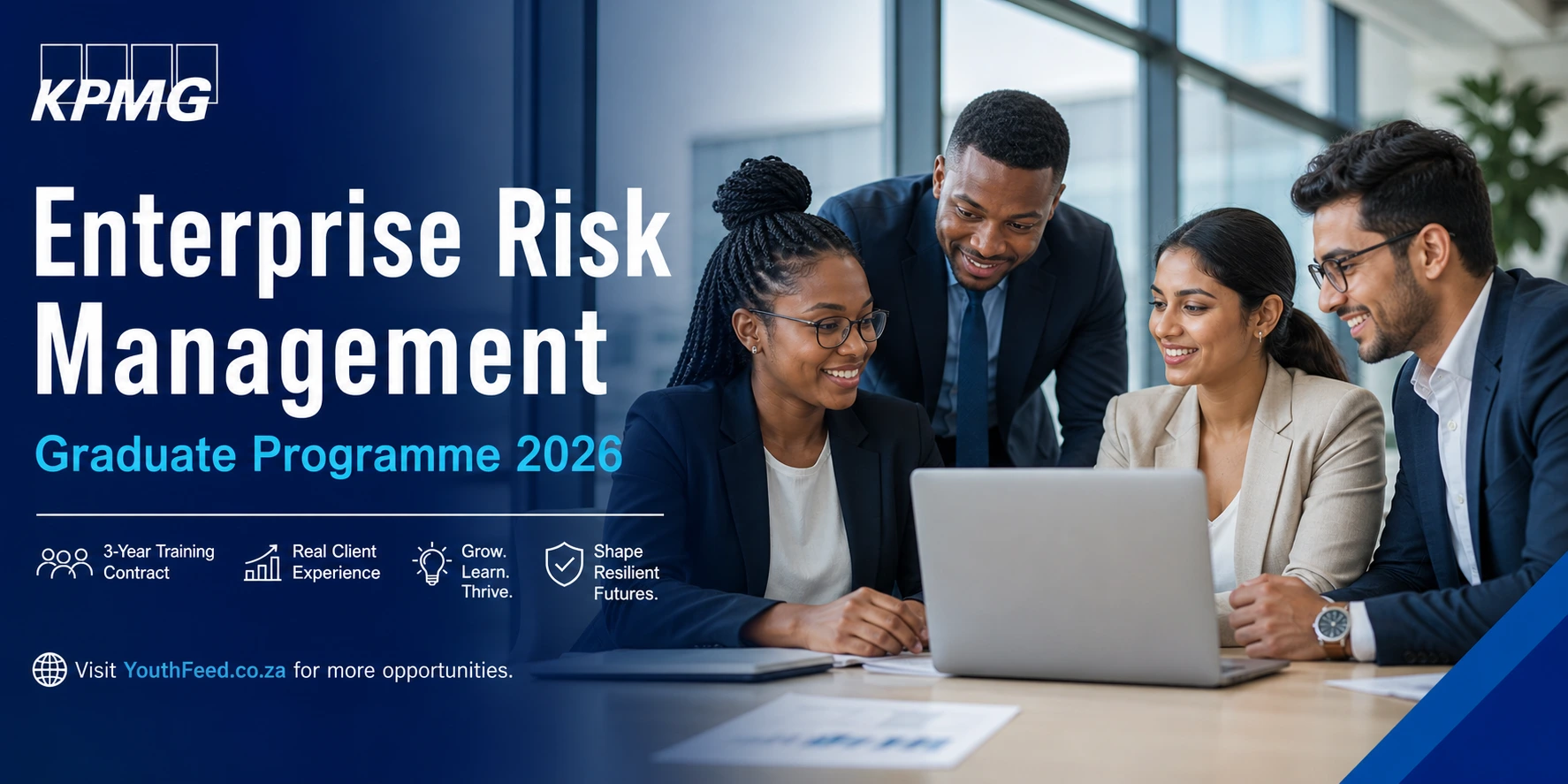
The conversation around graduate jobs in South Africa has shifted noticeably in 2026.
For years, students chased careers tied almost exclusively to finance, software development, investment banking, or data science. But a different trend is emerging now one built around risk, governance, compliance, sustainability, and corporate resilience. And that shift is part of the reason the KPMG Enterprise Risk Management Graduate Programme is drawing increasing attention among graduates looking for stable, future-focused careers.
At first glance, Enterprise Risk Management may sound like one of those highly technical corporate functions hidden deep inside boardrooms and audit committees. But the reality is far more dynamic. Modern risk management now touches everything from cyber threats and ESG regulations to operational failures, AI governance, financial controls, and reputational crises.
That is exactly why graduate programmes linked to risk consulting are suddenly becoming more relevant in 2026.
KPMG’s latest graduate opportunity within its Johannesburg office arrives at a time when companies across South Africa and globally are under pressure to improve governance standards while navigating economic uncertainty, digital transformation, and stricter compliance expectations.
For graduates entering a difficult employment market, that combination matters.
And it explains why opportunities like this are generating growing interest online among commerce graduates and aspiring consultants.
A Graduate Programme Built Around a Changing Corporate Reality
The KPMG Enterprise Risk Management Graduate Programme sits within the firm’s Internal Audit and Enterprise Risk Management practice. The programme spans three years and focuses heavily on Enterprise Risk Management delivery across clients in different industries.
What makes the programme notable is how broad the exposure appears to be.
Rather than placing graduates into a narrow administrative role, the structure suggests involvement in practical consulting work including:
- Risk workshops
- ERM framework development
- Governance processes
- Combined assurance
- Risk maturity assessments
- Appetite and tolerance statement development
- Business development support
- Proposal assistance
In many ways, this reflects how risk consulting itself has evolved.
A decade ago, risk functions were often viewed as compliance-heavy support departments. Today, organisations increasingly treat risk management as a strategic decision-making tool.
Companies want professionals who can identify vulnerabilities before they become crises.
That change is influencing hiring trends across consulting firms.
ALSO APPLY FOR : Fraser Alexander SHEQ Programme 2026
Why Risk Management Careers Are Becoming More Attractive
One of the most interesting developments in the graduate market is how students are reassessing what “secure” careers actually look like.
In previous years, many graduates focused mainly on industries perceived as glamorous or high-paying. But ongoing economic pressure, restructuring across sectors, and global instability have shifted priorities.
Students now want careers that are:
- Future-relevant
- Resistant to automation
- Globally transferable
- Skills-focused
- Connected to leadership pathways
Enterprise Risk Management increasingly checks those boxes.
Modern businesses face risks from multiple directions simultaneously:
- Cybersecurity threats
- ESG reporting requirements
- Regulatory pressure
- Supply chain disruptions
- AI governance concerns
- Fraud exposure
- Data privacy risks
- Sustainability obligations
That means companies cannot afford weak risk oversight anymore.
As a result, consulting firms are investing heavily in graduates who can support governance and risk functions from the ground up.
The KPMG programme appears positioned directly within that broader market shift.
The Johannesburg Factor Also Matters
Another reason the programme is gaining attention is location.
Johannesburg remains South Africa’s corporate and financial hub, especially for consulting, auditing, governance, and advisory careers. Graduates entering the JHB market often gain exposure to major listed companies, multinational organisations, financial institutions, and large-scale projects.
For ambitious graduates, proximity to that ecosystem matters.
A programme based in Johannesburg potentially offers:
- Exposure to diverse industries
- Networking opportunities
- Faster professional development
- Access to larger corporate clients
- Stronger long-term mobility within consulting
In a competitive graduate market, location can influence career acceleration almost as much as the employer brand itself.
And KPMG remains one of the most recognised professional services firms globally.
Academic Standards Reflect Growing Competition
The programme’s academic expectations are also revealing.
Applicants are expected to hold a:
- BCom Honours in Risk Management, Auditing, or Accounting
- Strong academic record with a 65% aggregate
- Microsoft Office competency
- Potential ERM-related certifications like CCSA
That combination signals something important about the current graduate environment.
Consulting firms are becoming increasingly selective.
Graduate programmes are no longer simply recruitment pipelines — they are strategic talent investments. Firms want graduates who can adapt quickly, work independently, communicate professionally, and contribute to client-facing projects earlier in their careers.
Interestingly, the programme also highlights agility, innovation, problem-solving, and collaborative ability as key attributes.
That mirrors a wider hiring trend across professional services in 2026.
Technical qualifications still matter, but firms increasingly prioritise adaptability and communication skills alongside academic performance.
ALSO APPLY FOR: Afrimat Sales Internship 2026
Public Reaction: Why Students Are Sharing Opportunities Like This Online
Graduate opportunities connected to major firms tend to spread rapidly across student networks and social media platforms in South Africa.
But programmes linked to governance, consulting, and risk have gained even more visibility recently because many graduates are actively searching for alternatives to overcrowded traditional career paths.
Online reactions often reveal a few recurring themes:
1. Growing interest in “future-proof” careers
Students are becoming more aware that governance and risk-related roles are expanding globally.
Risk management is no longer viewed as a niche field.
2. Increased concern about employability
Many graduates are prioritising programmes that provide structured training and practical exposure rather than generic entry-level jobs with limited growth.
3. Attraction to consulting experience
Working across industries appeals to graduates who want faster learning curves and broader exposure.
4. Concern about academic competitiveness
At the same time, some students worry that opportunities at firms like KPMG remain difficult to access due to high academic expectations and limited vacancies.
That tension reflects the reality of South Africa’s graduate economy in 2026: opportunity exists, but competition is intense.
Why This Matters Right Now
The timing of this programme is particularly relevant.
South African businesses are operating in an environment shaped by uncertainty, compliance pressure, and rapid technological change. Corporate governance failures, cybersecurity incidents, and operational disruptions continue to affect organisations across sectors.
That creates a growing need for professionals who understand:
- Enterprise risk frameworks
- Governance structures
- Internal controls
- Sustainability reporting
- Regulatory compliance
- Strategic risk analysis
At the same time, graduates are entering one of the toughest employment environments in recent years.
Many students are no longer looking only for jobs. They are looking for career ecosystems that provide training, mentorship, recognised credentials, and long-term relevance.
The KPMG Enterprise Risk Management Graduate Programme intersects with both realities.
For employers, it helps build future consulting and governance talent.
For graduates, it offers exposure to a field that appears increasingly central to how modern organisations operate.
That balance is a major reason opportunities like this are attracting attention right now.
ALSO APPLY FOR: Nedbank Young Analyst Programme 2027
The ESG and Sustainability Connection
Another important layer behind the growing interest in Enterprise Risk Management is ESG.
Environmental, Social, and Governance reporting is no longer treated as a side conversation inside major corporations. Investors, regulators, and stakeholders increasingly expect businesses to demonstrate accountability and sustainability readiness.
That changes the role of risk professionals dramatically.
Modern ERM specialists are often involved in:
- Sustainability governance
- Climate-related risk analysis
- Ethical compliance
- Reporting assurance
- Operational resilience planning
KPMG’s reference to sustainability services within the broader practice highlights how interconnected these areas have become.
Graduates entering the field now may find themselves working on challenges that barely existed in mainstream corporate conversations a few years ago.
That creates both pressure and opportunity.
Consulting Culture Is Also Evolving
There is another reason programmes like this resonate with graduates today: consulting itself is changing.
Younger professionals increasingly want:
- Collaborative environments
- Skills growth
- Meaningful project work
- Flexible thinking
- Exposure to innovation
The programme’s emphasis on agility, smarter ways of working, and creative problem-solving reflects how consulting firms are trying to modernise workplace culture.
While consulting still demands high performance and long hours in some environments, firms increasingly recognise that graduates value development and adaptability just as much as prestige.
That evolution matters for talent attraction.
What Could Happen Next
The growing visibility of risk-focused graduate programmes may signal a broader shift in how commerce graduates approach career planning over the next few years.
Several outcomes seem likely.
Greater demand for ERM-related qualifications
Students may increasingly pursue specialised governance, auditing, and risk certifications earlier in their academic journeys.
Expansion of consulting graduate programmes
As regulatory pressure grows, firms may continue investing in governance and risk advisory talent pipelines.
Stronger integration between technology and risk
Future ERM roles will likely involve deeper interaction with AI governance, cybersecurity, data analytics, and digital risk monitoring.
Increased competition among applicants
As awareness grows, programmes like this may become even more competitive, especially for graduates with strong academic records and communication skills.
Broader career mobility for graduates
Risk consulting experience often opens pathways into internal audit, compliance, governance leadership, sustainability, operational risk, and executive advisory roles later in a career.
That long-term flexibility is part of the appeal.
A Career Path Many Students Previously Overlooked
One of the more fascinating aspects of the current graduate market is how previously overlooked professions are becoming highly desirable.
Enterprise Risk Management was once viewed as highly specialised and somewhat invisible compared to finance or strategy consulting.
That perception is changing quickly.
Businesses increasingly depend on professionals who can identify operational weaknesses, assess uncertainty, support governance structures, and help organisations respond to disruption.
In other words, risk management is no longer operating quietly in the background.
It is becoming central to business survival and strategic planning.
And for graduates entering the workforce in 2026, that reality could shape career decisions more than many expected.
APPLY HERE: KPMG Enterprise Risk Management Graduate Programme 2026
FAQ: KPMG Enterprise Risk Management Graduate Programme 2026
What qualifications are required for the KPMG Enterprise Risk Management Graduate Programme?
Applicants typically need a BCom Honours degree in Risk Management, Auditing, Accounting, or a related field.
Where is the programme based?
The graduate programme vacancy is based in Johannesburg.
How long does the programme run?
The training contract spans three years.
What type of work will graduates do?
Graduates may assist with risk workshops, ERM frameworks, governance processes, combined assurance, and risk assessments across multiple industries.
What skills does KPMG look for in applicants?
The programme highlights agility, teamwork, innovation, problem-solving ability, and strong Microsoft Office competency as important attributes.Tools